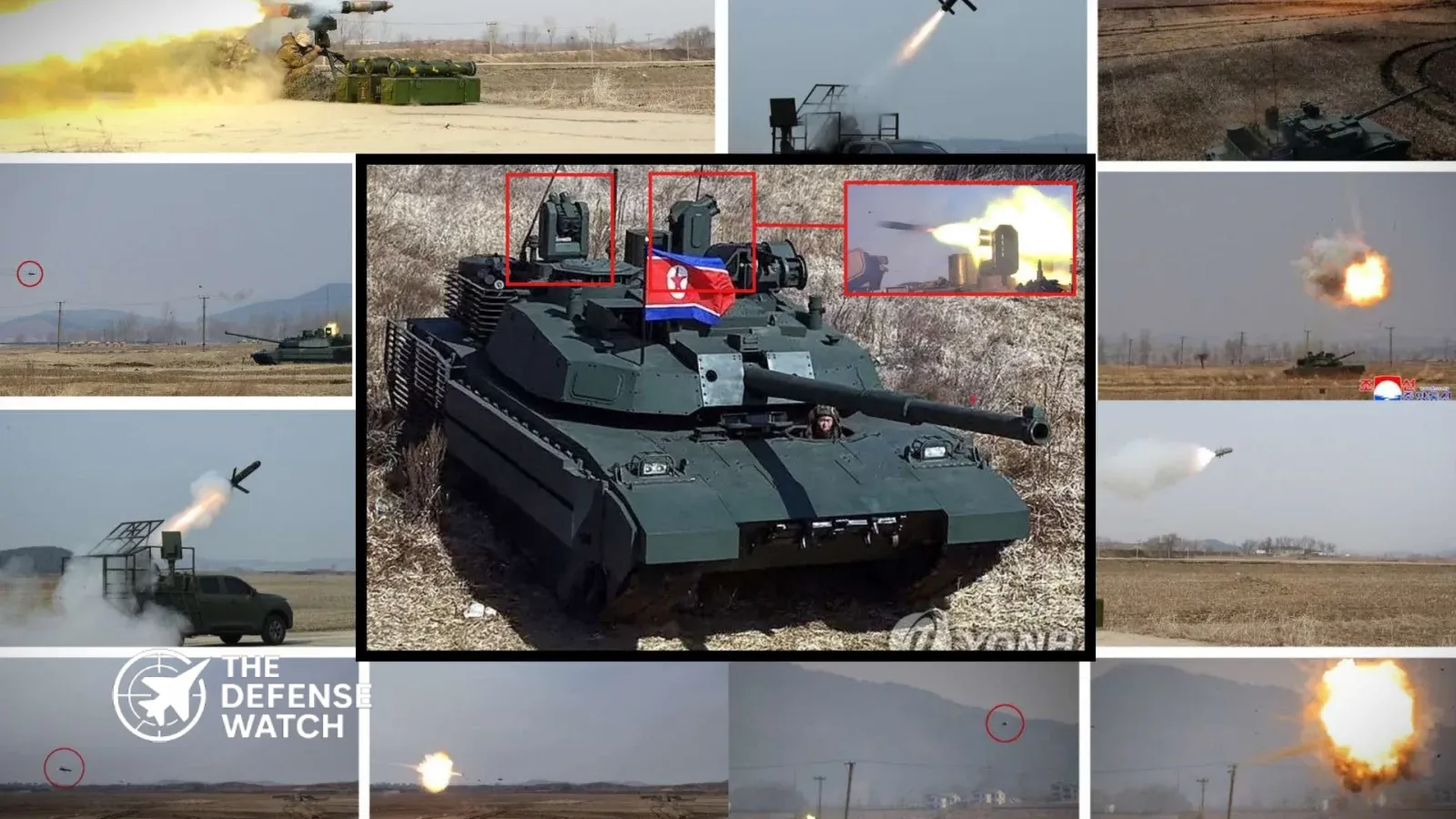
- North Korea tested a new tank active protection system designed to intercept incoming threats.
- The system demonstrated interception capability against anti tank guided missiles and drone threats.
- Development reflects growing focus on survivability amid evolving battlefield threats.
- Test likely conducted on a modernized North Korean main battle tank platform.
- The system signals Pyongyang’s intent to modernize armored forces in line with global APS trends.
North Korea Tank Active Protection System Test Highlights New Battlefield Focus
North Korea tank active protection system capabilities were demonstrated in a recent test aimed at countering anti tank missiles and drone threats, according to reporting by Army Recognition. The test marks a notable step in Pyongyang’s effort to improve armored vehicle survivability in modern combat environments.
The Big Picture
Modern armored warfare has shifted rapidly due to the widespread use of precision guided munitions and low cost drones. Conflicts such as those observed in Ukraine and the Middle East have shown that even advanced tanks remain vulnerable without layered protection.
Active protection systems, or APS, have become a critical component of next generation armored vehicle design. Militaries including the United States, Israel, and Russia have invested heavily in these systems to counter anti tank guided missiles and loitering munitions.
North Korea’s latest test suggests it is aligning its armored doctrine with these global trends despite limited access to advanced defense technology ecosystems.
What’s Happening
North Korea conducted a test of a new tank active protection system designed to detect, track, and intercept incoming threats before impact.
The system reportedly engaged simulated or live anti tank guided missiles and drone based threats. Visual evidence released by state media indicates the use of radar or sensor arrays paired with countermeasure launchers mounted on a tank platform.
The test likely involved one of North Korea’s more modern tank designs, potentially from its Chonma or Songun series, though official confirmation remains limited.
The demonstration highlights an integrated approach combining detection sensors and hard kill interceptors, which are typical features of contemporary APS systems.
Why It Matters
The emergence of a North Korea tank active protection system reflects a direct response to the growing effectiveness of anti tank weapons on the battlefield.
Portable systems such as anti tank guided missiles have significantly reduced the survivability of legacy armored platforms. At the same time, drones equipped with explosive payloads or used for targeting have introduced new vulnerabilities from above.
By testing an APS capable of addressing both threats, North Korea is attempting to close a critical survivability gap in its armored forces.
This development also indicates a shift from reliance on passive armor toward active defensive measures, which can defeat threats before impact rather than absorbing damage.
Strategic Implications
North Korea’s move to develop APS technology has implications for regional military balance, particularly on the Korean Peninsula.
South Korea fields advanced anti tank systems and precision strike capabilities, many of which are designed to neutralize armored formations quickly in a conflict scenario. An operational APS could complicate these calculations by reducing the effectiveness of such weapons.
Improved survivability for North Korean tanks could enhance their role in offensive or defensive operations, especially in terrain where armored maneuver remains viable.
The development also signals a broader effort by Pyongyang to modernize its conventional forces alongside its strategic weapons programs.
Competitor View
Regional actors are likely to interpret this development through the lens of evolving ground combat dynamics.
South Korea and the United States have already integrated or are testing APS solutions on platforms such as the M1 Abrams and K2 Black Panther. From this perspective, North Korea’s effort represents an attempt to narrow a technological gap rather than leap ahead.
China and Russia, both of which have developed their own APS systems, may view North Korea’s progress as consistent with broader trends in armored warfare modernization.
At the same time, limitations in industrial capacity and sensor technology could constrain the effectiveness and scalability of North Korea’s system compared to established designs.
What To Watch Next
Future developments will likely focus on additional testing and potential deployment.
Key indicators include repeated trials under varied conditions, integration across multiple tank units, and evidence of serial production.
Observers should also monitor whether North Korea expands APS integration to other armored vehicles, such as infantry fighting vehicles or self propelled artillery systems.
Any indication of export or technology sharing would also carry broader regional implications.
Capability Gap
North Korea’s armored forces have historically relied on upgraded legacy designs with limited protection against modern threats.
The introduction of an APS aims to address vulnerabilities to top attack munitions, tandem warhead missiles, and drone delivered explosives.
However, APS systems require advanced sensors, rapid processing, and reliable interceptors. These components demand a high level of engineering precision and manufacturing quality.
Without sustained testing and refinement, the system may face challenges in reliability, reaction time, and coverage against multiple simultaneous threats.
The Bottom Line
North Korea’s tank active protection system test signals a focused effort to improve armored survivability, but its real impact will depend on operational reliability and large scale deployment.