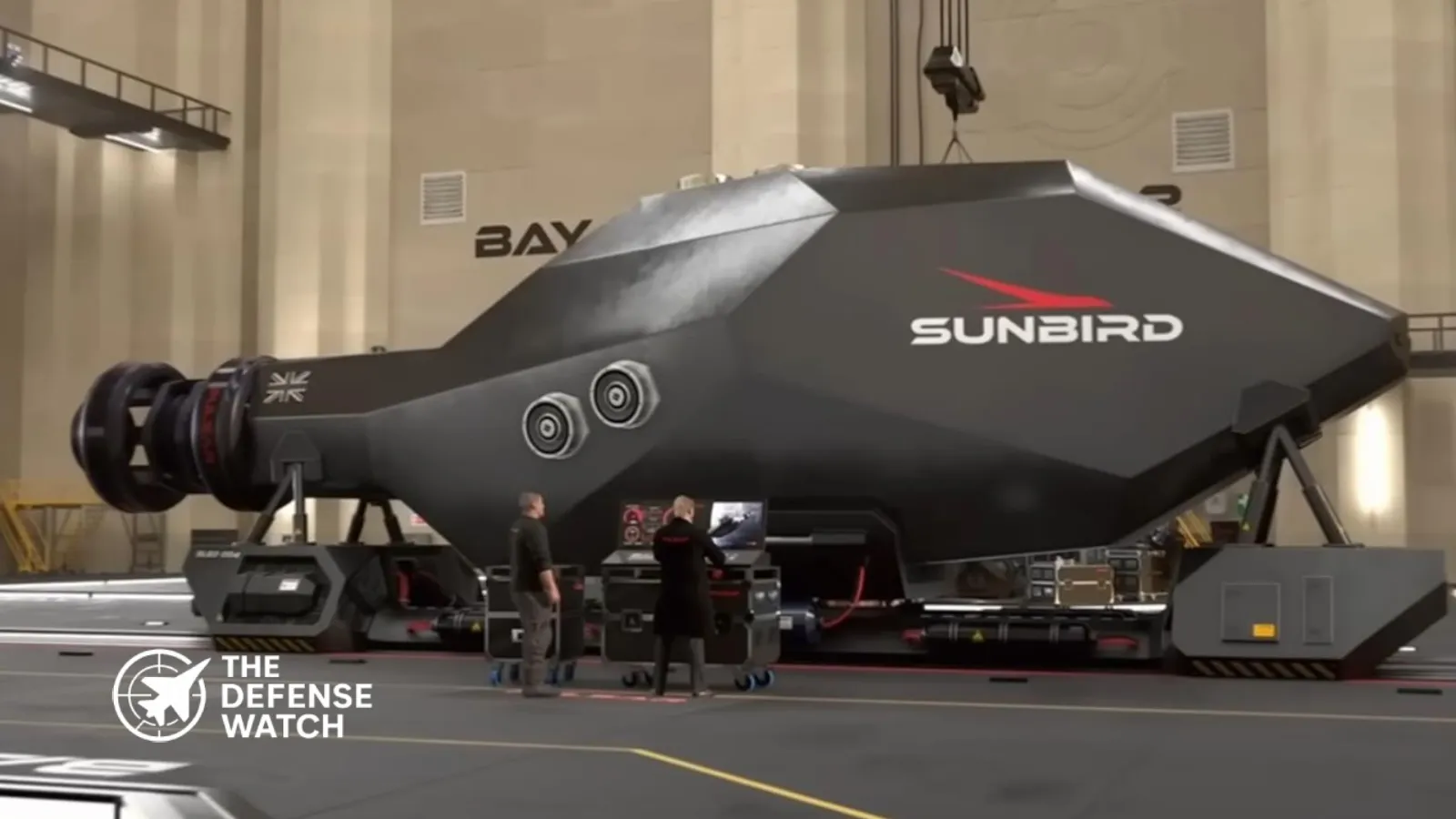
- UK-based Pulsar Fusion achieved “first plasma” in its Mark I Sunbird exhaust test system in March 2026.
- The demonstration used krypton propellant and a combination of electric and magnetic fields to generate and confine plasma in the exhaust architecture.
- The test was conducted at the company’s facility in Bletchley, UK, and live-streamed during a technical session at Amazon’s MARS Conference hosted by Jeff Bezos.
- Pulsar Fusion CEO Richard Dinan described the milestone as an “exceptional moment” for the Sunbird nuclear fusion rocket program.
- The Sunbird is designed as an in-space “tugboat” to dock with spacecraft in low Earth orbit and provide high-performance propulsion for deep-space missions.
- Next steps include plasma diagnostics in June 2026, superconducting magnet upgrades, and an in-orbit demonstration of core technology targeted for 2027.
Pulsar Fusion Reaches Early Milestone in Nuclear Fusion Rocket Development
Pulsar Fusion has achieved first plasma in the exhaust test system of its Sunbird nuclear fusion rocket concept, the UK company announced on March 25, 2026.
The test represents an initial validation of plasma generation and confinement in the physical architecture intended for the Sunbird propulsion system. Conducted at the company’s facility in Bletchley, UK, the experiment was live-streamed during a technical session at Amazon’s MARS Conference in California.
Pulsar Fusion CEO Richard Dinan described the demonstration as an “exceptional moment” for the program. The test used krypton propellant and a combination of electric anda magnetic fields to guide and accelerate charged particles through the exhaust channel.
Technical Details of the Sunbird Test
The Mark I Sunbird exhaust test system successfully produced and confined plasma, marking the first such demonstration for this specific fusion rocket architecture. Unlike traditional chemical rockets, the approach aims to leverage fusion principles for high specific impulse and sustained thrust.
Pulsar Fusion’s Sunbird concept centers on a Dual Direct Fusion Drive (DDFD) using deuterium and helium-3 for an aneutronic reaction. The system is engineered to function as an orbital “space tug,” docking with spacecraft in low Earth orbit rather than launching payloads directly from the ground.
Company projections indicate that a mature Sunbird vehicle could deliver 1,000 to 2,000 kilograms of payload to Mars orbit in under six months, compared with roughly 10 months using conventional chemical propulsion for similar mass missions. These performance claims remain conceptual at this stage and depend on successful scaling of the technology.
Development Timeline and Next Steps
Pulsar Fusion has outlined a phased approach. Static testing of components is underway, with an in-orbit demonstration (IOD) of core technology elements targeted for 2027. In June 2026, the team plans to introduce Langmuir probes and a Retarding Potential Analyzer to collect data on plasma behavior, plume characteristics, and thermal loads.
Future upgrades include more powerful superconducting magnets for improved plasma containment and control. The company is also collaborating with the UK Atomic Energy Authority (UKAEA) on neutron shielding and activation modeling to support long-term system durability.
The Sunbird program builds on Pulsar Fusion’s existing work in electric propulsion, including Hall Effect Thrusters, while pursuing the higher-performance fusion pathway.
Implications for Deep-Space Missions
Nuclear fusion propulsion, if realized at scale, could address key limitations of current systems. Chemical rockets offer high thrust but low efficiency, while electric propulsion provides high specific impulse but low thrust. A fusion drive seeks to combine advantages, enabling continuous acceleration and shorter transit times for crewed and uncrewed missions.
For defense and national security applications, faster interplanetary transit could enhance responsiveness in cislunar operations, satellite servicing, or logistics support for future space architectures. U.S. and allied programs, including those under NASA and the Department of Defense, continue to monitor advanced propulsion concepts for potential integration into long-term space domain awareness and sustainment strategies.
However, significant engineering challenges remain. Sustained fusion reactions, materials capable of withstanding extreme conditions, radiation shielding, and overall system mass must be addressed before operational viability. The current milestone is limited to an exhaust test system using krypton and does not yet involve actual fusion reactions.
Analysis: Context Within Broader Aerospace Propulsion Efforts
From a defense aerospace perspective, Pulsar Fusion’s progress occurs amid renewed global interest in high-energy propulsion technologies. The United States maintains active research through NASA’s Innovative Advanced Concepts program and DARPA initiatives exploring nuclear thermal and nuclear electric propulsion. European and Asian efforts similarly target breakthroughs in efficiency for deep-space access.
The Sunbird concept, while ambitious, aligns with broader trends toward reusable in-space transportation systems. Operating as a tug reduces the need for every mission to carry its own high-delta-V propulsion, potentially lowering costs for satellite operators and government payloads.
Success in the 2027 IOD would provide critical flight data on power generation, thrust vectoring, and long-duration operation in the space environment. Failure modes, particularly related to plasma stability and component erosion, will require rigorous mitigation.
Pulsar Fusion’s approach benefits from UK expertise in fusion research, including facilities and modeling support from UKAEA. For U.S. observers, this development underscores the value of allied innovation in dual-use technologies that could support both commercial space growth and military space objectives.
Challenges and Realistic Outlook
Achieving first plasma in a test exhaust system is a necessary but preliminary step. Full fusion ignition, net energy gain in a propulsion-relevant configuration, and integration into a flight-ready vehicle represent far greater hurdles. Historical fusion programs have demonstrated that laboratory milestones do not always translate directly to compact, reliable space systems.
Regulatory, safety, and international cooperation aspects will also influence deployment. Nuclear-powered systems require careful handling of fuels, launch approvals, and orbital debris considerations.
Nevertheless, incremental progress by private entities like Pulsar Fusion contributes to the overall knowledge base. Shared data from such tests can inform parallel government-led efforts, accelerating collective advancement in propulsion technology.