

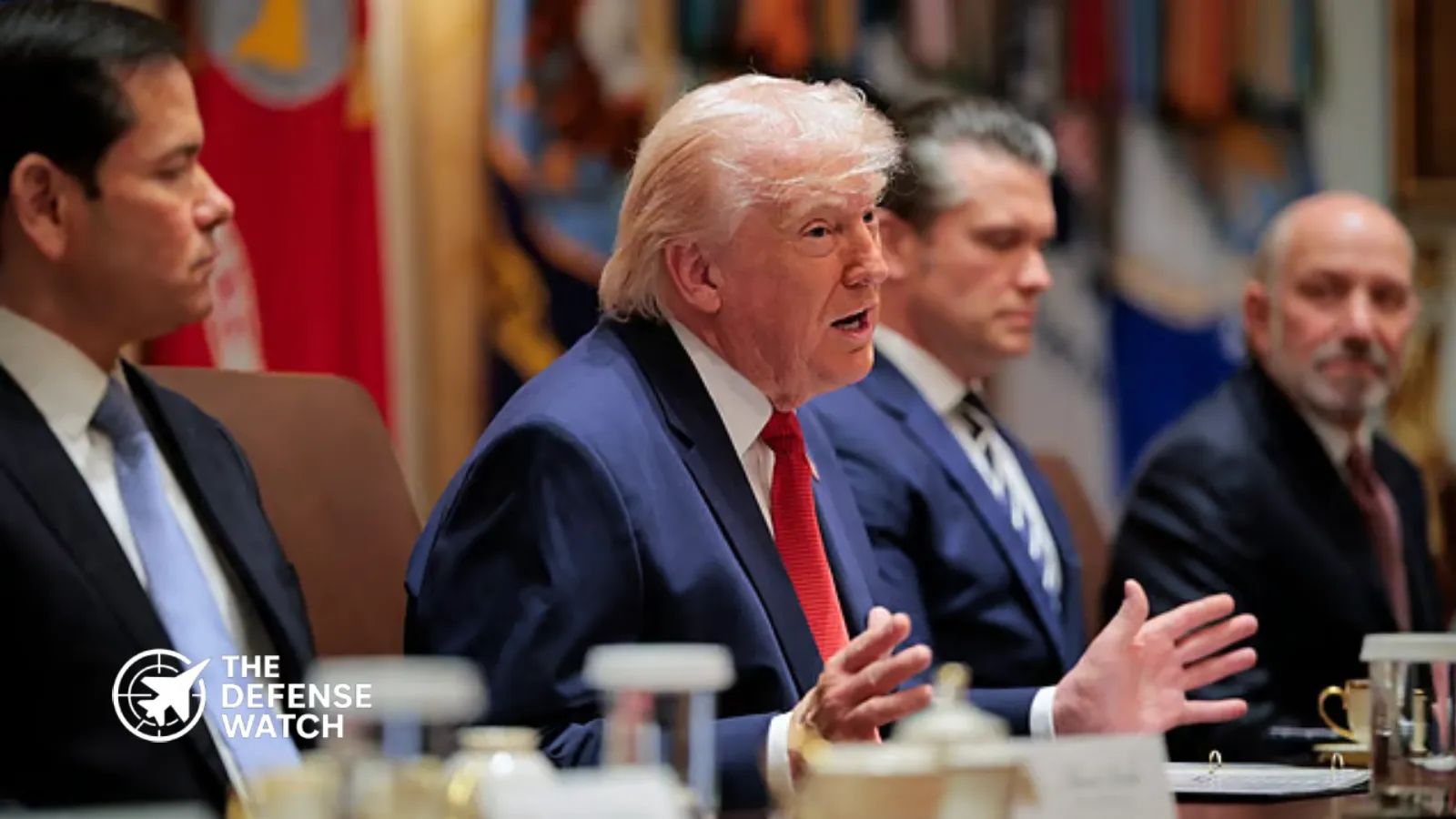
- The U.S.-Israel conflict with Iran began on February 28, 2026, under Operation Epic Fury, killing Supreme Leader Ali Khamenei and targeting nuclear and military sites across Iran.
- Iran’s IRGC closed the Strait of Hormuz to most traffic immediately after the strikes; tanker transit dropped by approximately 70%, with over 150 ships anchored outside the waterway. Brent crude surged above $126 per barrel at its peak.
- Washington delivered a 15-point ceasefire framework to Tehran via Pakistan on or around March 23; Iran formally rejected the plan on March 25 and submitted its own five-point counterproposal demanding war reparations and sovereignty over the Strait of Hormuz.
- Trump extended his deadline for Iran to reopen the Strait to April 6, 2026, citing “ongoing talks” — while simultaneously deploying the USS Tripoli amphibious group with 2,500 Marines and ordering 1,000 paratroopers from the 82nd Airborne to the region.
- Iran holds an estimated 440 kilograms of highly enriched uranium; the IAEA has confirmed an “ambitious” nuclear program but has found no direct evidence of a structured weapons program at the time of the strikes.
Iran-US Ceasefire Talks Remain Deadlocked as Hormuz Standoff Defines a New Middle East War
Iran-US ceasefire negotiations entered a critical and volatile phase this week, with Washington and Tehran exchanging competing peace proposals through third-party intermediaries while each side simultaneously escalated military and economic pressure. As of March 27, no direct dialogue has been established, no ceasefire is in place, and the Strait of Hormuz — the world’s most important energy chokepoint — remains effectively closed to most international shipping.
The Big Picture
The conflict that erupted on February 28, 2026, marks the most direct U.S. military engagement with Iran in modern history. Operation Epic Fury, a coordinated U.S.-Israeli strike campaign, struck Iran’s nuclear infrastructure, military command nodes, and senior leadership — including Supreme Leader Ali Khamenei. Within days, Iran’s Islamic Revolutionary Guard Corps (IRGC) retaliated by closing the Strait of Hormuz, striking U.S. military bases across the Gulf, and launching ballistic missile salvos at Israel.
The strategic stakes are without parallel in recent decades. The Strait of Hormuz handles roughly 20 percent of global seaborne oil and natural gas in peacetime. Its closure has driven Brent crude above $100 per barrel — exceeding $126 at the peak — and analysts compare the supply disruption to the 1970s energy crisis. Iran has positioned control over the strait as both a military weapon and a future diplomatic asset, making it the defining issue of any potential settlement.
What’s Happening
Washington’s 15-Point Framework
Using Pakistan as its primary intermediary — with Egypt and Turkey playing supporting roles — the Trump administration delivered a 15-point “action list” to Tehran around March 23. U.S. Special Envoy Steve Witkoff confirmed the framework publicly on March 26, describing it as a basis for a possible peace deal. The proposal reportedly includes a one-month ceasefire, during which both sides would restart negotiations.
The core U.S. demands, as reported by The New York Times and Al Jazeera, center on three pillars: Iran surrendering its stockpile of highly enriched uranium, halting all further enrichment, and accepting limits on its ballistic missile program. Washington also demands that Tehran cease support for regional militant groups including Hezbollah and the Houthis in Yemen.
In exchange, the U.S. reportedly offered full sanctions relief — a significant economic incentive for an Iranian economy hammered by decades of restrictions and now further strained by active conflict.
Iran’s Five-Point Counterproposal
Tehran formally rejected the 15-point plan on March 25 and submitted a five-point counterproposal through intermediaries. Iran’s conditions, confirmed by state broadcaster Press TV and the IRGC-linked Tasnim News Agency, include: an end to all U.S. and Israeli attacks on Iran and on Iranian-backed forces in Lebanon and Iraq; legally binding mechanisms guaranteeing that neither Washington nor Jerusalem would resume hostilities; full payment of war reparations; a comprehensive ceasefire across all conflict fronts including Hezbollah and Hamas; and international recognition of Iranian sovereignty over the Strait of Hormuz.
The Wall Street Journal separately reported that Tehran is also demanding the closure of all U.S. military bases in the Gulf region — a demand that would require Washington to fundamentally restructure its regional force posture.
The Diplomatic Limbo
Iranian Foreign Minister Abbas Araghchi publicly stated that his government has not engaged in negotiations and does not plan to — while simultaneously acknowledging that messages are “being exchanged through friendly countries.” Tasnim confirmed on March 26 that Iran had sent an official response to Washington the previous evening. The semantic distinction Tehran draws between “message exchanges” and “negotiations” is deliberate: it preserves domestic political cover for a regime that publicly frames any dialogue with the U.S. as capitulation.
Why It Matters
The Iran-US ceasefire talks carry consequences that extend far beyond the immediate conflict zone.
The Strait of Hormuz closure constitutes the largest single disruption to global energy supply since the 1970s oil embargo. Oil prices above $100 per barrel have cascaded through global supply chains — driving fertilizer shortages that threaten agricultural production, elevating aviation fuel costs to the point where multiple carriers have suspended Middle East routes, and increasing consumer fuel prices sharply in U.S. markets.
On the nuclear dimension, the IAEA has confirmed Iran holds approximately 440 kilograms of highly enriched uranium. Whether that stockpile survived U.S. and Israeli strikes on the Natanz, Fordow, and Isfahan nuclear facilities is a central intelligence question that shapes the entire negotiating dynamic. If Iran retains meaningful enriched material, it retains leverage. If the strikes substantially degraded that stockpile, Washington’s negotiating position improves considerably.
Strategic Implications
The gap between the two sides’ positions is not merely tactical — it reflects fundamental incompatibilities in strategic objectives.
Washington seeks a post-conflict Iran that is militarily neutered: stripped of enrichment capacity, denied long-range missile reach, and severed from its proxy network. This would permanently alter the regional balance of power in favor of U.S. allies, particularly Israel and the Gulf Cooperation Council states.
Tehran’s counterproposal preserves exactly what Washington seeks to remove. Sovereignty over the Strait of Hormuz — even as a formal legal claim — would institutionalize Iran’s ability to threaten global energy markets as a deterrent against future military action. Demanding the closure of U.S. bases would hollow out America’s forward deterrence architecture in the Gulf, built over decades and currently housing approximately 50,000 U.S. troops.
The troop movements signal that Washington has not abandoned the military option. The deployment of USS Tripoli with 2,500 Marines, combined with 1,000 paratroopers from the 82nd Airborne, provides the U.S. with a credible forcible-entry capability — the kind required to seize port infrastructure or secure the strait by force if diplomacy collapses.
Trump’s April 6 deadline for Iran to reopen the Strait — backed by a threat to strike Iranian power plants — functions as compellence rather than deterrence: it demands a specific action under threat of escalation. Whether Tehran treats it as a credible red line or as political theater will determine the near-term trajectory of the conflict.
Competitor View
China and Russia are watching the Hormuz crisis with strategic interest that defies a simple allied-versus-adversary framework.
China receives a substantial share of its crude oil through the Strait of Hormuz. The IRGC has confirmed that Chinese-flagged vessels may transit the waterway, effectively carving out a preferential lane for Beijing. This gives China an implicit stake in the conflict’s continuation at manageable intensity — high enough to weaken U.S. credibility and strain the global economy, but not so severe that Chinese energy imports are disrupted.
Russia has a parallel interest in elevated oil prices, which benefit its hydrocarbon export revenues even as Western sanctions persist. Moscow is also a potential guarantor of any security arrangement Tehran might seek — a role that would expand Russian strategic influence in the Persian Gulf at minimal direct cost.
Both nations abstained from the UN Security Council resolution condemning Iranian retaliatory strikes on Gulf states, signaling that neither intends to facilitate a swift U.S. diplomatic victory.
Iran’s Houthi allies in Yemen have explicitly threatened to attack Red Sea shipping if the U.S. attempts to reopen the Strait by force, which would open a second maritime front and further constrain global energy logistics.
What To Watch Next
April 6 Deadline: Trump’s extended ultimatum expires on April 6. If Iran has not meaningfully reopened the Strait, Trump has threatened strikes on Iranian power plants. Whether he executes that threat — or extends the deadline again — will signal the credibility of U.S. coercive diplomacy.
Islamabad Meeting: UN nuclear watchdog chief Rafael Grossi has indicated a meeting in Islamabad is under discussion, potentially involving Iranian representatives. If that session occurs, it would represent the first identifiable formal contact point in the indirect channel.
82nd Airborne and Marine Deployment: The arrival posture of the 82nd Airborne and the USS Tripoli group in theater will clarify whether the U.S. is positioning for a negotiated solution or a forced strait-opening operation. The 82nd’s paratroopers specialize in seizing airfields and key terrain in hostile environments — exactly the kind of capability needed to take and hold port or coastal infrastructure.
Iran’s Nuclear Stockpile Assessment: Intelligence assessments of how much enriched uranium Iran retains after the strikes will drive the nuclear dimension of any framework. Witkoff’s public insistence on a complete halt to enrichment — a harder line than the pre-war U.S. position — suggests Washington believes the strikes degraded Iran’s program sufficiently to demand permanent cessation rather than a monitored cap.
Capability Gap
The central capability gap this crisis exposes is Washington’s difficulty translating overwhelming air power into durable political outcomes.
U.S. and Israeli forces have demonstrated the ability to strike deeply into Iranian territory, neutralize senior leadership, and degrade nuclear infrastructure. What they have not demonstrated is the ability to force Iran’s compliance with specific behavioral demands — particularly the reopening of the Strait of Hormuz — without a ground or naval component that carries significant escalation risk.
Iran, conversely, has shown that a determined adversary can impose severe global economic costs even while absorbing substantial military punishment. The closure of the Strait is a form of asymmetric coercion that does not require air superiority or advanced technology — it requires only the credible threat of mine warfare, anti-ship missiles, and IRGC small-boat attacks on tanker traffic.
Any sustainable resolution must address this gap: creating conditions under which Iran cannot credibly threaten the Strait in the future, without requiring a permanent U.S. military occupation of Iranian territorial waters.
The Bottom Line
Washington and Tehran remain structurally incompatible in their war-termination demands — but the converging military and economic costs of continued conflict may ultimately force both sides toward a compromise that neither can fully claim as victory.
