British Commandos Fire High-Tech Mortars In Arctic Conditions
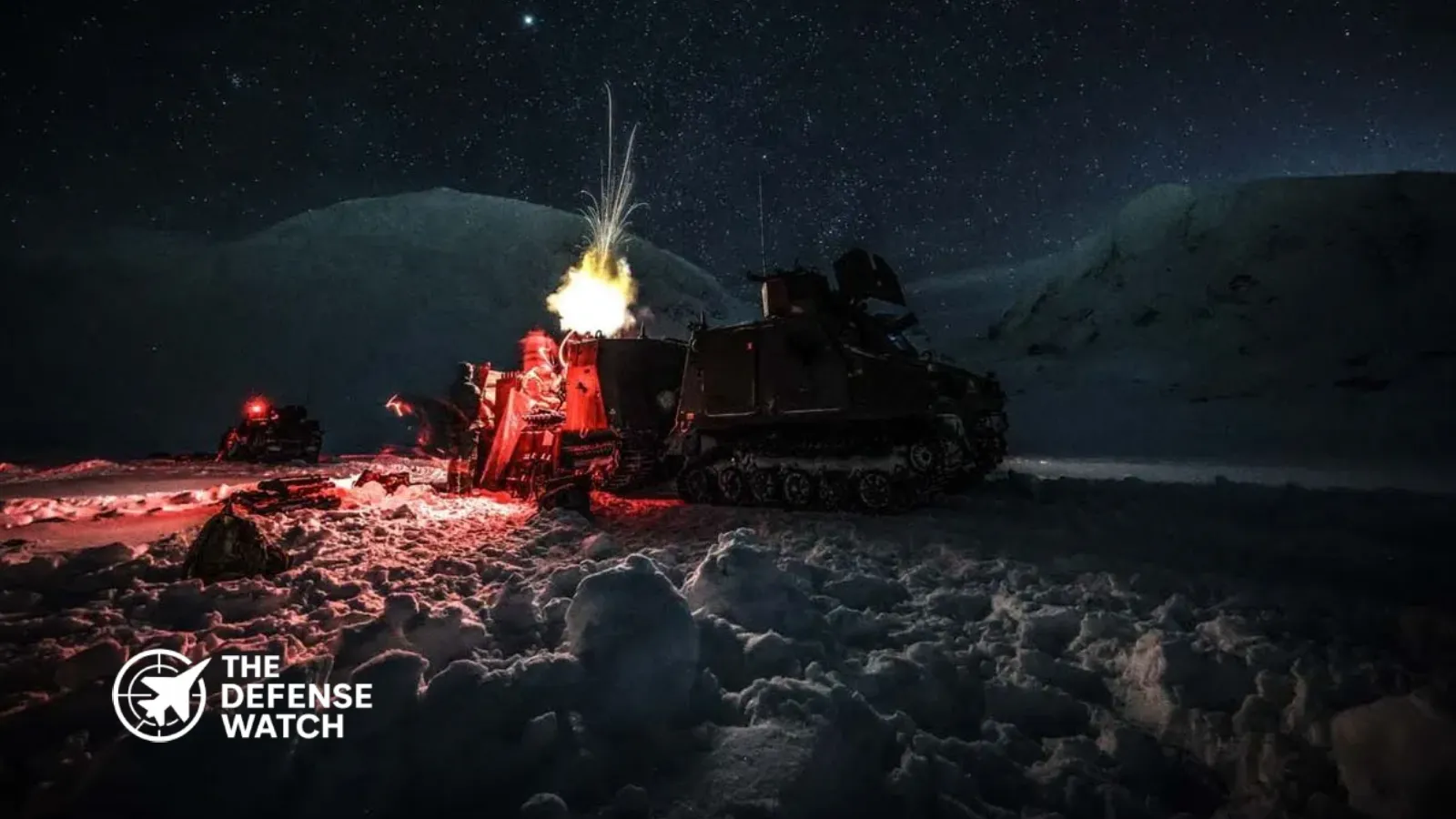
Royal Marines conducted intensive 81mm mortar fire missions in temperatures approaching -20°C near the village of Moen, more than 200 miles inside the Arctic Circle, as part of escalating preparations for NATO’s largest Arctic military exercise in 2026. The specialized mortar drills coincided with UK Defence Secretary John Healey’s announcement that British troop deployments to Norway will double from 1,000 to 2,000 personnel over the next three years.
The mortar operations, conducted by approximately 1,500 Royal Marine Commandos deployed to northern Norway, demonstrated the UK’s commitment to Arctic security as tensions with Russia intensify in the High North region. The Commando Forces’ 81mm mortars can deliver approximately 15 shells per minute on enemy positions, with rounds leaving the barrel at around 500 mph and striking targets up to 3.5 miles away.
During the week-long training exercise near Camp Viking in Øverbygd, mortar troops deployed their weapons from Viking and BV206 all-terrain vehicles, practicing rapid-fire missions both day and night. The training emphasized mobility and survivability in Arctic conditions, with crews quickly relocating positions across deep snow to evade potential adversaries while maintaining fire support for advancing troops.
UK Strengthens Arctic Presence Amid Rising Russian Activity
Defence Secretary John Healey stated that Russia poses the greatest threat to Arctic and High North security seen since the Cold War, noting Putin is rapidly re-establishing military presence in the region, including reopening old Cold War bases. The announcement came during Healey’s visit to British forces at Camp Viking, the UK’s permanent Arctic base established in 2024.
The expanded British deployment forms part of broader NATO efforts to strengthen the alliance’s northern flank. Healey confirmed that UK Armed Forces will play a vital part in NATO’s Arctic Sentry mission, with detailed military planning currently underway at NATO headquarters. The Defence Secretary is scheduled to discuss these proposals with NATO counterparts in Brussels.
(adsbygoogle = window.adsbygoogle || []).push({});This commitment builds on the historic Lunna House Agreement signed between the UK and Norway in December 2024, which established closer defense cooperation including joint operation of submarine-hunting Type 26 frigates and expanded Arctic training opportunities.
Cold Response 2026: NATO’s Premier Arctic Exercise
The mortar training exercises serve as intensive mission rehearsals ahead of Exercise Cold Response 2026, scheduled for March 9-19. The Norwegian-led exercise will involve approximately 25,000 troops from 14 NATO nations operating across Norway’s northern regions, with participation from Norway, the United States, United Kingdom, Germany, Netherlands, France, Italy, Canada, Spain, Turkey, Sweden, Finland, Denmark, Belgium, and NATO headquarters elements.
U.S. forces will contribute approximately 3,000 Marines from II Marine Expeditionary Force, deploying from Marine Corps Base Camp Lejeune, North Carolina, to demonstrate rapid transatlantic reinforcement capabilities. The exercise aims to test NATO’s ability to defend strategically important locations across fjords and mountains while operating in harsh Arctic conditions with limited daylight and extreme cold.
Cold Response 2026 represents a critical demonstration of alliance cohesion and interoperability. The exercise will be conducted as a multi-domain operation, coordinating effects across land, maritime, air, cyber, and space domains. A large-scale simulation running parallel to live operations will involve significantly larger simulated forces, increasing realism and complexity for participating headquarters.
Royal Marines: NATO’s Arctic Warfare Specialists
The Royal Marines have maintained Arctic warfare expertise for over 50 years, conducting annual training deployments to Norway. Lieutenant Colonel Chris Armstrong, Commanding Officer of 30 Commando Information Exploitation Group, emphasized the significance of the current deployment: “The UK Commando Force is stepping up readiness to war-fight alongside our allies in the High North. As NATO’s cold-weather specialists, we are ruthlessly focused on mission rehearsals with our closest partners”.
The 81mm mortar system remains a critical component of the Royal Marines‘ Arctic capabilities. These weapons provide indirect fire support for advancing commando units operating in terrain where conventional artillery may struggle to deploy. The mortar teams demonstrated their ability to conduct illumination missions, coordinate fire control in degraded conditions, and maintain high rates of fire despite extreme cold affecting personnel and equipment.
British forces are also integrating new technologies into their Arctic operations, including drones, enhanced communications systems, and AI-enabled targeting capabilities. The modernization effort aims to provide NATO with operational advantages in the High North while maintaining the Royal Marines’ traditional expertise in cold-weather warfare.
Joint Expeditionary Force Plans Major Arctic Operations
Beyond Cold Response, the UK-led Joint Expeditionary Force will conduct Exercise Lion Protector in September 2026, deploying air, land, and naval forces across Iceland, the Danish Straits, and Norway to train protection of critical national infrastructure from attacks and sabotage while enhancing joint command and control capabilities.
The Joint Expeditionary Force, which includes Denmark, Estonia, Finland, Iceland, Latvia, Lithuania, Netherlands, Norway, Sweden, and the United Kingdom, represents a rapid-reaction framework for security challenges in northern Europe. Lion Protector will involve hundreds of personnel focusing on deterrence and defense capabilities across the Arctic, High North, and North Atlantic regions.
These exercises occur against a backdrop of evolving Arctic geopolitics. Climate change is opening new sea routes and increasing access to natural resources, while great power competition intensifies in the region. Russia has significantly expanded its military footprint in the Arctic in recent years, reopening Soviet-era bases and upgrading Arctic capabilities as part of President Vladimir Putin’s effort to consolidate strategic depth in northern Europe .
UK Defense Spending Increase Supports Arctic Commitments
The British government has committed to the largest sustained increase in defense spending since the end of the Cold War, reaching 2.6% of GDP from 2027. This funding increase enables expanded operations in Norway and throughout NATO’s northern regions while supporting equipment modernization and force readiness.
The expanded Arctic presence also addresses concerns raised by the United States regarding European contributions to collective defense. NATO Secretary General Mark Rutte and alliance military commanders have warned of growing threats in the Arctic and High North from Russia and China, emphasizing the need for robust deterrence measures.
(adsbygoogle = window.adsbygoogle || []).push({});The Royal Marines’ mortar training exercises, combined with the announced troop increases and major exercise participation, demonstrate Britain’s commitment to remaining a leading contributor to Arctic security and NATO’s northern flank defense. As geopolitical competition intensifies and climate change reshapes the region’s strategic landscape, the UK’s Arctic expertise and operational capabilities will play an increasingly vital role in alliance security.