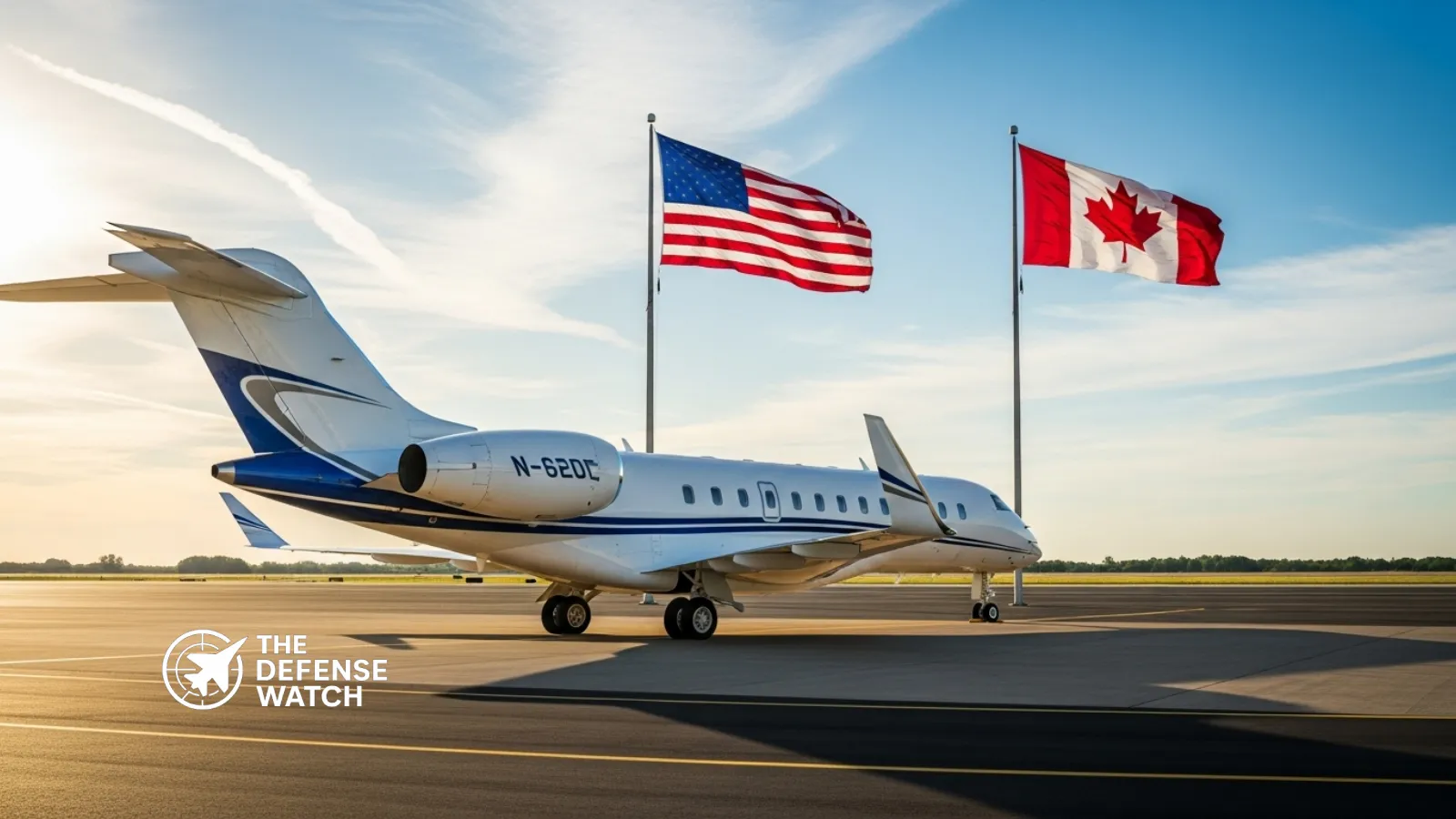
Industry Shock as White House Escalates Aerospace Trade War
President Donald Trump threatened to impose 50% tariffs on Canadian-made aircraft and decertify Bombardier business jets on January 29, 2026, triggering immediate market volatility and raising serious questions about U.S. aviation operations.
Bombardier shares plunged 9% in Friday morning trading following the late Thursday announcement, which aviation industry experts describe as an unprecedented use of safety certification as a trade weapon.
The President’s declaration on Truth Social accused Canada of refusing to approve several Gulfstream aircraft models, claiming Ottawa had “wrongfully, illegally, and steadfastly refused to certify the Gulfstream 500, 600, 700, and 800 Jets.” In response, Trump stated he was “hereby decertifying their Bombardier Global Expresses, and all Aircraft made in Canada.
Technical Dispute Over Fuel System Testing
The certification dispute centers on fuel system icing tests for Gulfstream’s G700 and G800 models, which received FAA approval through a temporary exemption valid through December 2026. The exemption allows Gulfstream to deliver aircraft while completing full-scale testing to ensure fuel systems can operate safely when ice forms from water droplets in cold temperatures.
Transport Canada has not granted a similar exemption, requiring Gulfstream to complete the testing before certification. Aviation industry sources note this follows a global trend of increased regulatory scrutiny after the Boeing 737 MAX crisis, with international authorities demanding more independent verification.
Canada has already certified the Gulfstream G500 and G600 models, contradicting Trump’s claim that all four aircraft types have been blocked. The G700 and G800 certification reviews remain pending as Gulfstream works to meet updated fuel system icing standards.
Market Impact and Industry Response
Montreal-based Bombardier issued a measured statement acknowledging the President’s comments and confirming contact with the Canadian government. “Our aircraft, facilities and technicians are fully certified to FAA standards and renowned around the world,” the company stated, emphasizing its U.S. operations expansion.
More than half of Bombardier’s global fleet of approximately 5,200 aircraft operate in the United States, with 64% of the company’s 2024 sales coming from the U.S. market. The threatened tariffs would severely impact Bombardier’s access to its largest customer base.
Aviation data firm Cirium reports 150 Bombardier Global Express aircraft currently operate in U.S. airspace, flown by 115 operators. Across all Canadian manufacturers, approximately 5,425 aircraft registered in the United States could potentially face operational restrictions.
Defense and Commercial Aviation at Risk
The decertification threat extends beyond business aviation. The U.S. military operates modified Bombardier Global Express jets known as E-11A BACN aircraft, with one currently deployed to the Middle East for battlefield communications relay missions.
Major U.S. commercial carriers would also face disruptions. Delta Air Lines operates 46 Airbus A220 aircraft built in Canada, while JetBlue flies 10 of the type. Regional carriers using Bombardier CRJ jets for mainline operations would encounter significant operational challenges if new aircraft deliveries were blocked.
General Dynamics, which owns Gulfstream, would stand to benefit competitively if its primary rival faces trade barriers. However, industry analysts warn the precedent of using safety certification for economic leverage could invite retaliatory measures globally.
Broader Trade War Context
The aircraft dispute represents the latest escalation in deteriorating U.S.-Canada relations since Trump’s January 2025 inauguration. The President previously threatened 100% tariffs on Canadian goods if Ottawa proceeded with trade agreements involving China.
Tensions intensified after Canadian Prime Minister Mark Carney’s speech at the World Economic Forum in Davos, where he warned nations to prepare for the end of the rules-based global order, comments widely interpreted as criticism of U.S. trade policy. Treasury Secretary Scott Bessent subsequently warned Carney that such statements could backfire during the upcoming USMCA trade agreement review.
Aviation industry executives expressed alarm at mixing trade disputes with safety certification processes. Mixing safety issues with politics and grievances is an incredibly bad idea,” stated Richard Aboulafia, managing director of AeroDynamic Advisory, a U.S. aerospace consulting firm.
Economic Implications for Both Nations
Bombardier employs more than 3,000 people across nine U.S. facilities and maintains relationships with 2,800 American suppliers across 47 states. The company estimates over 40% of its aircraft content originates from U.S. manufacturers, with wings produced in Texas, avionics in Iowa, and engines in Indiana.
The United States maintains a significant trade surplus with Canada in aerospace products, making the sector an unusual target for tariff threats typically justified by trade imbalances. Industry observers note aircraft and aerospace components had largely escaped previous trade war measures under the USMCA agreement.
White House officials later clarified that existing Canadian-built aircraft would not be grounded, with decertification applying only to new deliveries. However, aviation law specialists report the announcement triggered immediate inquiries from corporate aircraft owners and potential buyers seeking clarification on their Bombardier fleet operations.
Regulatory Authority Questions
Aviation experts questioned whether the President possesses legal authority to decertify aircraft approved by the Federal Aviation Administration. The FAA, an independent regulatory body within the Department of Transportation, bases certification decisions on safety criteria rather than economic or political considerations.
The agency can only revoke certifications for safety-related deficiencies, not trade disputes. Trump’s declaration would require FAA implementation, but the legal framework for such action remains unclear. Previous presidential directives on aviation matters have typically been executed by relevant agencies with modifications to comply with statutory requirements.
Transport Canada declined immediate comment on the certification timeline for Gulfstream models. Canadian Industry Minister Mélanie Joly told media that certification processes are underway and should not be politicized, expressing confidence the situation could be resolved through normal regulatory channels.
Industry Outlook and Strategic Considerations
Bombardier’s Global 8000, which received FAA certification in December 2025, is the fastest civilian aircraft since the Concorde, with a top speed of Mach 0.95. The aircraft directly competes with Gulfstream’s G800 in the ultra-long-range business jet market, a segment dominated by North American manufacturers.
RBC Capital Markets analysts noted that sustained decertification threats could create near-term uncertainty around U.S. customer commitments for Bombardier, potentially affecting order books and delivery schedules even if the threats are not fully implemented.
The aerospace industry operates on global supply chains and reciprocal certification agreements that have functioned for decades. Unilateral actions by major aviation markets could destabilize the international regulatory framework, according to industry trade groups.
Canadian officials emphasized the country’s aviation safety record and certification standards meet or exceed international benchmarks. The standoff highlights growing fragmentation in global aviation regulation following increased scrutiny of manufacturer-regulator relationships after high-profile safety failures.
Political Ramifications
The timing of Trump’s aircraft threats coincides with Canada’s approach to upcoming USMCA negotiations scheduled for formal review. Prime Minister Carney has publicly committed to diversifying Canadian trade relationships away from overwhelming U.S. dependence, which currently accounts for approximately 70% of Canadian exports.
Carney rejected suggestions he walked back his Davos comments during subsequent conversations with Trump, stating he meant what he said about global order shifts and confirmed plans to pursue a dozen new trade agreements. The Prime Minister’s defiant stance marks a significant departure from previous Canadian governments’ careful management of U.S. relations.
Both nations face potential economic damage from sustained aerospace trade conflicts. The interconnected nature of North American aerospace manufacturing means tariffs and certification barriers would disrupt production networks on both sides of the border.
Next Steps and Resolution Prospects
Industry observers expect the situation to evolve through back-channel negotiations between government officials and company executives. Trump’s trade threats have historically served as opening positions for bargaining, with eventual implementation featuring modifications and exemptions.
Aviation regulators in both countries maintain technical working relationships independent of political leadership, providing potential channels for addressing the underlying certification issues. Gulfstream’s compliance deadline of December 31, 2026 for full fuel system icing certification may factor into resolution timelines.
Bombardier’s response strategy will likely emphasize its substantial U.S. economic footprint and the potential for retaliatory measures affecting American aerospace exports. The company faces a delicate balance between defending its market position and avoiding further escalation that could damage customer confidence.
The aerospace industry will closely monitor whether other countries interpret the U.S. actions as precedent for using safety certification as trade leverage, potentially fragmenting the global aviation regulatory system built on bilateral and multilateral agreements.