
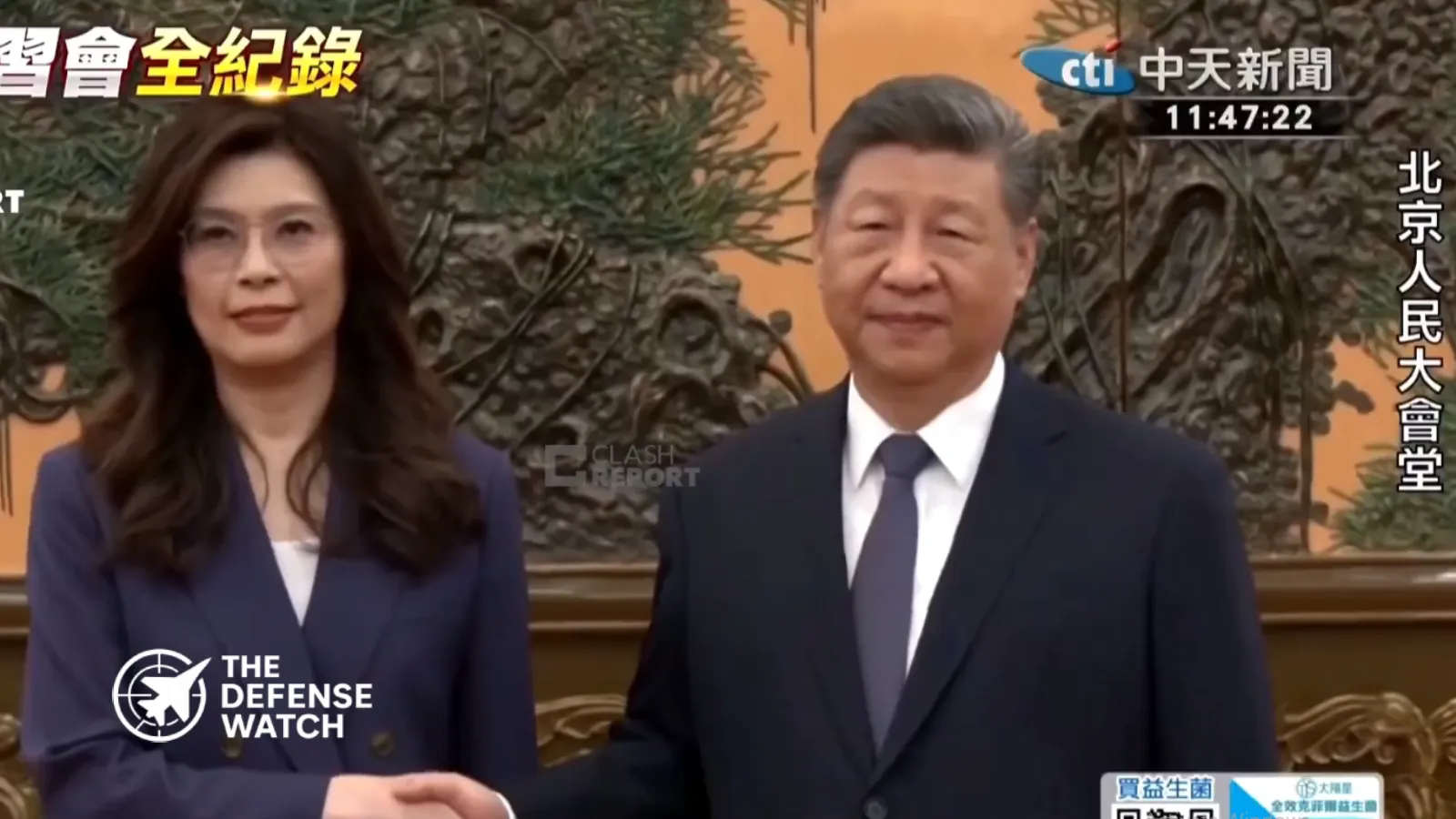
- Chinese President Xi Jinping met Taiwan opposition figure Cheng Li-wun in Beijing for cross-strait dialogue.
- Talks focused on reaffirming the 1992 Consensus and opposing Taiwan independence.
- Beijing emphasized peaceful development and long-term stability across the Taiwan Strait.
- The meeting highlights China’s continued engagement with Taiwan’s opposition parties.
- The move comes amid ongoing military tensions and geopolitical competition in the Indo-Pacific.
Xi Jinping Meets Taiwan Opposition Leader Amid Cross-Strait Tensions
The Xi Jinping Taiwan meeting marks a notable political engagement as Xi Jinping hosted Taiwanese opposition figure Cheng Li-wun in Beijing, signaling Beijing’s continued push to shape cross-strait relations through dialogue rather than confrontation.
According to official remarks, both sides framed the meeting as an effort to “safeguard peace and tranquility” and promote the “peaceful development” of ties between mainland China and Taiwan.
Xi reiterated Beijing’s long-standing position that engagement must be based on adherence to the 1992 Consensus, a political framework that acknowledges a single China while allowing differing interpretations.
Political Messaging Anchored In Strategic Stability
The Xi Jinping Taiwan meeting reflects a calibrated messaging strategy from Beijing. By engaging a Taiwanese opposition figure rather than current ruling authorities, China continues to bypass the leadership of Lai Ching-te, whose administration rejects the 1992 Consensus.
Xi emphasized three key pillars during the meeting:
- Opposition to Taiwan independence
- Promotion of cross-strait economic and social integration
- Framing reunification as part of national rejuvenation
This language aligns closely with broader Chinese Communist Party messaging that ties Taiwan’s future to long-term national strategy.
From a geopolitical perspective, the meeting underscores Beijing’s dual-track approach. While the People’s Liberation Army continues to conduct military exercises near the Taiwan Strait, political outreach remains active, particularly toward parties seen as more open to engagement.
Strategic Context: Diplomacy Alongside Military Pressure
The timing of the Xi Jinping Taiwan meeting is significant. It comes amid sustained military signaling in the region, including air and naval operations by China near Taiwan’s air defense identification zone.
Analysts note that Beijing often pairs such military activity with political messaging to create a layered pressure environment. This approach serves multiple objectives:
- Demonstrating military capability and readiness
- Reinforcing political narratives around inevitability of reunification
- Testing international responses, particularly from the United States and regional allies
According to assessments from organizations such as the Center for Strategic and International Studies, this blend of coercion and engagement is central to China’s long-term Taiwan strategy.
Implications For Regional Security And U.S. Interests
For U.S. defense planners, the Xi Jinping Taiwan meeting highlights the evolving nature of cross-strait competition. While military scenarios often dominate analysis, political influence operations and diplomatic outreach remain critical components.
The United States, under the framework of the Taiwan Relations Act, continues to support Taiwan’s self-defense capabilities. At the same time, Washington monitors political developments that could alter the status quo without direct military confrontation.
The meeting also reflects Beijing’s attempt to shape internal Taiwanese politics. By engaging opposition figures, China seeks to influence public discourse and potentially shift future electoral outcomes.
Cross-Strait Relations Enter A Complex Phase
The Xi Jinping Taiwan meeting illustrates a broader trend. Cross-strait relations are no longer defined solely by military deterrence or economic ties. Instead, they now operate across multiple domains:
- Political engagement
- Information influence
- Military signaling
- Economic leverage
This multi-domain competition complicates policy responses for regional actors.
While Beijing emphasizes peaceful development, its conditions remain unchanged. Any progress in dialogue is tied to acceptance of the 1992 Consensus, a position that continues to divide Taiwan’s political landscape.
Outlook
In the near term, the Xi Jinping Taiwan meeting is unlikely to produce immediate breakthroughs. However, it reinforces a pattern of selective engagement that could shape future cross-strait dynamics.
For defense and policy communities, the key takeaway is clear. Political signaling events like this should be assessed alongside military developments, not in isolation.
The trajectory of cross-strait relations will depend on how these parallel tracks evolve and whether they converge or diverge under rising geopolitical pressure in the Indo-Pacific.
Get real time update about this post category directly on your device, subscribe now.
