
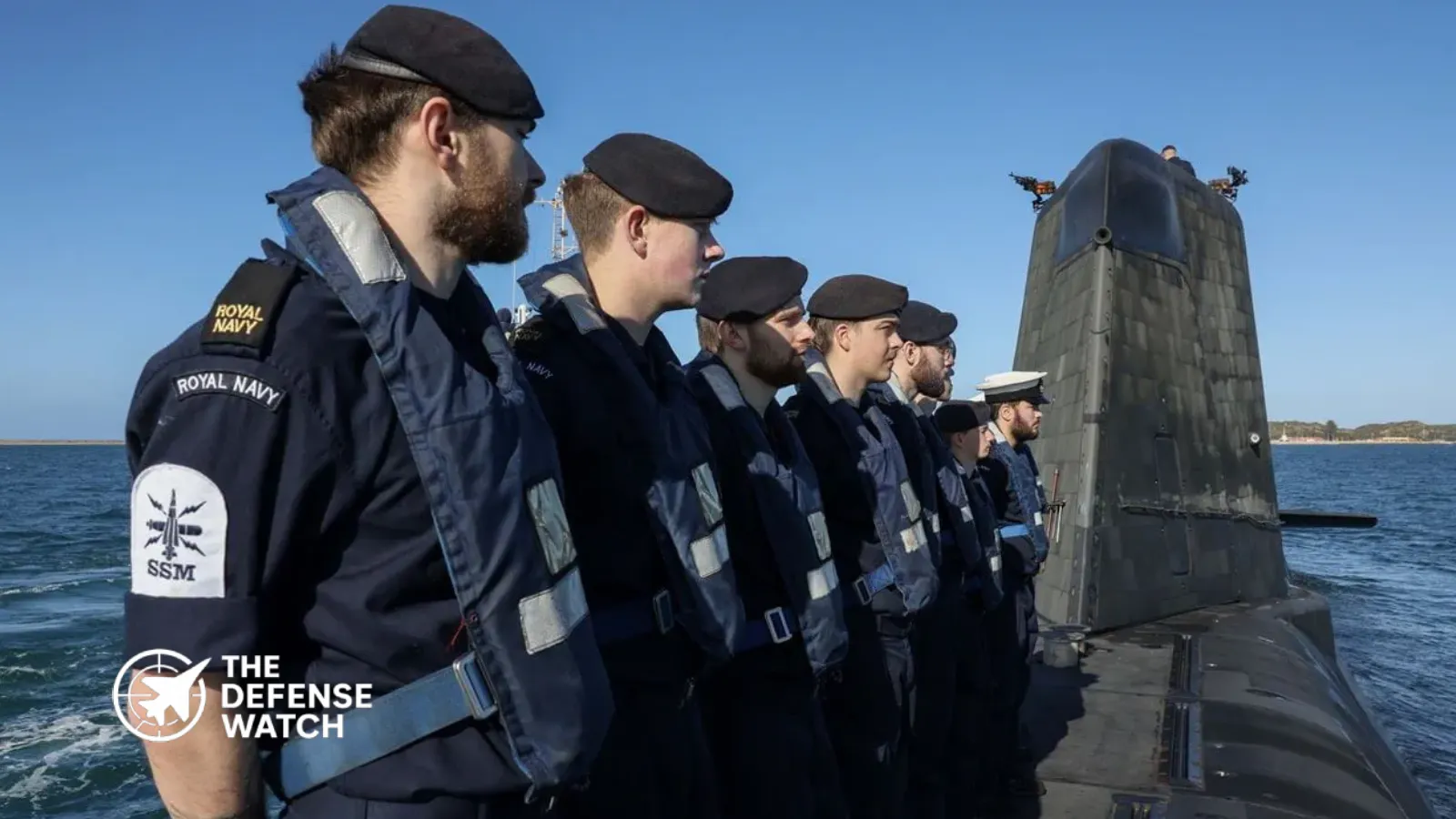
- ► A submarine from the UK’s :contentReference[oaicite:0]{index=0} conducted a historic port visit to Australia in February 2026.
- ► The visit supports implementation of the :contentReference[oaicite:1]{index=1} trilateral security partnership.
- ► The submarine is part of the UK’s nuclear powered attack submarine force.
- ► The deployment included engagement with the :contentReference[oaicite:2]{index=2}.
- ► The visit aligns with plans to rotate UK and US submarines through Western Australia under AUKUS.
- ► Australia plans to acquire conventionally armed, nuclear powered submarines under the SSN AUKUS program.
Royal Navy Submarine Visit Australia Underscores AUKUS Momentum
The Royal Navy submarine visit to Australia marks more than a ceremonial port call. It reflects a tangible step in implementing AUKUS and expanding allied undersea cooperation in the Indo-Pacific.
According to the UK Ministry of Defence, the submarine’s arrival represents the first visit of its kind in decades. It comes as the United Kingdom deepens operational ties with Australia ahead of the planned rotational presence of British and American nuclear powered attack submarines in Western Australia later this decade.
The timing is significant. With undersea competition intensifying in the Indo-Pacific, visible demonstrations of allied submarine cooperation send a strategic signal well beyond Canberra and London.
Operational Impact: Building Submarine Interoperability
The immediate operational value of the Royal Navy submarine visit to Australia lies in training, infrastructure familiarization, and command level coordination.
Australia is preparing to host regular rotations of UK and US submarines under the Submarine Rotational Force West construct. This will require port upgrades, nuclear stewardship procedures, safety protocols, and expanded sustainment capacity at HMAS Stirling in Western Australia.
A visiting British nuclear powered attack submarine allows Australian personnel to work alongside experienced crews. That includes exposure to reactor safety regimes, logistics chains, and dockyard handling procedures. These are not symbolic exercises. They are foundational steps for Australia’s transition from a conventional submarine operator to a nuclear powered one.
The UK benefits as well. Operating in Australian waters expands the Royal Navy’s Indo-Pacific familiarity. It also increases endurance options for British boats deployed east of Suez.
For the United States, which is the third AUKUS partner, such visits reinforce the credibility of the trilateral model. Interoperability is not built on paper agreements. It is built through repeated, practical integration at sea and in port.
Industrial And Programmatic Context
The Royal Navy submarine visit to Australia takes place as the SSN AUKUS design moves forward.
Under current plans, Australia will first acquire US Virginia class submarines as an interim capability before transitioning to a jointly developed SSN AUKUS design with the UK. That future class is expected to draw heavily from Britain’s experience with its Astute class and successor programs.
For London, this cooperation strengthens its domestic submarine industrial base. The UK’s submarine enterprise, centered at Barrow-in-Furness, faces workforce and production challenges similar to those in the United States. A trilateral pipeline offers longer term stability in design and construction work.
For Australia, the industrial implications are even larger. Canberra plans to build SSN AUKUS boats domestically in Adelaide. That requires workforce expansion, nuclear engineering skills, and regulatory structures that did not previously exist in the country.
The visit, therefore, supports more than naval diplomacy. It reinforces political commitments to a multi decade industrial transformation.
Regional Security Context: Undersea Competition In The Indo-Pacific
Submarines remain among the most survivable and strategically flexible military assets. In the Indo-Pacific, where maritime distances are vast and surveillance networks are expanding, nuclear powered attack submarines offer endurance, stealth, and rapid repositioning.
China’s People’s Liberation Army Navy has expanded its submarine fleet significantly over the past two decades. While many Chinese boats are diesel electric, Beijing continues to field new nuclear powered attack and ballistic missile submarines.
Against that backdrop, AUKUS partners are signaling that allied undersea capabilities will remain present and integrated.
The Royal Navy submarine visit to Australia sends a message of sustained UK engagement in the Indo-Pacific. Britain’s 2021 Integrated Review and its 2023 refresh identified the region as central to long term security and economic interests. This visit demonstrates follow through.
For regional states such as Japan and India, closer UK Australia submarine cooperation reinforces a broader network of maritime security partnerships. For Southeast Asian nations, it underscores that external powers are investing long term resources into regional stability.
For Beijing, the message is more direct. Allied nuclear powered attack submarines operating more frequently from Australian territory complicate Chinese naval planning. They expand patrol options in the South China Sea and beyond.
Comparison With Competitors
Few countries operate nuclear powered attack submarines. The United States and the United Kingdom are among the most experienced.
France also fields advanced nuclear submarines, and Paris maintains Indo-Pacific territories and a naval presence. However, France is not part of AUKUS, and its cooperation with Australia shifted after Canberra canceled its conventional submarine contract in 2021.
Russia retains significant submarine capabilities but has limited sustained presence in the Indo-Pacific compared to the Cold War period.
China is expanding its fleet, yet questions remain about acoustic quieting and operational experience compared to Western navies.
In that context, the Royal Navy submarine visit to Australia highlights the concentration of advanced undersea expertise within the AUKUS framework. It consolidates capability among close allies rather than dispersing it.
Strategic Assessment
The Royal Navy submarine visit to Australia carries implications beyond bilateral ties.
Impact on regional power balance:
Regular UK and US submarine rotations through Australia will increase allied undersea presence in the eastern Indian Ocean and western Pacific. This strengthens deterrence by complicating any adversary’s planning and increasing uncertainty about allied submarine locations.
Deterrence implications:
Nuclear powered attack submarines are optimized for anti submarine warfare, intelligence gathering, and land attack missions. Their presence signals high end warfighting capability, not just maritime patrol. That contributes to denial strategies aimed at preventing coercion in contested waters.
Budget and procurement signals:
The visit reinforces political backing for the expensive SSN AUKUS pathway. Submarine programs require long term funding certainty. Visible milestones help sustain domestic support in all three AUKUS countries.
Alliance dynamics:
AUKUS moves beyond technology sharing into integrated force posture. The Royal Navy submarine visit to Australia demonstrates that London is not a peripheral partner. It is an operational contributor in the Indo-Pacific.
Escalation risks:
While allied submarine deployments are defensive in nature, increased undersea activity can heighten risks of miscalculation. Close encounters at sea, especially in contested areas, demand robust communication mechanisms.
What Happens Next
In the near term, additional port visits and joint activities are likely as Australia prepares for rotational deployments beginning later this decade.
Longer term, attention will shift to infrastructure readiness at HMAS Stirling, workforce development, and legislative frameworks governing nuclear stewardship.
The success of SSN AUKUS will depend not only on engineering design but on sustained political alignment across three governments.
The Royal Navy submarine visit to Australia is therefore an early operational indicator. It shows that AUKUS is progressing from policy announcement to practical execution.
Get real time update about this post category directly on your device, subscribe now.
