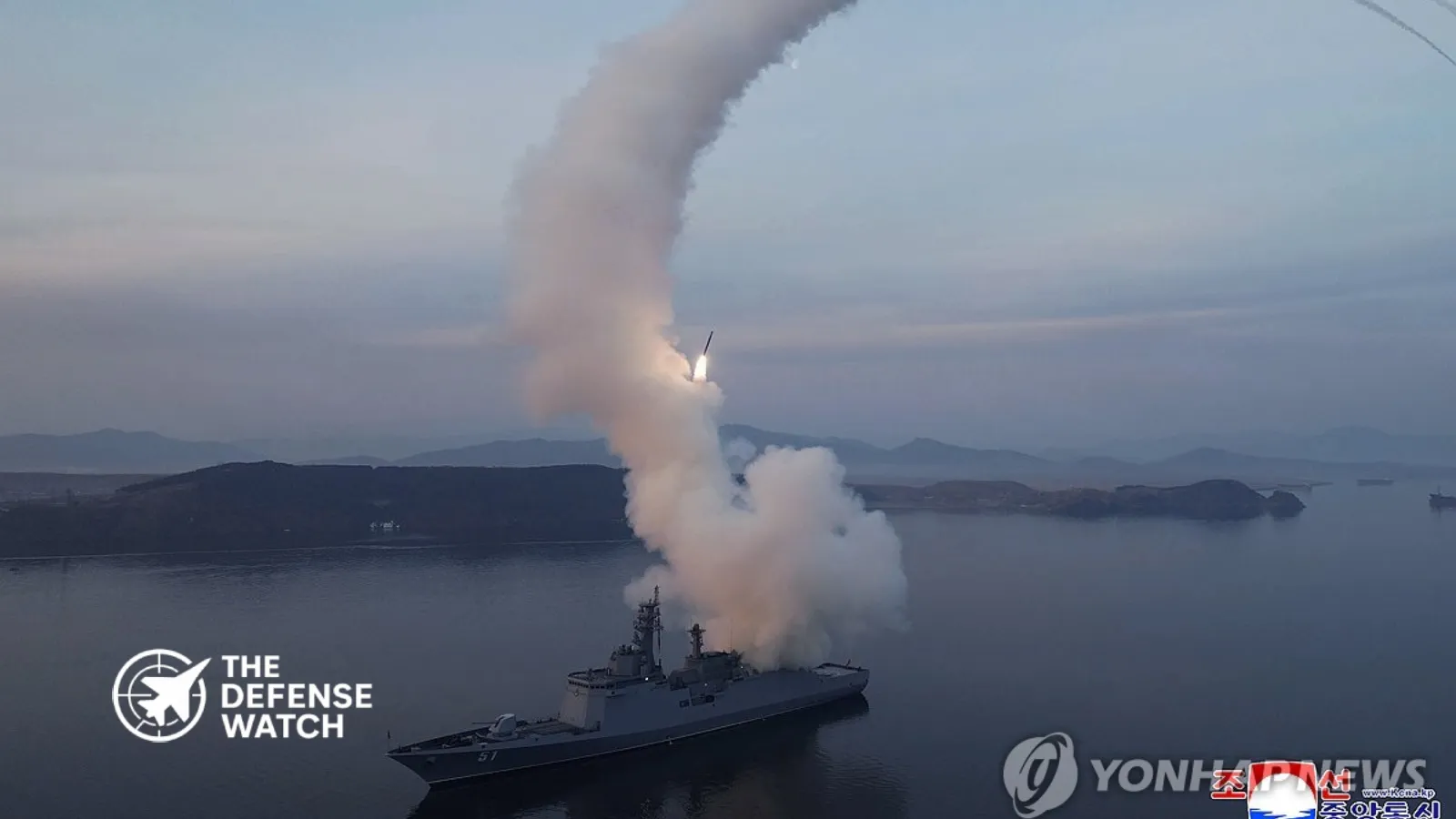
- North Korea conducted a repeat ripple launch of strategic cruise missiles from its new Choe Hyon destroyer.
- The missiles followed preset flight paths for more than 10,000 seconds before striking targets in the Yellow Sea.
- The test evaluated the destroyer’s integrated combat system and strategic weapons control network.
- The launch occurred within days of a similar demonstration, suggesting the vessel is nearing operational readiness.
- The test highlights North Korea’s growing emphasis on sea based nuclear capable strike platforms.
North Korean Destroyer Conducts Strategic Cruise Missile Ripple Launch
A North Korean destroyer conducted a repeat ripple launch of strategic cruise missiles in a test that underscores Pyongyang’s efforts to operationalize a new class of missile armed warships.
State media reported that the 5,000 ton destroyer Choe Hyon launched multiple strategic cruise missiles during a weapons test on March 10. The missiles followed preset flight paths for more than 10,000 seconds before striking designated targets in the Yellow Sea.
The launch marks the second demonstration within a week, indicating that the vessel and its weapons systems are approaching operational readiness as part of North Korea’s ongoing naval modernization program.
North Korean leader Kim Jong Un reportedly observed the exercise via remote link and praised the results, describing the test as confirmation of the reliability of the country’s integrated strategic weapons control system.
The Big Picture
North Korea’s repeat strategic cruise missile launch reflects a broader shift in Pyongyang’s military strategy toward survivable nuclear delivery systems.
For decades, the Korean People’s Navy primarily focused on coastal defense using small missile boats and submarines. The introduction of large missile carrying destroyers represents an effort to transform the fleet into a more capable strike force able to launch weapons from offshore positions.

Sea based cruise missile platforms complicate the defensive planning of the United States, South Korea, and Japan. Unlike fixed land based launchers, warships can maneuver and disperse across coastal waters, making them harder to track and target.
This approach mirrors a wider global trend in which states deploy mobile and distributed missile forces to improve survivability in high intensity conflict.
What’s Happening
North Korea carried out the latest test on March 10 using the destroyer Choe Hyon, a 5,000 ton multipurpose warship introduced in 2025 as the largest vessel in the country’s navy.
According to official reporting, the destroyer launched several strategic cruise missiles in rapid succession, a technique known as a ripple launch. In this method, multiple missiles fire sequentially within seconds, allowing a warship to saturate enemy defenses.
The missiles flew between 10,116 and 10,138 seconds before striking their designated targets in the Yellow Sea.
The test evaluated several components of the ship’s combat system, including:
- The integrated control system for strategic weapons
- The destroyer’s sensors and targeting systems
- Launch authorization procedures
- Coordination between command networks and onboard weapons
North Korean officials said the results confirmed the reliability of the vessel’s integrated combat architecture.
Why It Matters
Strategic cruise missile launches from surface combatants significantly expand North Korea’s potential strike options.
The term strategic in North Korean military terminology typically indicates nuclear capable systems. Analysts believe several of the country’s cruise missiles are designed to carry tactical nuclear warheads.
A destroyer armed with such missiles can perform several operational roles:
- Land attack missions against regional bases or ports
- Anti ship strikes against naval forces
- Saturation attacks designed to overwhelm missile defense systems
Unlike ballistic missiles, cruise missiles fly at lower altitudes and follow complex routes. This flight profile makes them more difficult for radar systems to detect early.
For regional missile defense planners, this introduces an additional layer of complexity in tracking and intercepting incoming threats.
Strategic Implications
The emergence of missile armed destroyers suggests North Korea is pursuing a more diversified nuclear deterrent structure.
Until recently, Pyongyang relied heavily on land based missile launchers and submarine launched systems. Surface warships provide a third delivery option, allowing missiles to be launched from multiple directions.
Such capabilities can complicate preemptive strike strategies and increase the survivability of North Korea’s nuclear forces.
The development also reflects Pyongyang’s long term goal of expanding its naval power beyond coastal defense. A fleet capable of launching cruise missiles at sea offers greater operational flexibility and strengthens deterrence messaging during periods of regional tension.
Competitor View
Regional powers are likely to interpret the test as another step in North Korea’s steady expansion of its missile forces.
South Korea and the United States already operate layered missile defense systems designed primarily to counter ballistic threats. The increasing use of cruise missiles requires adjustments in detection, tracking, and interception capabilities.
China and Russia will also monitor the development closely. Both countries have extensive experience with cruise missile equipped surface combatants and may view North Korea’s efforts as an attempt to replicate similar operational concepts on a smaller scale.
For U.S. and allied naval planners, the appearance of cruise missile armed destroyers introduces new variables in maritime security operations in the Yellow Sea and surrounding waters.
What To Watch Next
Several developments could follow this series of missile tests.
First, the Choe Hyon destroyer is likely to undergo additional operational evaluations before full commissioning into active naval service.
Second, North Korea has signaled plans to expand its destroyer fleet. Kim Jong Un has previously called for the construction of additional ships of the same class or larger designs.
Finally, future tests may focus on integrating additional weapons systems, including supersonic missiles or upgraded strike platforms for larger warships.
Capability Gap
North Korea historically lacked large surface combatants capable of launching multiple guided missiles from vertical launch systems.
Most of its fleet consisted of aging Soviet era designs or small coastal patrol craft. These vessels offered limited strike range and survivability.
The introduction of the Choe Hyon destroyer appears aimed at addressing this gap by providing:
- Greater missile capacity
- Improved sensors and combat management systems
- A platform capable of coordinated strike operations
However, the overall effectiveness of these ships remains uncertain. Sustained operations require advanced logistics, training, and maintenance infrastructure that North Korea is still developing.
The Bottom Line
North Korea’s repeat strategic cruise missile launch from a new destroyer signals Pyongyang’s growing ambition to field a more capable missile armed navy.
Get real time update about this post category directly on your device, subscribe now.