

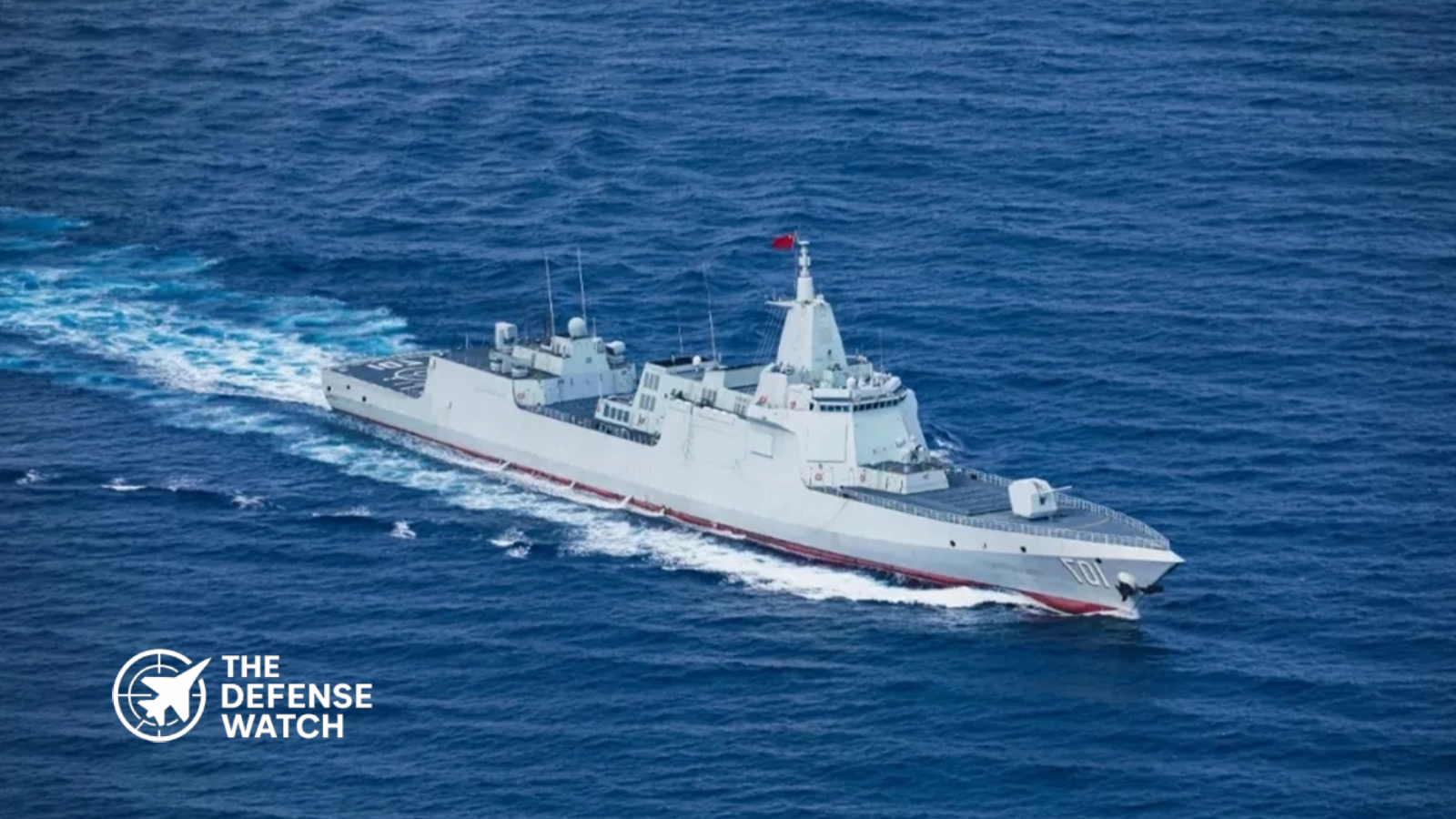
Chinese Crew Says Foreign Warship Lost Power Tracking Zunyi
A Chinese officer serving aboard the PLA Navy Type 055 destroyer Zunyi has described an encounter in which an unidentified foreign warship allegedly lost electrical power while tracking the Chinese vessel during a routine training mission.
The account was broadcast by China Central Television and reported by the Global Times on October 7. According to Captain Zhang Jun, the foreign warship followed the Zunyi as the Chinese destroyer increased speed. During what Zhang described as a standoff, the foreign vessel reportedly lost power, its radar stopped emitting and its navigation lights went dark.
Zhang said the outage lasted nearly 30 minutes, while the Zunyi and its crew continued operating normally. Chinese state media did not identify the foreign warship, disclose the location or provide a date for the encounter. There is also no independent evidence currently establishing the circumstances described by Zhang.
That uncertainty is important because the incident has been linked in some Chinese reporting to the U.S. Navy destroyer USS Benfold, which suffered a separate and publicly documented engineering casualty in the South China Sea in July. The available information does not establish that the two events were connected.
An unidentified encounter at sea
The account provides few details that would allow the foreign vessel to be identified.
Zhang said the encounter occurred while Zunyi was conducting routine training and that the foreign warship began tracking the Chinese destroyer. He described both ships operating at high speed before the foreign vessel apparently lost electrical power.
According to the Chinese account, the foreign ship temporarily stopped transmitting radar and its navigation lights went out. Zhang said the condition lasted approximately half an hour.
Neither the CCTV report nor the Global Times account identified the foreign vessel, its nationality, the operating area or the specific training exercise.
The lack of those details prevents independent confirmation of the event and makes it difficult to determine whether the power loss resulted from an engineering casualty, an electrical-system problem or another cause.
The report therefore should be treated as a Chinese military account of an encounter rather than as an independently verified incident involving a specific foreign navy.
The USS Benfold comparison remains unproven
The timing of the Chinese report has drawn attention to the July power failure aboard the U.S. Navy’s USS Benfold, an Arleigh Burke class guided-missile destroyer.
USNI News reported in August that Benfold lost power on July 24 while conducting routine operations in the Indo-Pacific. The U.S. 7th Fleet said the engineering casualty involved the ship’s generators. The resulting outage lasted four days, after which the destroyer was towed to Subic Bay in the Philippines for repairs.
The U.S. Navy said the power loss affected potable water, galley services, toilets and air conditioning. Other ships from the George Washington Carrier Strike Group provided support while Benfold was disabled. The Navy later said repairs were completed and the ship resumed operations.
There is a major difference between the two accounts. Zhang described an unidentified foreign warship losing power for about 30 minutes during a close encounter with Zunyi, while the publicly documented Benfold casualty lasted four days and involved a generator-related engineering failure.
No U.S. Navy statement has linked the Benfold casualty to an encounter with Zunyi. The U.S. 7th Fleet’s public information confirms Benfold was operating in the region, but does not establish that it was the foreign vessel described by the Chinese officer.
That distinction matters. At present, identifying Benfold as the ship described by Zhang would go beyond the available evidence.
Why the Zunyi is significant to the PLA Navy
The Zunyi, hull 107, is one of China’s Type 055 large guided-missile destroyers. Chinese military sources identify it as the seventh Type 055 vessel and associate it with the PLA Navy’s Southern Theater Command.
China commissioned the first eight Type 055 destroyers between 2020 and 2023. In March 2026, Chinese military authorities reported that two additional ships, Dongguan and Anqing, had entered service, bringing the publicly identified Type 055 fleet to 10 vessels.
The class occupies an important position in China’s naval force structure. Chinese military sources describe the Type 055 as capable of air defense, anti-submarine warfare, surface warfare and long-range strike missions. Its larger hull also gives it the space to support substantial sensor, communications and weapons systems.
The Type 055 is also increasingly associated with carrier task-force operations. Chinese official reporting describes the class as a major escort and command platform that can operate within larger naval formations.
Zunyi has previously operated in distant waters. In February and March 2025, it led a Chinese naval formation during exercises and movements in waters around Australia, where Australian and New Zealand forces monitored the Chinese ships.
Anti-submarine warfare is another focus
The latest CCTV reporting also emphasized Zunyi’s anti-submarine warfare development.
Chinese military reporting said the ship has spent significant time developing submarine detection and tracking tactics, including exercises designed to reproduce more demanding underwater warfare conditions. A January 2026 report described Zunyi conducting a confrontational anti-submarine exercise in the South China Sea, where the ship performed reconnaissance and early-warning duties and passed information to other elements of the naval formation.
Chinese reporting has also highlighted the ship’s ability to operate with shipborne helicopters and integrate information from different sensors into a wider naval formation.
Those claims should be distinguished from independently verified measurements of Type 055 sensor performance. Public information does not provide reliable figures for the class’s actual submarine detection ranges, acoustic performance or effectiveness against operational submarines.
The same caution applies to Chinese assessments that Type 055 sonar systems are larger or more capable than those aboard Type 052D destroyers and Type 054A frigates. Such assessments have been presented by Chinese military experts, but detailed technical specifications remain unavailable in public sources.
What the encounter says about naval operations
Even without identifying the foreign warship, the account illustrates a broader feature of modern naval operations in the Western Pacific: warships increasingly operate in close proximity while monitoring one another’s movements, sensors and communications.
Tracking another warship does not necessarily mean that an engagement is imminent. Maritime forces routinely conduct surveillance, shadowing and maneuvering during exercises and deployments. Such encounters can also test how crews respond to changes in speed, course, sensor emissions and tactical positioning.
A sudden loss of electrical power, however, can have serious operational consequences for any modern surface combatant. Radar, communications, navigation equipment and other mission systems depend on a stable electrical supply. The extent of the impact depends on the nature of the failure and the availability of backup systems.
That is one reason the circumstances of the Chinese-reported incident cannot be assessed fully without knowing what actually happened aboard the foreign ship.
Zunyi’s own record of long-distance deployments is more readily documented. Chinese military reporting has said the destroyer spent more than 200 days at sea during a year of operations and covered more than 50,000 nautical miles, including carrier formation exercises, South China Sea patrols and training in distant waters.
The figures demonstrate the high operational tempo China is seeking from its newer large surface combatants, although they do not by themselves establish superior reliability or combat effectiveness compared with foreign warships.
For now, the most significant fact in the latest report is not the identity of the unidentified vessel, which remains unknown. It is that Beijing is publicly presenting Zunyi as a ship capable of sustained far-seas operations, close maritime encounters and increasingly complex multi-domain training.
Until the foreign warship, location and circumstances are independently established, the reported power loss should remain classified as an unverified Chinese account rather than evidence of a specific foreign vessel being disabled by or because of the Zunyi.
