

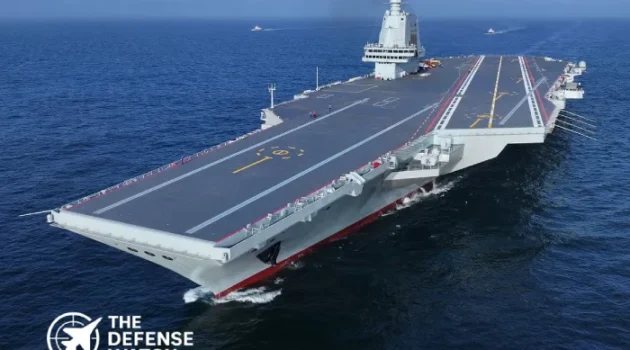
China’s newest aircraft carrier, the Fujian (hull number 18), has officially entered service with the People’s Liberation Army Navy, equipped with a domestic electromagnetic aircraft launch system that represents a significant milestone in China’s naval aviation development. The event took place at a commissioning ceremony in early November 2025 at the Yulin Naval Base in Hainan Province.
New Era in Chinese Naval Aviation
The Fujian is China’s third aircraft carrier and its first to use electromagnetic catapults for aircraft launch and recovery. The carrier displaces more than 80,000 tonnes and features a flat-deck design that departs from the ski-jump approach used on China’s first two carriers, the Liaoning and Shandong. Unlike steam-powered systems, electromagnetic launch systems use electrical drives to accelerate aircraft along the flight deck.
State media report that the Chinese navy has successfully completed initial training using the electromagnetic catapults and new arresting gear systems. This training saw carrier-borne aircraft including the Shenyang J-15T fighters, the new J-35 stealth fighter, and the KJ-600 airborne early warning aircraft complete takeoff and landing cycles.
Electromagnetic Catapult Technology
Electromagnetic aircraft launch systems (EMALS) represent an advanced alternative to steam catapults. They are designed to provide smoother acceleration, improved reliability, and more precise control. China’s system is a domestically developed version of the technology, powered by a medium-voltage direct current integrated power system.
In September 2025 Chinese officials released footage showing J-35 stealth fighters using the EMALS for launch and recovery operations at sea. The J-35 is a fifth-generation stealth fighter adapted for carrier operations with folding wings and reinforced landing gear.
The Fujian’s electromagnetic launch capability allows it to support a broader range of aircraft types with heavier fuel loads and armaments, including early warning aircraft that enhance carrier group situational awareness and command and control.
Strategic and Operational Context
China’s shift to electromagnetic launch systems aligns with its long-term goal of modernizing the People’s Liberation Army Navy (PLAN) and expanding its blue-water capabilities. Electromagnetic launch systems were once exclusive to the U.S. Navy’s new Ford-class carriers. With Fujian now operational, China becomes the second country to field such technology on a carrier.
At the commissioning ceremony, Chinese leaders underscored the Fujian’s role in advancing the PLAN’s broader strategic objectives. Analysts note the carrier increases China’s ability to project air power from the sea and to operate a more capable carrier air wing.
Comparison With Global Carriers
Even with its new technology, the Fujian does have differences compared to the U.S. Navy’s nuclear-powered carriers. The Fujian uses conventional propulsion rather than a nuclear reactor, so its endurance and range are more limited compared with U.S. nuclear carriers capable of nearly unlimited deployment without refueling.
The U.S. Navy operates a larger carrier fleet, but few of its carriers have shown public footage of electromagnetic catapult operations with fifth-generation aircraft. China’s Fujian has publicly showcased J-35 and other aircraft operations with its EMALS, contributing to global interest in its capabilities.
What This Means for Regional Security
Analysts see the successful integration of electromagnetic catapult systems on Fujian as a tangible sign of China’s advancing naval aviation technology. While the carrier still must complete further trials and integration with support ships and training units, its operational status reflects China’s investment in enhancing its maritime force projection.
Regional navies and defense partners will monitor the Fujian’s deployment patterns as the PLAN seeks to extend its operating range beyond the immediate waters around China. This carrier may have implications for operations in the South China Sea, East China Sea, and other strategic maritime areas.
Looking Ahead
The Fujian’s electromagnetic catapults and new generation aircraft operations signal a new chapter for the PLAN’s carrier force. China continues to research and develop future carrier designs, including larger nuclear-powered ships that could carry more aircraft and operate with greater endurance.
As the Fujian transitions from trials to a fully integrated carrier strike group role, global naval watchers will assess how this technology influences carrier aviation norms and operational doctrines.
Get real time update about this post category directly on your device, subscribe now.

7 comments
[…] purchase is designed to ensure that Finland’s F‑35A fighters enter service with a modern beyond‑visual‑range air‑to‑air capability. The AIM‑120D‑3 is the newest export version of the AMRAAM family and will supplement the […]
[…] had planned to begin F-35A deliveries in 2027, with aircraft entering service through 2030. The original plan called for replacing aging McDonnell Douglas F/A-18 Hornets that […]
[…] stated the collaboration supports its vision of digitally enabled submarines, combining traditional naval engineering with software-driven capabilities to improve situational awareness and operational […]
[…] for use under Cloud One. The platform provides infrastructure as a service and platform as a service capabilities, including compute, storage, networking, data analytics, and application […]
[…] planners had considered retrofitting catapults and arrestor gear to expand the carriers’ capabilities. Those options are now being de-emphasized in favor of drones that operate within the existing STOL […]
[…] Ahead of deployment, Commander Naval Colonel İsmail Koç and Executive Officer Major Orkun Turan briefed journalists onboard the submarine. According to the crew, the platform has conducted numerous national and international missions since entering service. […]
[…] details of the France Libre nuclear aircraft carrier, a next-generation platform expected to enter service in the […]