
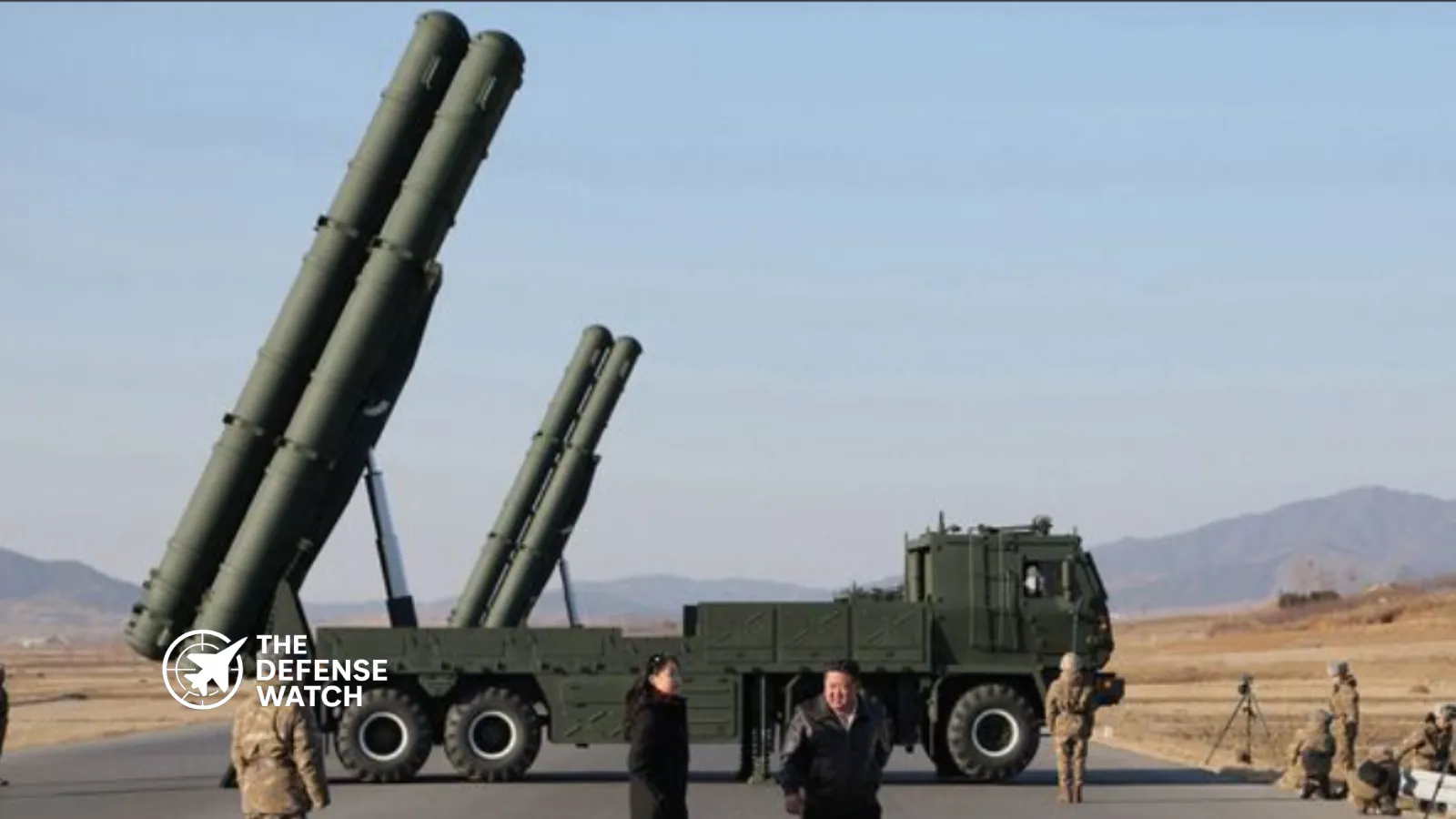
- ► North Korea publicly displayed its 600 mm multiple rocket launchers in new state media footage.
- ► The system is assessed to have long range strike capability, potentially covering much of South Korea.
- ► Analysts note the launcher blurs the line between traditional artillery and short range ballistic missiles.
- ► The display comes amid continued weapons development activity on the Korean Peninsula.
- ► The system reinforces Pyongyang’s emphasis on survivable, mobile strike forces.
North Korea Showcases 600 mm Multiple Rocket Launchers In Renewed Artillery Push
North Korea 600 mm multiple rocket launchers have again been placed in the spotlight, following new imagery and reporting highlighting the system’s operational presence. According to recent state media coverage showed the large caliber launcher system in what appeared to be a demonstration or inspection setting.
The system, often described as a 600 mm multiple rocket launcher, is one of the largest caliber artillery systems fielded globally. While officially categorized as a multiple rocket launcher, analysts widely assess its performance characteristics to overlap with those of short range ballistic missiles.
A Hybrid Between Artillery And Missile Systems
The North Korea 600 mm multiple rocket launchers are typically mounted on heavy wheeled transporter erector launcher vehicles. Each vehicle carries a limited number of oversized rockets, believed to be guided and capable of delivering high explosive or potentially other payloads at extended ranges.
Open source assessments over recent years have indicated that the system may reach ranges in excess of 300 kilometers, placing much of South Korea within coverage depending on launch location. That reach significantly expands the traditional role of tube artillery or conventional multiple rocket systems.
The caliber alone sets the platform apart. At 600 mm, the rockets approach the diameter of some short range ballistic missiles. This has led defense analysts to describe the system as a cost effective way to deliver precision strike capability while remaining within the structural framework of an artillery formation.
Operational Significance For The Korean Peninsula
The renewed attention on North Korea 600 mm multiple rocket launchers underscores Pyongyang’s continued investment in layered strike capabilities. North Korea has long relied on massed artillery positioned near the Demilitarized Zone. However, systems with longer range and mobility complicate defensive planning for both South Korea and United States forces stationed on the peninsula.
Unlike fixed missile silos, mobile rocket launchers are harder to detect and target preemptively. Their deployment enhances survivability in a crisis scenario. From a doctrinal standpoint, the system provides an intermediate option between conventional artillery bombardment and ballistic missile launches.
This layered approach aligns with North Korea’s broader modernization pattern observed over the past decade. Alongside intercontinental ballistic missile testing, Pyongyang has introduced new short and medium range systems designed to penetrate missile defense networks and saturate targets.
Implications For Missile Defense And Regional Stability
The presence of North Korea 600 mm multiple rocket launchers raises important questions for regional missile defense architecture. Systems deployed by South Korea and the United States, including Patriot and other interceptors, are optimized for specific threat profiles. Large caliber guided rockets that follow depressed or quasi ballistic trajectories may stress interception capacity during high volume launches.
While the system does not match the strategic reach of intercontinental platforms, its theater level impact is substantial. It provides North Korea with the ability to hold military infrastructure, air bases, and command centers at risk across a broader geographic area.
From a policy perspective, the system reinforces deterrence signaling. Public displays serve both internal and external audiences. Domestically, they highlight technological progress. Internationally, they communicate continued development despite sanctions and diplomatic pressure.
Technical And Industrial Considerations
The development of a 600 mm multiple rocket launcher reflects sustained industrial capability in large solid fuel rocket production. Precision guidance, if confirmed, suggests incremental advances in navigation and control systems.
Defense experts note that such systems can be produced in greater numbers and at lower cost compared to traditional ballistic missiles. That production dynamic could allow North Korea to field significant inventories over time, increasing salvo size in a potential conflict.
At the same time, questions remain about accuracy under operational conditions, reload rates, and command and control integration. Without independent verification, much of the system’s performance envelope relies on state released imagery and external analysis.
Strategic Context
The timing of renewed coverage of North Korea 600 mm multiple rocket launchers comes amid ongoing regional military activity and continued joint exercises between the United States and South Korea. Artillery and missile modernization on all sides has accelerated in recent years, reflecting heightened threat perceptions.
For defense planners, the system represents a bridge capability. It fills the gap between conventional rocket artillery and more escalatory ballistic missile forces. That flexibility gives Pyongyang additional options in crisis escalation management.
In practical terms, any conflict scenario on the peninsula would likely involve rapid and large scale use of artillery. The introduction of extended range guided rockets complicates defensive calculations and increases the potential depth of strike.
Get real time update about this post category directly on your device, subscribe now.
