
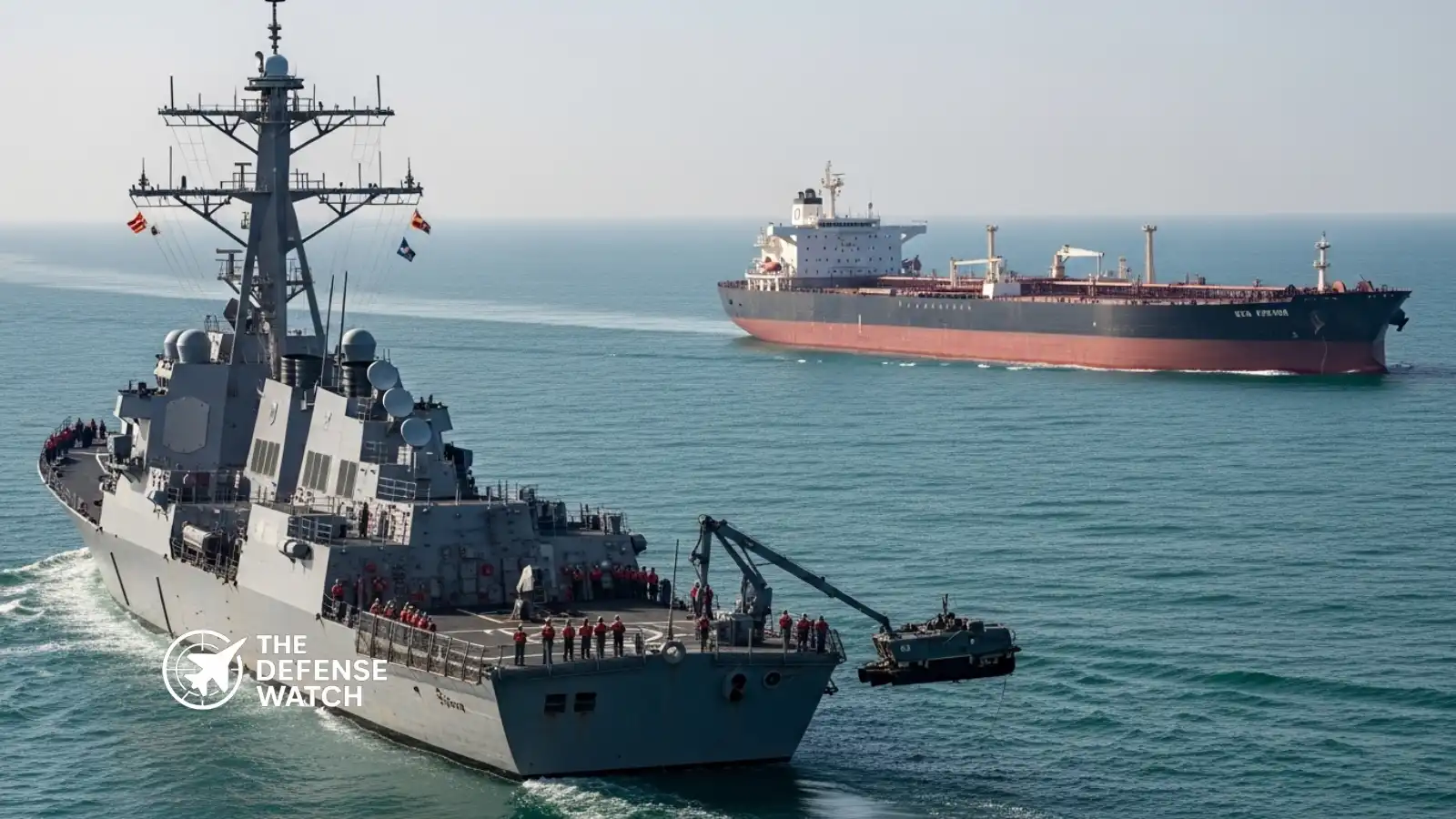
Strait of Hormuz Closure Triggers U.S. Military Campaign and Splits Gulf Oil Revenues
The Strait of Hormuz crisis, now entering its sixth week, has moved beyond an energy market shock and become a direct test of U.S. military power-projection capability in the Persian Gulf. Iran effectively shut the Strait — a route for about a fifth of global oil and LNG flows — after U.S. and Israeli airstrikes on Iran at the end of February led to a widening conflict. The closure’s economic toll has fallen unevenly across the region, exposing deep geographic vulnerabilities among Gulf states while simultaneously handing Iran a lever of strategic leverage it has long sought to exercise.
- Iran effectively closed the Strait of Hormuz following joint U.S.-Israeli airstrikes on Feb. 28, 2026, triggering the largest energy disruption since the 1970s oil crisis.
- Roughly 20 million barrels of oil per day — approximately 20% of global seaborne oil trade — normally transit the Strait, with no full alternative route available.
- Iraq’s oil revenues collapsed 76% to $1.73 billion in March; Kuwait fell 73% — while Saudi Arabia, the UAE, and Iran benefited from higher prices and bypass infrastructure.
- The U.S. Armed Forces launched a military campaign to reopen the Strait on March 19, 2026; Brent crude peaked at $126 per barrel following closure, a record monthly rise of 60% in March.
- The IEA authorized an unprecedented release of 400 million barrels from strategic reserves; the U.S. Department of Energy authorized release of 172 million barrels from the Strategic Petroleum Reserve.
The Big Picture: A Chokepoint Becomes a Weapon
The Strait of Hormuz has long figured in U.S. defense planning as the single most consequential maritime vulnerability in global energy supply. Its strategic importance is not theoretical. Roughly 27% of the world’s maritime trade in crude oil and petroleum products flows through the Strait. No alternative route exists that can fully compensate for its closure. The current crisis has validated decades of Pentagon concern about the waterway’s fragility — and exposed the limits of pre-positioned bypass capacity.
For U.S. Central Command, the Strait’s effective closure since early March represents a direct challenge to freedom of navigation, a foundational principle of American maritime strategy. U.S. President Donald Trump announced his intent to seize control of the Strait of Hormuz on March 9, and on March 19, 2026, the United States Armed Forces began a military campaign to open the strait. The operation marks one of the most consequential direct U.S. military engagements in the Persian Gulf since Operation Earnest Will in 1987-1988.
What’s Happening: Geography Determines Who Wins and Who Loses
The closure has fractured Gulf oil-producing states along stark geographic lines. Although Iran has control over the Strait, Oman, Saudi Arabia, and the United Arab Emirates can bypass it via pipelines and ports. By contrast, oil from Iraq, Kuwait, and Qatar has been trapped, as those countries lack alternative routes to international markets.
Saudi Arabia has leaned heavily on its East-West Crude Oil Pipeline — the Petroline — to redirect exports. The 1,200-kilometer pipeline runs from the Abqaiq oil processing center near the Gulf to the Yanbu port on the Red Sea. As of early 2026, approximately 2 million barrels per day of the pipeline’s capacity was in use, leaving an estimated 3 to 5 million barrels per day of spare capacity, depending on operational conditions.
The UAE has relied on its Habshan-Fujairah pipeline to route crude to the Arabian Sea. UAE oil export values still fell by more than $174 million year-on-year in March, and Fujairah has come under a series of attacks that led to loading halts.
The revenue damage to landlocked exporters has been severe. Iraq’s revenues fell the most, plunging 76% to $1.73 billion. Kuwait was next with a 73% fall to $864 million. Both countries are expected to sustain even steeper declines in April as the partial March relief from early-conflict transits evaporates.
Why It Matters: Energy Warfare as Strategic Coercion
Iran’s closure of the Strait is not simply a reflexive retaliation. It is the most operationally significant act of energy coercion since the 1973 Arab oil embargo — and it has succeeded in generating unprecedented market disruption. Brent crude oil prices surpassed $100 per barrel on March 8, 2026, for the first time in four years, rising to $126 per barrel at its peak, representing a record monthly increase of 60% in March.
A complete cessation of oil exports from the Gulf region amounts to removing close to 20% of global oil supplies from the market, about 80% of which is shipped to Asia. The IEA has described the disruption as the largest to the global oil market since the 1970s energy crisis.
The damage extends well beyond crude oil. About 85% of polyethylene exports from the Middle East move through this route, raising prices for packaging, automotive components, and consumer goods. Up to 30% of internationally traded fertilizers normally transit the Strait, and unlike oil, the fertilizer sector does not have internationally coordinated strategic reserves.
For U.S. defense planners, the crisis underscores a long-recognized vulnerability: the global economy’s dependence on a waterway that is just 21 miles wide at its narrowest point and sits within range of Iranian land-based anti-ship missiles, mines, and fast-attack craft.
Strategic Implications: U.S. Military Action and Its Limits
The March 19 U.S. military campaign to reopen the Strait carries significant operational and political weight. It signals that Washington views freedom of navigation through the Strait as a vital national interest worth defending with force — a posture consistent with decades of U.S. policy but now being tested under live-fire conditions.
The operation faces genuine operational constraints. In the short term, it is possible to escort three to four commercial ships a day with seven to eight destroyers providing air cover, depending on the risk from Iranian midget submarines; however, doing so sustainably for months requires substantially more resources. Iran’s ability to threaten the Strait with asymmetric assets — including mines, suicide drones, and undersea capabilities — means sustained escort operations would tax U.S. naval assets in theater.
Saudi Arabia remains vulnerable to further strikes by Iran or its allies in Yemen against its energy infrastructure and vessels passing through the Bab el-Mandeb Strait to the Red Sea — meaning even successful military action to reopen Hormuz does not eliminate Iran’s capacity to threaten alternative export routes.
Congressional concern has risen in the wake of the February-March 2026 conflict, with potential oversight regarding possible consequences of a Strait closure on world oil and gas prices and related U.S. policy options, including military action or sanctions. The 1987-1988 precedent of Operation Earnest Will — when the U.S. reflagged Kuwaiti tankers and conducted mine-clearing operations — is likely informing current planning, though the threat environment is considerably more sophisticated today.
Competitor View: China, Russia, and the Asian Energy Shock
Beijing is watching the Strait crisis with acute strategic concern. About 80% of the oil removed from global markets by the Gulf closure was destined for Asia. China and India combined received 44% of exports that transited the Strait in 2025. China’s heavy dependence on Persian Gulf crude gives it a powerful economic incentive to see the Strait reopened — but also hands Beijing a diplomatic card: any Chinese role in mediating a resolution would significantly enhance its regional influence at U.S. expense.
Russia, as a major oil exporter, has benefited indirectly from the price spike. Higher global oil revenues offset some of the pressure from Western sanctions, and a prolonged Strait closure serves Moscow’s interest in sustained energy market disruption. Russian analysts are likely assessing U.S. naval commitments in the Gulf for what they reveal about available assets for contingencies elsewhere, including in the Indo-Pacific.
Iran’s calculus, meanwhile, reflects a calculated risk. An Iranian official told Reuters that Iran would not open the Strait as part of a temporary ceasefire, saying it will not be humiliated. Some analysts say the U.S.-Israeli war on Iran has in some ways strengthened Tehran’s position. The regime has demonstrated that the Strait is a credible coercive instrument — and that the costs of closure, while damaging to Iran’s neighbors, are partially offset by higher prices for the oil Iran can still export.
What To Watch Next: Escalation Thresholds and Exit Ramps
Several near-term developments will determine how the crisis resolves. President Trump has set hard diplomatic deadlines for Tehran, threatening severe consequences for non-compliance, but Iran has rejected each ultimatum. The pace of the U.S. military campaign to reopen the Strait will test both American naval capability and Iranian willingness to absorb further strikes on its forces.
The pipeline bypass capacity of Saudi Arabia and the UAE has absorbed some export volume, but the combined capacity of available bypass pipelines is only about 9 million barrels per day, compared with approximately 20 million barrels per day for the Strait — and those pipelines remain within range of Iranian missiles and drones.
The IEA’s reserve release and U.S. Strategic Petroleum Reserve drawdown provide a short-term price cushion. Experts noted that whether the releases help stabilize oil markets depends on how fast the crude can be shipped and how much longer the fighting lasts.
If the Strait remains closed for a second month, traders and analysts expect global energy markets will quickly evolve into a fight for supplies — driving prices higher and forcing significant reductions in consumption. Analysts at the Federal Reserve Bank of Dallas estimate that a sustained second-quarter closure could lower global real GDP growth by an annualized 2.9 percentage points.
Capability Gap: The Limits of Bypass Infrastructure
The crisis has exposed a structural gap in global energy resilience that no amount of naval power can fully close in the near term. The available pipeline bypass capacity for Gulf oil — estimated at 3.5 to 5.5 million barrels per day between Saudi Arabia and the UAE — covers at best roughly a quarter of normal Strait throughput. Qatar has no bypass route at all for its LNG exports. About 93% of Qatar’s and 96% of the UAE’s LNG exports transit through the Strait, representing 19% of global LNG trade
The U.S. military can escort ships and suppress Iranian surface threats, but mine-clearing operations in constricted waters take time and carry significant risk. Iran’s undersea capabilities, including midget submarines and mine-laying assets, present a layered challenge that could extend the operational timeline well beyond initial estimates.
The Bottom Line
The Strait of Hormuz closure has transformed a regional military conflict into a global economic crisis — and the outcome of the U.S. military campaign to reopen it will define both American credibility in the Persian Gulf and the strategic calculus of every major power that depends on seaborne energy flows.
Get real time update about this post category directly on your device, subscribe now.
