
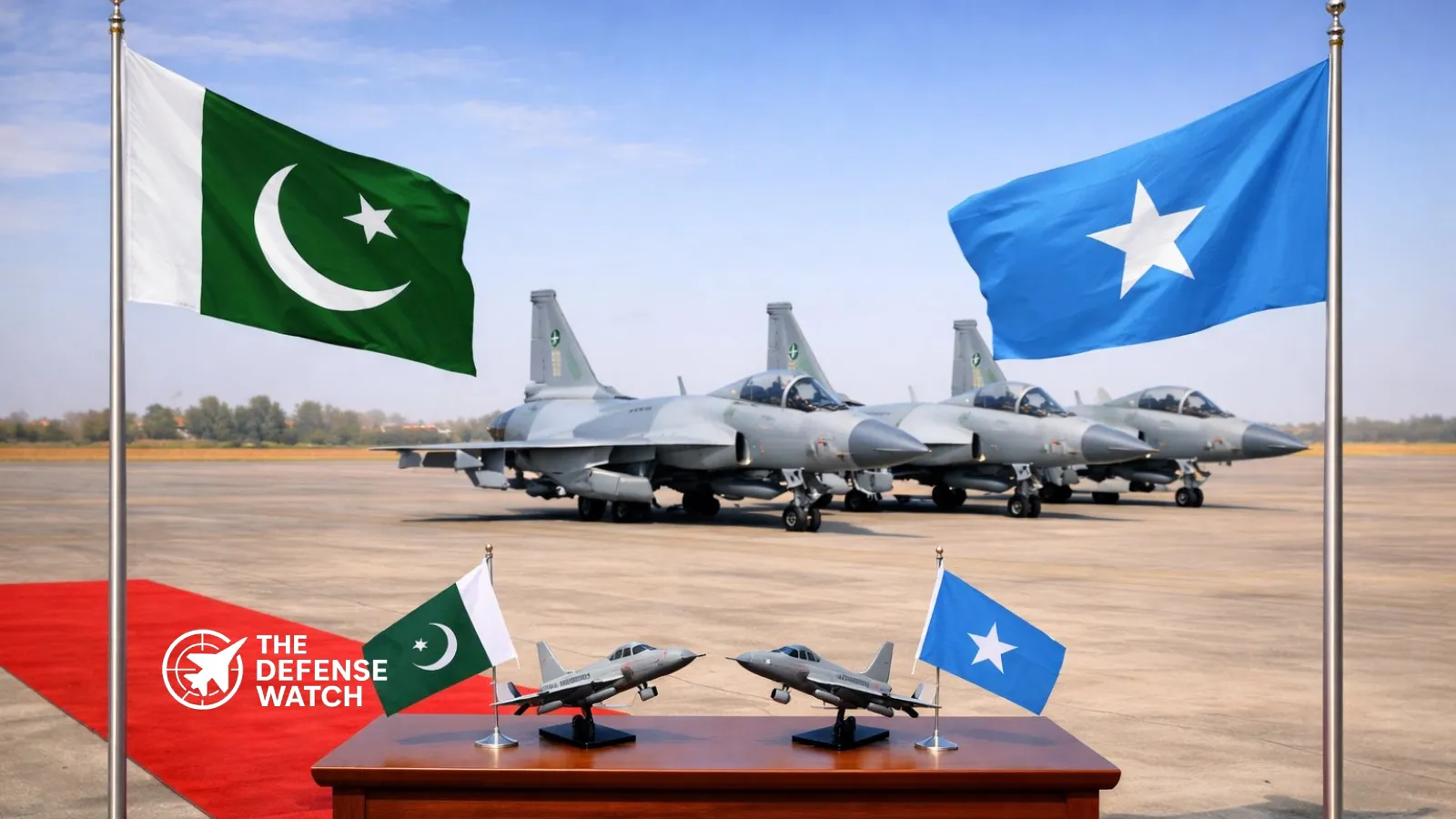
- ► Somalia has reportedly taken delivery of six JF-17 Block III fighter jets from Pakistan.
- ► The aircraft are part of a broader 24 jet defense agreement between Somalia and Pakistan.
- ► Saudi Arabia and Qatar are financing 65 percent of the total cost, with Turkey and Somalia covering the remaining 35 percent.
- ► The delivery marks the first batch under the agreement, with additional aircraft expected in subsequent phases.
- ► The acquisition represents a significant step in Somalia’s military modernization and regional defense cooperation.
Somalia Receives First Six JF-17 Block III Fighter Jets
The JF-17 Block III fighter jets have reportedly entered service with the Government of Somalia following delivery of an initial batch of six aircraft under a broader 24 jet agreement with Pakistan.
Officials familiar with the deal confirmed that the six aircraft represent the first phase of deliveries. The remaining fighters are expected to arrive in subsequent tranches as the agreement progresses.
The aircraft were developed jointly by the Pakistan Aeronautical Complex and China’s Aviation Industry Corporation of China under the JF-17 Thunder program. The latest Block III configuration represents the most advanced production standard of the platform.
Financing Structure Reflects Regional Backing
According to confirmed details tied to the agreement, 65 percent of the total acquisition cost is being financed jointly by Saudi Arabia and Qatar, with each government contributing 32.5 percent. The remaining 35 percent is shared between Turkey and Somalia, with both covering 17.5 percent.
The payment schedule reportedly requires Somalia to meet its financial obligations by April under terms set by partner nations.
The financing arrangement signals broader regional support for Somalia’s security sector reform efforts. It also highlights how defense partnerships are increasingly structured through multilateral funding mechanisms rather than direct bilateral transfers alone.
Capabilities Of The JF-17 Block III
The JF-17 Block III fighter jets incorporate several upgrades over earlier variants. The aircraft features an active electronically scanned array radar, an advanced electronic warfare suite, improved avionics, and enhanced data link capabilities.
Defense analysts note that these improvements significantly expand situational awareness, beyond visual range engagement capability, and network centric operations compared to legacy fighters commonly operated by developing air forces.
The Block III configuration is positioned as a cost effective multirole platform capable of air to air, air to ground, and maritime strike missions. For Somalia, this represents a substantial capability leap from its historically limited fixed wing combat aviation inventory.
Strategic Implications For Somalia
The introduction of JF-17 Block III fighter jets marks a major milestone in Somalia’s long term military modernization trajectory.
For decades, Somalia’s air force capabilities remained minimal due to prolonged instability and limited defense investment. The acquisition of 24 advanced multirole fighters, once fully delivered, could significantly alter the country’s air defense posture.
However, operational effectiveness will depend on pilot training, sustainment infrastructure, maintenance capacity, and integration into a broader command and control network. Aircraft procurement alone does not automatically translate into deterrence or air superiority.
Analysts also point out that building a sustainable logistics pipeline for advanced fighters requires stable funding, technical expertise, and long term institutional development.
Pakistan’s Expanding Defense Exports
The delivery underscores Pakistan’s ongoing efforts to expand defense exports, particularly the JF-17 program. The aircraft has previously been exported to countries including Myanmar and Nigeria.
By securing a 24 aircraft agreement with Somalia, Pakistan strengthens its footprint in Africa’s defense market. The financing model involving Gulf partners further demonstrates how defense exports can align with broader geopolitical interests.
Regional Security Context
Somalia continues to face internal security challenges and evolving regional dynamics in the Horn of Africa. Strengthening air capabilities may enhance surveillance, rapid response, and deterrence roles within national borders.
At the same time, the acquisition reflects deepening security ties between Somalia and partner nations including Saudi Arabia, Qatar, and Turkey, all of which maintain varying levels of political and security engagement in the region.
While the long term impact will depend on implementation and sustainment, the arrival of the first six JF-17 Block III fighter jets signals a clear shift toward rebuilding Somalia’s conventional military capacity.
If the remaining 18 aircraft are delivered as planned, Somalia will field one of the more modern fighter fleets in its immediate neighborhood, fundamentally reshaping its airpower profile.
Get real time update about this post category directly on your device, subscribe now.


