
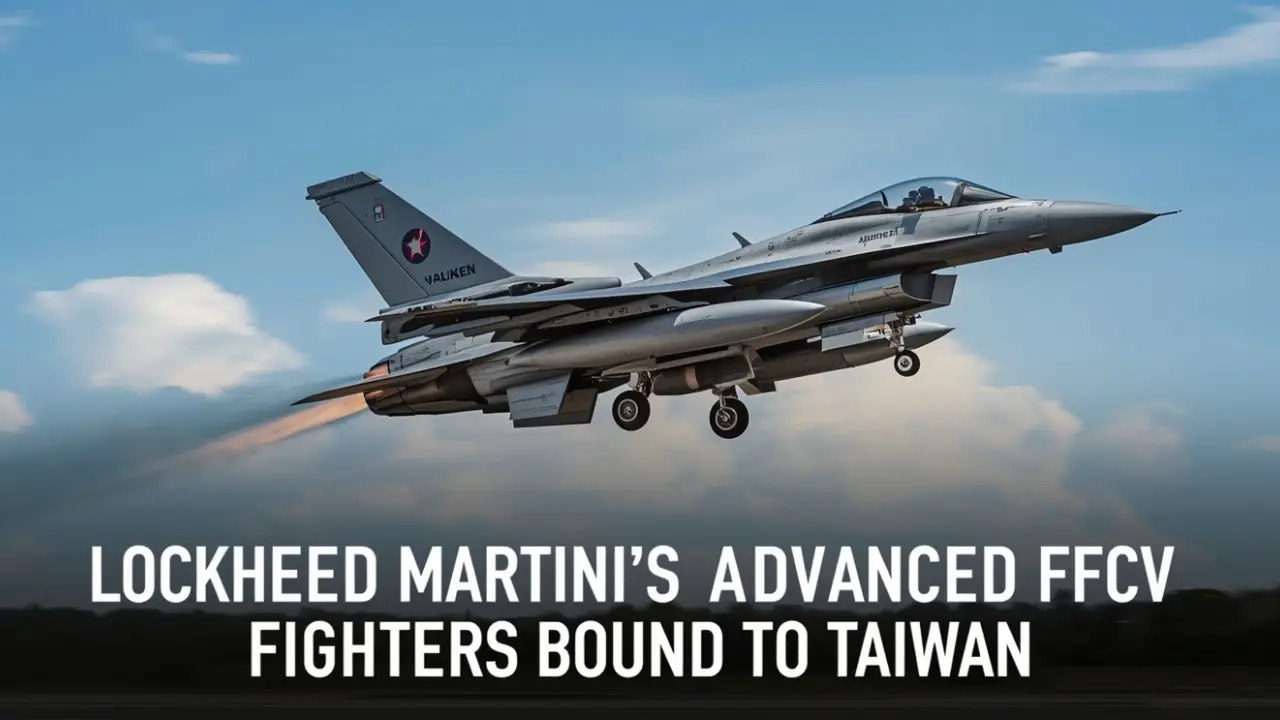
Lockheed Martin Speeds Up F-16 Deliveries to Taiwan
Lockheed Martin is accelerating the production and delivery of F-16V fighter jets to Taiwan, following delays caused by supply chain disruptions and parts shortages, according to a Reuters report on November 4, 2025. The move comes as Washington and Taipei intensify cooperation to enhance Taiwan’s air defense capabilities amid escalating tensions in the Taiwan Strait.
The U.S. defense contractor confirmed it is “working closely with the U.S. government” to meet revised delivery timelines for the advanced F-16 Block 70 aircraft. The jets, equipped with modern radar, avionics, and weapons systems, are intended to replace Taiwan’s aging fleet and improve its deterrence against potential Chinese military aggression.
Background: Taiwan’s Largest Fighter Jet Purchase in Decades
Taiwan signed a deal in 2019 to purchase 66 F-16V Block 70/72 aircraft from the United States for approximately $8 billion, marking the island’s largest fighter acquisition in three decades. The new variant features the APG-83 AESA radar, advanced mission computers, improved electronic warfare suites, and compatibility with U.S. precision-guided munitions.
Lockheed Martin manufactures the F-16V at its Greenville, South Carolina facility — the only active F-16 production line worldwide. However, pandemic-era disruptions and global supply shortages, particularly in microelectronics and avionics components, delayed output across several international orders, including those for Bahrain, Slovakia, Bulgaria, and Taiwan.
F-16V Viper Fighter Jet – Full Specifications
- Generation: 4.5
- Maximum Speed: Mach 2.0
- No. of Engines: 1
- Radar Range: 160+ km
U.S. Support and Strategic Implications
The U.S. Department of Defense has reportedly coordinated with Lockheed Martin to streamline production bottlenecks and allocate key resources to prioritize Taiwan’s deliveries. This decision aligns with Washington’s broader Indo-Pacific defense strategy, which emphasizes strengthening the military readiness of regional partners in the face of expanding Chinese power projection.
A Pentagon spokesperson noted that “timely delivery of defense systems to Taiwan remains a top priority for maintaining stability and deterrence in the region.”
The F-16V’s integration into Taiwan’s Air Force will significantly enhance its operational flexibility. The aircraft’s data link systems allow interoperability with U.S. and allied forces, while its beyond-visual-range (BVR) missile capability extends Taiwan’s air combat reach over the Strait.
The F-16V: A Strategic Bridge Between Legacy and Stealth
The F-16V, often regarded as a 4.5-generation fighter, bridges the gap between older legacy jets and fifth-generation stealth fighters like the F-35. Though less stealthy, the F-16V’s advanced radar and targeting systems enable it to detect and engage threats earlier, making it a cost-effective and versatile asset for small and medium-sized air forces.
Compared to China’s J-10C and J-16 fighters, the F-16V offers improved radar performance and sensor fusion, though it remains outmatched by China’s J-20 stealth fighter in stealth and range. Nevertheless, analysts argue that in Taiwan’s defensive context—focused on denial rather than air superiority—the F-16V remains highly effective.
Analysis: Strengthening Taiwan’s Deterrence and U.S. Industrial Posture
Lockheed Martin’s decision to accelerate F-16V deliveries carries implications beyond Taiwan’s defense posture. It reflects Washington’s determination to maintain supply chain resilience in critical defense production and to demonstrate reliability to allies amid global competition.
This development also underscores the revitalization of the F-16 production line, which continues to generate export orders despite the global shift toward stealth platforms. For the U.S. defense industry, it highlights the balancing act between meeting international commitments and managing domestic priorities such as F-35 production and next-generation fighter programs.
For Taiwan, early receipt of the jets will bolster its readiness as Chinese air incursions near its air defense identification zone (ADIZ) become more frequent. The enhanced air fleet will improve both survivability and response speed in crisis scenarios.
Conclusion: A Critical Step in Indo-Pacific Defense Readiness
Lockheed Martin’s accelerated F-16V delivery schedule marks a pivotal moment in U.S.-Taiwan defense cooperation. Beyond addressing logistical setbacks, it sends a clear signal of Washington’s resolve to support Taipei’s defense modernization amid growing regional challenges.
As production ramps up through 2026, the delivery of these aircraft will likely strengthen Taiwan’s air deterrence and deepen U.S. industrial engagement in Indo-Pacific security. The move also reaffirms the enduring relevance of the F-16 platform in a rapidly evolving global air combat landscape.
Get real time update about this post category directly on your device, subscribe now.

11 comments
[…] Its investment in Firehawk reflects South Korea’s strategic aim to strengthen cooperation with U.S. defense startups specializing in propulsion and hypersonic […]
[…] U.S. defense planners, the YJ-1000 serves as a reminder that China’s airpower modernization is accelerating on […]
[…] sourcing specialized metals, avionics chips, and radar components, forcing prime contractors like Lockheed Martin, Boeing, and BAE Systems to revise delivery […]
[…] on Western suppliers and shifting job- and production-flows towards the Indo-Pacific region. For U.S. defense firms engaged in India, this means increased competition but also partnership opportunities — […]
[…] Tokyo’s more pointed rhetoric—highlighting the proximity of Taiwan, the importance of tech supply chains (particularly semiconductors) and the risk to Japan’s own security—signals that Japan may deem interference with Taiwan as having a material impact on its national security. […]
[…] years, U.S. defense leaders, congressional committees, and military commanders have expressed concerns that the […]
[…] policies. The work stoppage quickly scaled into one of the longest labor disruptions in the modern U.S. defense sector, halting production lines at a time when the Pentagon is pushing to accelerate aircraft […]
[…] depends on appropriations and follow through. They note that Washington must balance support to Taiwan with competing global […]
Can you be more specific about the content of your article? After reading it, I still have some doubts. Hope you can help me.
[…] lessons learned from recent conflicts, including Russia’s invasion of Ukraine and evolving tensions in the Taiwan Strait. The strategy emphasizes distributed operations, resilient logistics networks, and expeditionary […]
[…] terms, the report warns that submarines sold to Canberra might not be available for fighting in a Taiwan Strait crisis if Canberra chooses not to commit […]