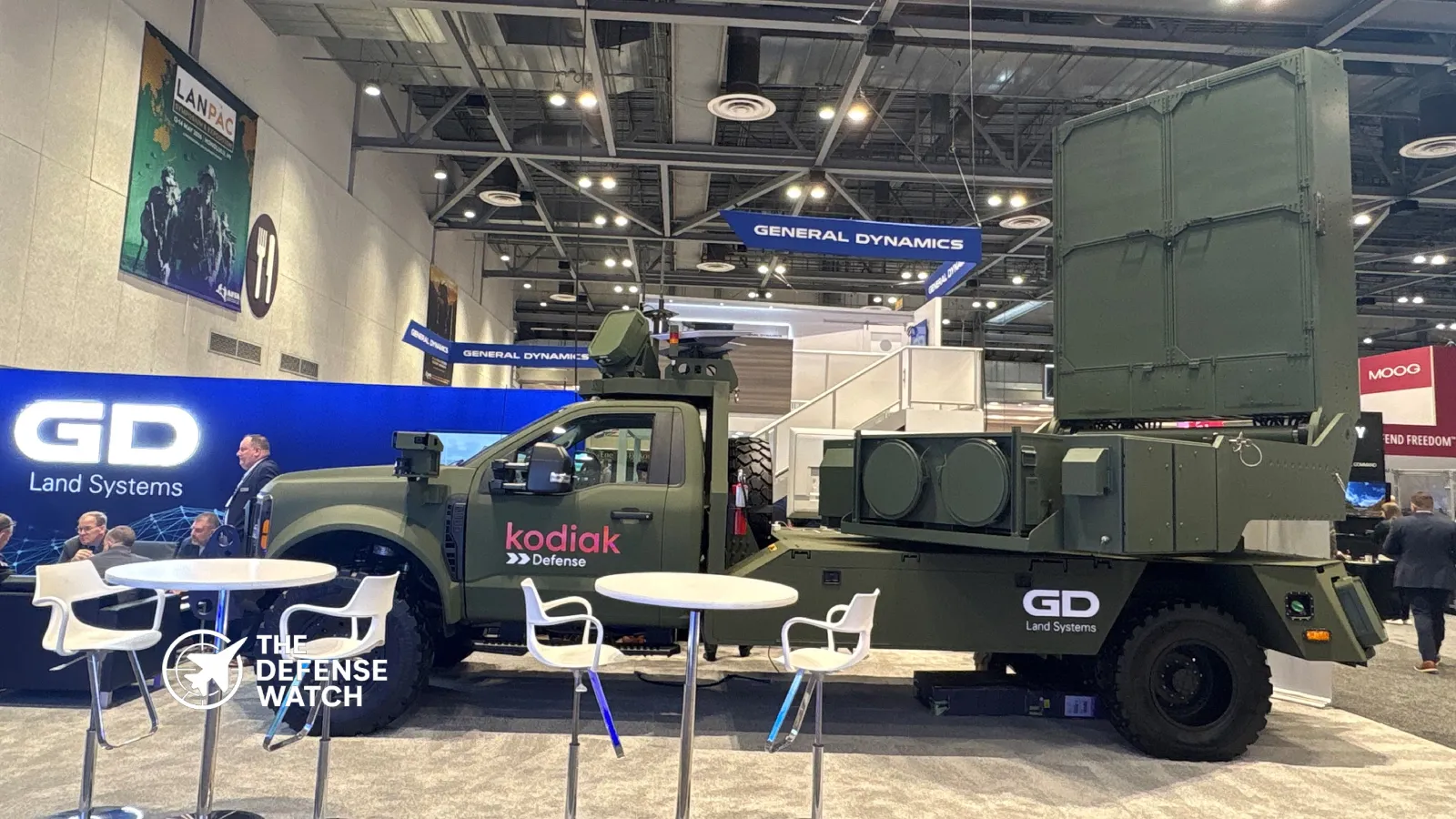
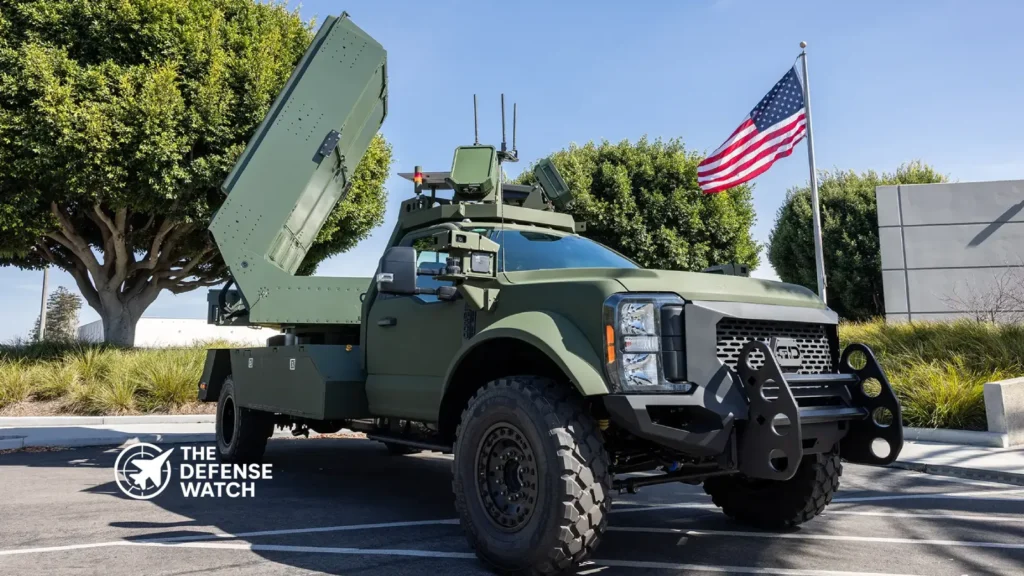
- ► General Dynamics Land Systems partnered with Epirus and Kodiak AI to unveil an autonomous HPM counter-UAS system.
- ► The system integrates high-power microwave technology to disable drone swarms without kinetic interceptors.
- ► Autonomous driving capability enables unmanned operation in contested or high-risk environments.
- ► Designed to counter growing UAV threats across military bases, maneuver forces, and critical infrastructure.
- ► Reflects broader U.S. shift toward scalable, non-kinetic, and autonomous air defense solutions.
Autonomous HPM Counter-UAS System Marks Shift In Drone Defense
The autonomous HPM counter-UAS system unveiled by General Dynamics Land Systems in partnership with Epirus and Kodiak AI represents a significant step in the evolution of counter-drone warfare.
Announced via official company release, the system combines high-power microwave technology with autonomous mobility, aiming to address the rapid proliferation of small unmanned aerial systems across modern battlefields.
Unlike traditional air defense systems that rely on missiles or guns, this platform uses directed energy to disrupt or disable drone electronics at scale. That approach reduces cost per engagement and avoids the logistical burden of interceptors.
Directed Energy Meets Autonomous Mobility
At the core of the system is Epirus’ high-power microwave capability, designed to neutralize multiple drones simultaneously. This is particularly relevant as militaries face increasingly complex drone swarm threats, where conventional defenses can be overwhelmed.
The integration of autonomy from Kodiak AI allows the platform to operate without a human driver. This enables deployment in high-risk or forward areas while reducing personnel exposure.
General Dynamics Land Systems provides the vehicle platform and system integration, leveraging its experience in armored and tactical mobility systems.
The result is a mobile, unmanned counter-UAS asset capable of operating as part of layered air defense networks.
Operational Relevance In Modern Conflicts
The emergence of the autonomous HPM counter-UAS system reflects lessons observed in recent conflicts, where low-cost drones have demonstrated outsized battlefield impact. From reconnaissance to loitering munitions, UAVs now challenge both static bases and maneuver units.
Traditional countermeasures, including kinetic interceptors and electronic warfare, remain effective but face scalability issues. Missile-based systems are costly, while jamming can be limited by spectrum congestion or countermeasures.
High-power microwave systems offer a different approach. By targeting drone electronics directly, they can engage multiple threats in a single pulse, making them well suited for swarm scenarios.
The addition of autonomy further enhances operational flexibility. Unmanned systems can be pre-positioned, remotely supervised, or integrated into broader autonomous force structures.
Strategic Implications For U.S. Defense
The autonomous HPM counter-UAS system aligns with broader U.S. Department of Defense priorities focused on layered air defense and emerging technologies.
Directed energy has long been viewed as a promising solution for countering drones, cruise missiles, and other low-cost threats. Programs across the services continue to explore both laser and microwave-based systems.
This collaboration between industry players highlights a trend toward modular, rapidly deployable solutions. By combining existing technologies, companies can accelerate fielding timelines compared to traditional acquisition programs.
There is also a clear emphasis on autonomy. As the U.S. military moves toward distributed operations, autonomous systems are expected to play a larger role in force protection and logistics.
Industry Collaboration And Technology Integration
The partnership between General Dynamics Land Systems, Epirus, and Kodiak AI reflects increasing convergence between defense primes and technology firms.
Epirus has focused on scalable directed energy solutions tailored for counter-UAS missions. Kodiak AI brings commercial autonomous driving expertise, adapted for military applications. General Dynamics integrates these capabilities into a deployable platform.
Such collaborations are becoming more common as defense programs seek to incorporate commercial innovation, particularly in areas like artificial intelligence and autonomy.
Outlook For Counter-UAS Systems
The introduction of the autonomous HPM counter-UAS system underscores the growing importance of non-kinetic solutions in air defense.
As drone threats continue to evolve, militaries are likely to adopt a mix of kinetic and non-kinetic systems to ensure resilience. High-power microwave systems offer a scalable option, especially against massed or low-cost threats.
While operational deployment timelines were not disclosed, the system reflects a clear direction in U.S. and allied defense planning.
Future developments will likely focus on improving range, power efficiency, and integration with command-and-control networks.
Get real time update about this post category directly on your device, subscribe now.