
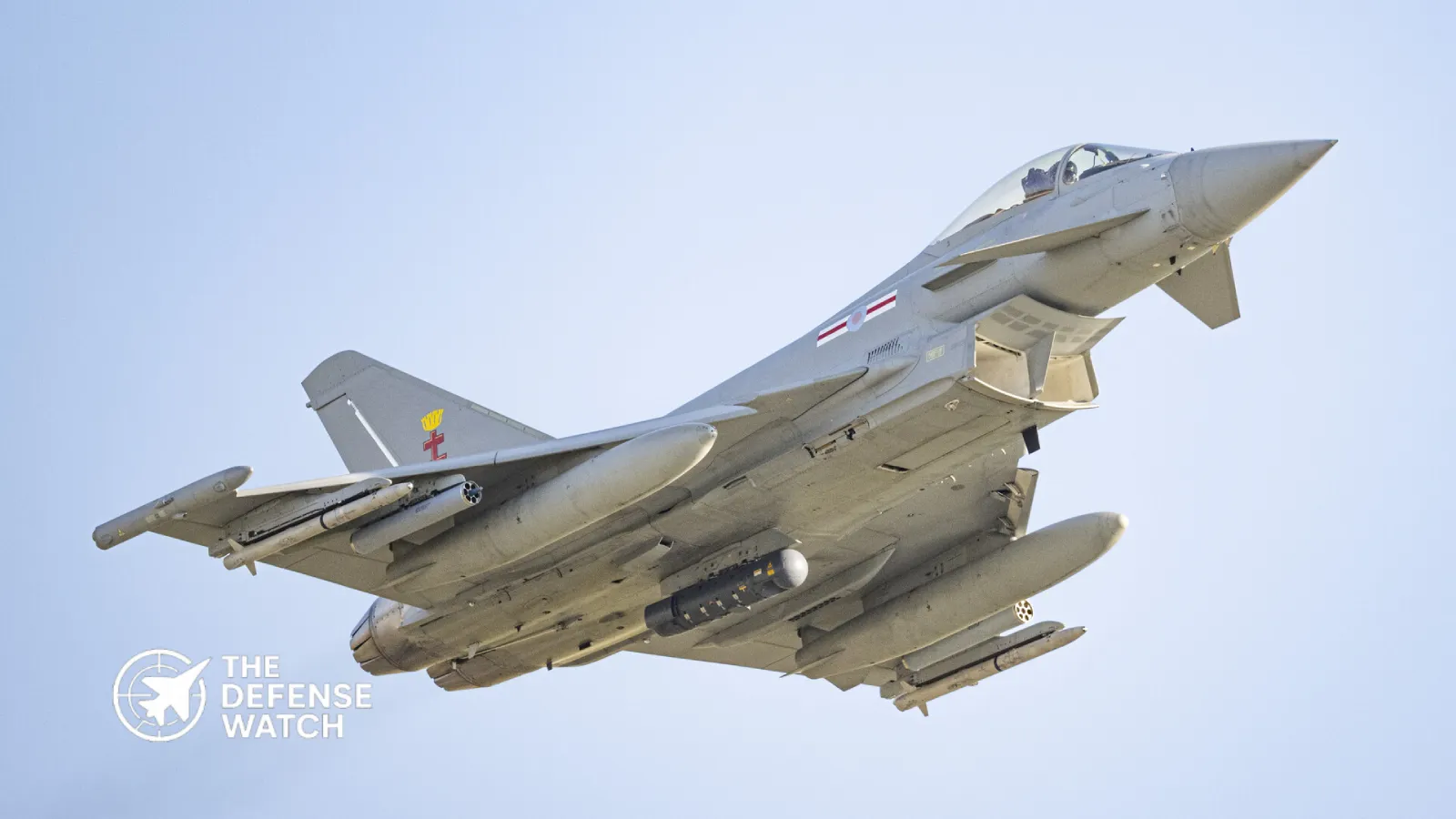
RAF Tests Low Cost Typhoon Weapon Against Drone Threats
The Typhoon low cost weapon test marks a significant step in adapting modern fighter aircraft to counter the growing threat posed by unmanned aerial systems, according to reporting from UK Defence Journal.
The Royal Air Force has conducted trials of a new low cost weapon integrated onto the Eurofighter Typhoon, aimed specifically at defeating drones in a more cost effective manner. The initiative reflects a broader shift across Western air forces, which are increasingly seeking scalable solutions to counter large numbers of low cost aerial threats.
Unlike traditional air to air missiles, which can cost hundreds of thousands or even millions of dollars per shot, the new system is designed to provide a more economical option when engaging relatively inexpensive drones.
- The RAF has tested a new low cost weapon on the Typhoon to counter emerging drone threats.
- The system is designed to provide an affordable alternative to expensive air to air missiles.
- The test reflects growing concern over mass drone attacks in modern conflicts.
- Typhoon’s integration highlights a shift toward scalable and sustainable air defense solutions.
- The development aligns with broader Western efforts to adapt fighter aircraft to counter UAV swarms.
Addressing The Cost Imbalance In Air Combat
One of the central challenges in modern air defense is the cost imbalance between offensive and defensive systems. Adversaries can deploy large numbers of low cost drones, forcing defenders to expend high value munitions to neutralize them.
The Typhoon low cost weapon test directly addresses this issue. By equipping frontline fighters with cheaper intercept options, the RAF aims to preserve its high end missile inventory for more advanced threats such as enemy aircraft or cruise missiles.
This approach has become increasingly relevant following recent conflicts where drone swarms have overwhelmed traditional air defense systems. Lessons from Ukraine and the Middle East have underscored the need for layered, cost efficient responses.
Expanding Typhoon’s Operational Role
The integration of a low cost weapon also expands the operational flexibility of the Typhoon platform. Traditionally optimized for air superiority and strike missions, the aircraft is now being adapted for persistent counter drone operations.
This evolution reflects a broader trend in airpower doctrine. Fighters are no longer limited to high intensity engagements against peer adversaries. Instead, they are expected to operate across a spectrum of threats, including irregular and asymmetric challenges.
By incorporating affordable interceptors, the Typhoon can remain on station longer and engage multiple targets without rapidly depleting expensive munitions. This is particularly important in scenarios involving sustained drone activity.
Strategic Implications For NATO Air Forces
The Typhoon low cost weapon test has implications beyond the United Kingdom. NATO air forces are facing similar challenges, especially as drone proliferation accelerates across multiple regions.
Developing cost effective countermeasures is becoming a priority. High end systems alone are not sufficient to address the volume and diversity of modern aerial threats. Instead, a layered approach combining advanced missiles, electronic warfare, and low cost interceptors is emerging as the preferred model.
The RAF’s effort could serve as a template for other operators of the Typhoon and similar aircraft. If successfully fielded, the system may be adopted more widely across allied fleets.
Industry And Technology Considerations
While specific technical details of the low cost weapon remain limited, the concept aligns with ongoing industry efforts to develop modular, adaptable munitions. These systems often emphasize reduced unit cost, simplified guidance, and rapid production.
The focus is not necessarily on achieving the same performance as high end missiles, but rather on delivering sufficient capability against lower tier threats. This trade off is increasingly seen as acceptable given the operational context.
Additionally, integrating such weapons onto existing platforms like the Typhoon avoids the need for entirely new systems, accelerating deployment timelines and reducing overall costs.
Analysis: A Shift Toward Sustainable Air Defense
The Typhoon low cost weapon test highlights a broader transformation in air warfare. The emphasis is shifting from purely technological superiority to sustainable combat operations.
Air forces must now consider not only whether they can defeat a threat, but whether they can do so repeatedly and affordably over time. This is especially critical in prolonged conflicts where resupply and production capacity become decisive factors.
In this context, low cost weapons are not just a tactical innovation. They represent a strategic necessity. By enabling fighters to counter drones without exhausting high value munitions, they help ensure long term operational resilience.
The RAF’s initiative suggests that future air combat will be defined as much by economics and scalability as by performance.
Get real time update about this post category directly on your device, subscribe now.

