

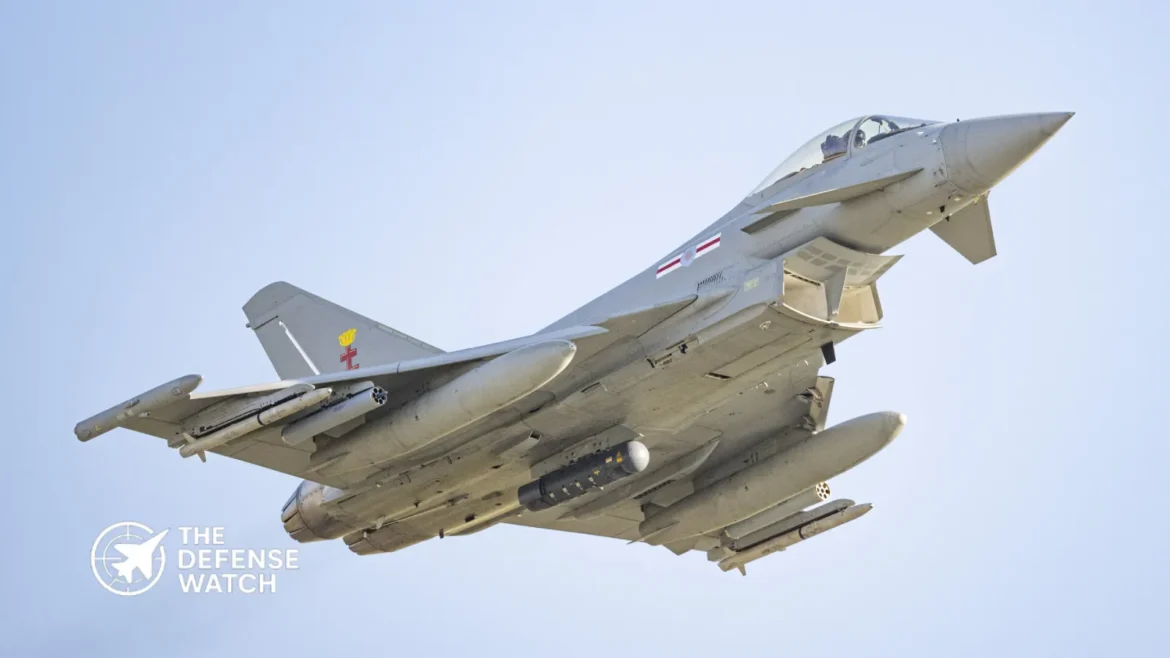
RAF Tests Low Cost Typhoon Weapon Against Drone Threats
The Typhoon low cost weapon test marks a significant step in adapting modern fighter aircraft to counter the growing threat posed by unmanned aerial systems, according to reporting from UK Defence Journal.
The Royal Air Force has conducted trials of a new low cost weapon integrated onto the Eurofighter Typhoon, aimed specifically at defeating drones in a more cost effective manner. The initiative reflects a broader shift across Western air forces, which are increasingly seeking scalable solutions to counter large numbers of low cost aerial threats.
Unlike traditional air to air missiles, which can cost hundreds of thousands or even millions of dollars per shot, the new system is designed to provide a more economical option when engaging relatively inexpensive drones.
- The RAF has tested a new low cost weapon on the Typhoon to counter emerging drone threats.
- The system is designed to provide an affordable alternative to expensive air to air missiles.
- The test reflects growing concern over mass drone attacks in modern conflicts.
- Typhoon’s integration highlights a shift toward scalable and sustainable air defense solutions.
- The development aligns with broader Western efforts to adapt fighter aircraft to counter UAV swarms.
Addressing The Cost Imbalance In Air Combat
One of the central challenges in modern air defense is the cost imbalance between offensive and defensive systems. Adversaries can deploy large numbers of low cost drones, forcing defenders to expend high value munitions to neutralize them.
The Typhoon low cost weapon test directly addresses this issue. By equipping frontline fighters with cheaper intercept options, the RAF aims to preserve its high end missile inventory for more advanced threats such as enemy aircraft or cruise missiles.
This approach has become increasingly relevant following recent conflicts where drone swarms have overwhelmed traditional air defense systems. Lessons from Ukraine and the Middle East have underscored the need for layered, cost efficient responses.
Expanding Typhoon’s Operational Role
The integration of a low cost weapon also expands the operational flexibility of the Typhoon platform. Traditionally optimized for air superiority and strike missions, the aircraft is now being adapted for persistent counter drone operations.
This evolution reflects a broader trend in airpower doctrine. Fighters are no longer limited to high intensity engagements against peer adversaries. Instead, they are expected to operate across a spectrum of threats, including irregular and asymmetric challenges.
By incorporating affordable interceptors, the Typhoon can remain on station longer and engage multiple targets without rapidly depleting expensive munitions. This is particularly important in scenarios involving sustained drone activity.
Strategic Implications For NATO Air Forces
The Typhoon low cost weapon test has implications beyond the United Kingdom. NATO air forces are facing similar challenges, especially as drone proliferation accelerates across multiple regions.
Developing cost effective countermeasures is becoming a priority. High end systems alone are not sufficient to address the volume and diversity of modern aerial threats. Instead, a layered approach combining advanced missiles, electronic warfare, and low cost interceptors is emerging as the preferred model.
The RAF’s effort could serve as a template for other operators of the Typhoon and similar aircraft. If successfully fielded, the system may be adopted more widely across allied fleets.
Industry And Technology Considerations
While specific technical details of the low cost weapon remain limited, the concept aligns with ongoing industry efforts to develop modular, adaptable munitions. These systems often emphasize reduced unit cost, simplified guidance, and rapid production.
The focus is not necessarily on achieving the same performance as high end missiles, but rather on delivering sufficient capability against lower tier threats. This trade off is increasingly seen as acceptable given the operational context.
Additionally, integrating such weapons onto existing platforms like the Typhoon avoids the need for entirely new systems, accelerating deployment timelines and reducing overall costs.
Analysis: A Shift Toward Sustainable Air Defense
The Typhoon low cost weapon test highlights a broader transformation in air warfare. The emphasis is shifting from purely technological superiority to sustainable combat operations.
Air forces must now consider not only whether they can defeat a threat, but whether they can do so repeatedly and affordably over time. This is especially critical in prolonged conflicts where resupply and production capacity become decisive factors.
In this context, low cost weapons are not just a tactical innovation. They represent a strategic necessity. By enabling fighters to counter drones without exhausting high value munitions, they help ensure long term operational resilience.
The RAF’s initiative suggests that future air combat will be defined as much by economics and scalability as by performance.

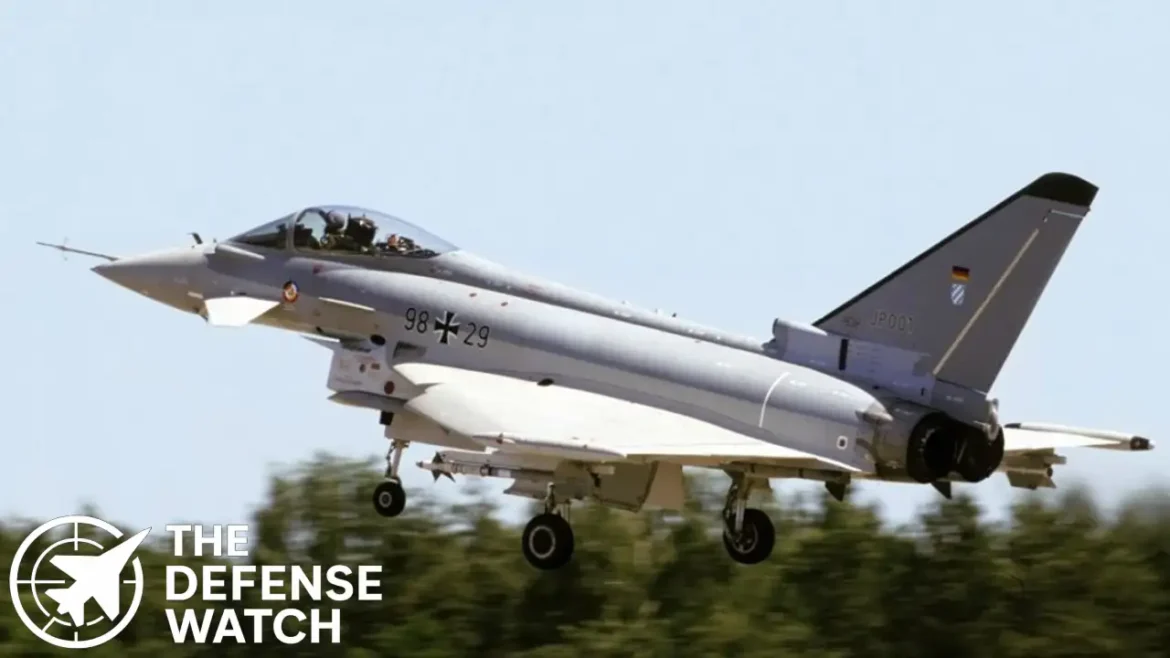
The Eurofighter Typhoon stands as one of Europe’s flagship combat aircraft — a twin-engine, delta-canard, multirole fighter that serves in several NATO and allied air forces, including the Royal Air Force (RAF). In this article, we examine the Typhoon’s origins, its manufacturing consortium, its performance envelope (including “how fast is the Eurofighter Typhoon”), and its operational role within the RAF and beyond.
Historical Development & Consortium Origins
From the Agile Combat Aircraft to European Fighter Aircraft
Efforts to develop a next-generation European fighter began in the early 1980s under the Agile Combat Aircraft (ACA) concept. That later evolved into the European Fighter Aircraft (EFA) program, with initial partners being the UK, Germany, and Italy, before Spain joined in 1985. France withdrew from the project to pursue its own path, eventually producing the Dassault Rafale.
Formal organizational structures followed: in 1986, Eurofighter Jagdflugzeug GmbH was established to manage development and production.
Prototype Flights and Entry into Service
The first development aircraft, DA1, flew on 27 March 1994. Subsequent prototypes (DA2, DA3, etc.) followed, produced by various national contractors across Europe.
In the late 1990s, production contracts were formalized (1997–1998). Between 2003 and 2005, Eurofighter Typhoon aircraft entered service with the four original partner air forces.
Today, the Typhoon continues to evolve, with upgrade paths in avionics, sensors, and weapons integration.
Who Made the Eurofighter Typhoon?
The Consortium Structure
The Typhoon is produced under a multinational joint venture—Eurofighter Jagdflugzeug GmbH. Ownership is divided among major European aerospace firms:
- Airbus Defence & Space (46%)
- BAE Systems (33%)
- Leonardo (21%)
These partners coordinate design, manufacturing, upgrades, and exports. The customer is managed through the NATO Eurofighter and Tornado Management Agency (NETMA), acting on behalf of partner nations.
Engines: EuroJet Consortium
The Typhoon is powered by two Eurojet EJ200 afterburning turbofan engines.
EuroJet Turbo GmbH, formed in 1986, is the consortium responsible for developing, producing, and sustaining the EJ200 engine. Ownership includes Rolls-Royce (UK), MTU Aero Engines (Germany), Avio (Italy), and ITP Aero (Spain).
The choice of the EJ200 was part of broader negotiations among partner nations; interestingly, France’s exit from the joint project coincided with insistence on a French engine, which other partners rejected in favor of the EJ200.
Technical Profile: How Fast Is the Eurofighter Typhoon?
Airframe & Dimensions
- Length: ~15.96 m (52.4 ft)
- Wingspan: ~10.95 m (35.9 ft)
- Height: ~5.28 m (17.3 ft)
- Empty Weight: ~11,000 kg
- Maximum Take-off Weight (MTOW): ~ 23,500 kg
Speed & Altitude
- At altitude, the Typhoon can reach Mach 2.0 (approx. 2,495 km/h) under some conditions according to Eurofighter’s performance materials.
- Some sources state Mach 2.35 for its two engines producing ~150,000 horsepower (though this is a claimed or extrapolated figure)
- At sea-level, maximum speed is lower, roughly Mach 1.25 (≈1,530 km/h) as per manufacturer data.
- Service ceiling: over 16,764 m (≈55,000 ft)
These figures place the Typhoon among the faster fourth-generation fighters, though in practice sustained Mach 2+ flight is constrained by operational limits, fuel, and structural considerations.
Performance Highlights
- The Typhoon has excellent thrust-to-weight characteristics, aided by its relatively light structure and powerful engines.
- It boasts short take-off times: reported < 8 seconds from standstill.
- The aircraft is designed as a swing-role platform, capable of switching between air-to-air and air-to-surface roles in a single sortie.
Role in the RAF & Operational Capabilities
RAF Typhoon (FGR.4)
In RAF service, the Typhoon is designated FGR Mk.4 (Fighter / Ground attack / Reconnaissance). It carries a variety of air-to-air and air-to-ground munitions: ASRAAM, AMRAAM, Meteor, IRIS-T, Storm Shadow, Brimstone, Paveway IV, plus a 27 mm Mauser internal cannon.
The aircraft uses the CAPTOR-E AESA radar, PIRATE FLIR sensor, and PRAETORIAN electronic defensive aids (DASS) subsystems, often leveraging sensor fusion to maximize situational awareness.
In its air policing or QRA (Quick Reaction Alert) role, its rapid climb capability is a major asset — one source claims it can ascend to 11,000 m in just two minutes.
Export & Global Use
Beyond the UK, Typhoon serves in Germany, Italy, Spain, Austria, Saudi Arabia, Oman, Kuwait, and Qatar. Over 600 aircraft have been ordered, with the majority delivered.
Modernization efforts continue, with ongoing upgrades in radar, electronic warfare, weapons integration, and structural life extension programs.
Strategic & Operational Context (Analysis)
Europe’s investment in the Eurofighter Typhoon reflects a commitment to aerospace sovereignty—ensuring that European nations retain control over critical military aviation capabilities rather than relying entirely on external suppliers. The consortium model, though complex, allows burden-sharing across nations and fosters deep industrial cooperation.
Yet the Typhoon faces challenges amid shifting defense priorities. As next-generation technologies emerge (e.g. sixth-generation fighters, unmanned systems), keeping the Typhoon competitive will require sustained investment in upgrades. Its longevity will depend on how effectively it can integrate advanced sensors, networked warfare capabilities, and new weapon systems.
In RAF service, Typhoons remain a key pillar of the UK’s air power, particularly for air policing and intercept missions in European airspace. Their performance envelope and rapid response capability make them effective QRA assets. However, decisions to pair future assets with unmanned systems or to transition toward newer platforms will influence their long-term relevance.
Conclusion
The Eurofighter Typhoon is a remarkable example of European aerospace collaboration—a sleek, capable multirole fighter that combines impressive speed, agility, and weapon flexibility. Built by a consortium of Airbus, BAE Systems, and Leonardo, and powered by the EuroJet EJ200 engines, it remains a backbone of several European air forces, including the RAF.
Despite its maturity, the Typhoon continues to evolve, balancing legacy airframes with modernization to meet future threats. As Europe charts its military aviation path into the coming decades, the Typhoon will remain a critical stepping stone toward next-generation systems.
FAQs
Its top speed at altitude is commonly cited as Mach 2.0 (≈ 2,495 km/h), though some sources claim brief bursts to Mach 2.35 under ideal conditions.
The Typhoon is built by Eurofighter Jagdflugzeug GmbH, a consortium owned by Airbus, BAE Systems, and Leonardo.
It is powered by two EuroJet EJ200 turbofan engines, developed and maintained by EuroJet Turbo GmbH.
In RAF service (as Typhoon FGR.4), it fulfills air-to-air, air-to-ground, and reconnaissance roles, and is routinely used for Quick Reaction Alert (QRA) and air policing tasks.
Its maiden flight occurred on 27 March 1994 (DA1 prototype). The first operational deliveries began in 2003 across the partner air forces.