
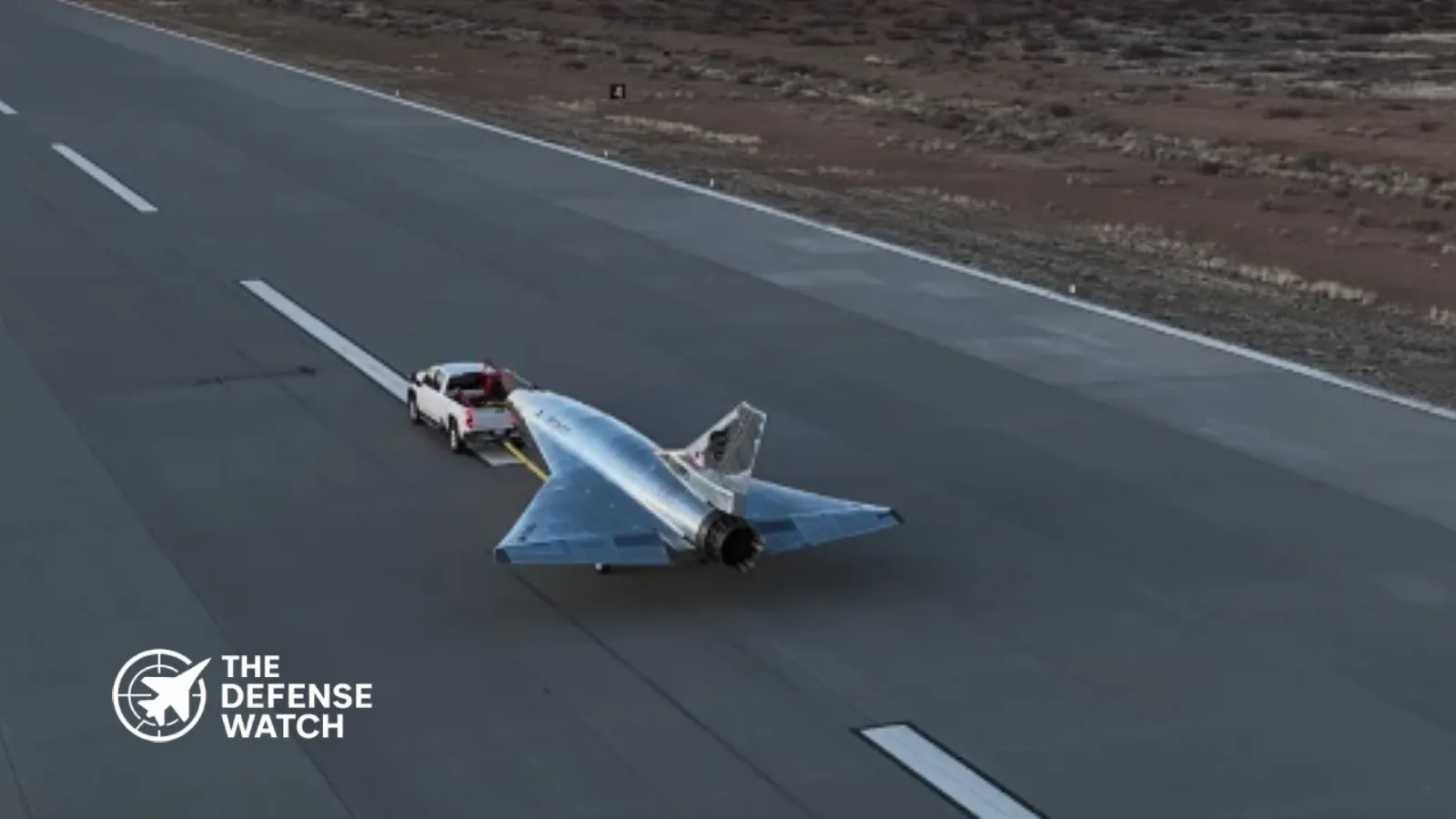
- ► Hermeus flew Quarterhorse Mk 2.1 on March 2, 2026 at Spaceport America, New Mexico — its second aircraft first flight in less than nine months.
- ► Mk 2.1 is roughly the size of an F-16, powered by a Pratt & Whitney F100 engine — approximately three times larger and four times heavier than the Mk 1.
- ► The Mk 2.1 flight kicks off a test campaign aimed at reaching supersonic speeds; the follow-on Mk 2.2 is projected to become the world’s fastest unmanned aircraft.
- ► The U.S. Air Force has backed Hermeus with a $60 million STRATFI contract; the Defense Innovation Unit selected Hermeus for its HyCAT hypersonic flight test program.
- ► The Congressional Research Service has warned that the U.S. is unlikely to field an operational hypersonic weapon system before FY2027 at the earliest.
- ► A former Pentagon senior official has noted China has tested hypersonic flight at roughly ten times the rate of the United States since the late 1960s.
- ► Hermeus CEO AJ Piplica has stated the company expects Quarterhorse to begin supporting Department of Defense test events in 2026, around when its Mk 3 vehicle rolls out.
Hermeus Quarterhorse Mk 2.1 Takes Flight, Pushing U.S. Toward Reusable Supersonic Drone Capability
The Hermeus Quarterhorse Mk 2.1 supersonic drone completed its first flight on March 2, 2026, at Spaceport America over White Sands Missile Range airspace in New Mexico — a milestone that marks the Atlanta-based startup’s second aircraft first flight in under nine months. While the event generated predictable industry applause, the strategic importance of this test runs deeper than any single flight.
For the United States, this flight is less about one company’s momentum and more about whether commercial-pace innovation can solve a systemic problem: America’s chronic inability to generate enough reusable high-speed test capacity to keep pace with China and Russia in the hypersonic domain.
What Actually Flew — and What Comes Next
The Quarterhorse Mk 2.1 is powered by a Pratt & Whitney F100 engine — the same powerplant used in the F-15 and F-16 — and is nearly three times larger and four times heavier than its predecessor, the Mk 1. It was flown remotely from a ground-based flight deck, validating aircraft systems, handling qualities, and operational procedures.
The Mk 1 flew first in May 2025 at Edwards Air Force Base. That initial flight focused on validating Quarterhorse’s ability to take off and land at high speeds — a particular engineering challenge unique to future hypersonic aircraft. Mk 2.1 builds on that foundation by entering what Hermeus describes as its Mk 2 phase: a multi-aircraft series focused on achieving and expanding supersonic flight.
Following Mk 2.1, the next aircraft in the series — Mk 2.2 — is expected to become the world’s fastest unmanned aircraft. Subsequent phases will push toward the company’s ultimate objective: sustained ramjet-powered flight, the propulsion breakthrough required for true hypersonic cruise capability at Mach 5 and beyond.
This matters because the road from supersonic to hypersonic is not linear. Crossing Mach 1 is a precondition, but the engineering leap to Mach 5 involves fundamentally different physics — extreme aerodynamic heating, inlet design, fuel chemistry, and propulsion transitions that cannot be solved on paper or in wind tunnels alone. Real flight data at each speed regime is irreplaceable.
Why the Pentagon Is Watching Closely
The Defense Innovation Unit selected Hermeus under its Hypersonic and High-Cadence Airborne Testing Capabilities program — known as HyCAT — which is designed to leverage commercial technology to increase the Pentagon’s hypersonic flight-testing capacity.
That program exists because the United States has a testing bottleneck problem. The Pentagon’s Test Resource Management Center has begun modernizing facilities and exploring the use of commercial space assets for more frequent hypersonic flight testing, but according to former Pentagon hypersonics official Michael White, progress has been too slow. White, who co-authored a 2025 Atlantic Council report with former Air Force Secretary Deborah Lee James and former Army Secretary Ryan McCarthy, argued that the U.S. needs to leverage commercial innovation more aggressively to break the testing bottleneck.
That bottleneck is not just an inconvenience. A former Pentagon senior official has noted that since the late 1960s, China has tested hypersonic flight at approximately ten times the rate of the United States. In a field where proficiency is earned through accumulated flight hours and failure analysis, that testing disparity compounds over time.
Hermeus CEO AJ Piplica has said the company expects Quarterhorse to begin supporting Department of Defense test events in 2026, around when its Mk 3 vehicle rolls off the line. That timeline, if met, would position Quarterhorse as a commercially operated, reusable hypersonic test bed available to AFRL, DIU, and other defense customers — exactly the kind of infrastructure the Pentagon’s test enterprise currently lacks at scale.
The Industrial Logic: Speed as a Strategic Asset
The most consequential aspect of Hermeus’ program is not any single aircraft — it is the company’s development cadence. Hermeus flew Mk 2.1 within a year of its previous flight campaign, compressing timelines that traditionally take decades into a single development cycle.
This approach runs counter to the dominant model in U.S. defense aviation. Legacy programs — even agile ones — routinely spend five to ten years between major prototype milestones. The causes are familiar: cost-plus contracting incentives, requirements volatility, congressional budget cycles, and industrial base constraints. Hermeus operates outside most of those constraints, using venture capital and fixed-price government partnerships to maintain velocity.
The company’s goal is to build one test vehicle per year, and CEO AJ Piplica has emphasized that refining rapid build-and-fly processes is just as important as the capability demonstrated in any single flight. That philosophy — hardware richness over risk aversion — deliberately mirrors what SpaceX demonstrated in the launch vehicle sector: iterating through failures faster than competitors can iterate through planning cycles.
Hermeus has stated it could manufacture roughly a dozen Mk 2 drones per year in its current Atlanta facility, with the ability to expand if there is a clear demand signal from the Defense Department. That production capacity, modest by legacy standards, is nonetheless significant in the context of reusable high-speed aircraft — a category where operational numbers have historically been measured in single digits.
RTX’s venture capital arm has invested in Hermeus, linking Pratt & Whitney’s F100 engine supply chain directly to the program’s growth. The $60 million AFWERX STRATFI contract, awarded in 2021, was described at the time as one of the most valuable startup contracts of its type ever awarded — a signal that AFRL and the Air Force Life Cycle Management Center viewed the company’s technical approach as credible, not speculative.
Competitive Landscape: Hermeus Is Not Alone
Hermeus is the most publicly visible player in the commercial reusable high-speed aircraft race, but it is not operating in a vacuum. Stratolaunch’s Talon-A vehicle, backed by Ursa Major propulsion, has already demonstrated Mach 5 flight, becoming the first reusable hypersonic test aircraft to reach that threshold in over five decades. The Talon-A flights, conducted in December 2024 and March 2025, were carried aloft by Stratolaunch’s Roc carrier aircraft over the Pacific — marking the United States’ first return to reusable hypersonic flight trials since the X-15 program ended nearly 60 years ago. NewsNation
The two companies occupy different portions of the speed-altitude envelope and serve complementary roles. Talon-A focuses on Mach 5+ regime testing, delivered via air launch. Quarterhorse’s roadmap emphasizes ground-launched, runway-independent operations that more closely replicate the operational profile of future military hypersonic aircraft. The Pentagon benefits from having both approaches in parallel, particularly given the acknowledged weakness in domestic high-speed test infrastructure.
What neither program has yet demonstrated is the full propulsion transition central to hypersonic cruise: the turbine-based combined cycle (TBCC) handoff from turbojet to ramjet operation at speed. That remains Hermeus’ most technically ambitious goal — and the achievement that, if realized, would most directly validate the propulsion architecture for future operational vehicles like the Darkhorse multi-mission drone.
Strategic Assessment
The Testing Bottleneck Is the Real Problem
The United States does not lack hypersonic ambition. The Pentagon has dedicated approximately $1 billion to hypersonic facility modernization from FY2015 to FY2024, and the FY2026 budget request included roughly $3.9 billion for hypersonics research and development. What it lacks is the test cadence to convert that investment into fielded capability at competitive speed.
The Congressional Research Service, in its August 2025 update, noted that U.S. hypersonic weapons programs are unlikely to field operational systems before FY2027 at the earliest — and that limitation stems partly from infrastructure constraints, particularly for simulating Mach 8 and above flight conditions. Hermeus and Stratolaunch both address the lower end of that envelope; the upper range remains dependent on government-owned facilities that are oversubscribed.
Who Benefits
The Air Force Research Laboratory gains a commercially operated, reusable high-speed test bed — reducing per-test costs and increasing test frequency without requiring congressional appropriations for each flight. The Defense Innovation Unit validates its HyCAT investment thesis. Pratt & Whitney secures a development and production relationship in an emerging high-speed aircraft sector. And the broader U.S. defense industrial base gets proof that iterative, commercial development timelines can apply to high-speed aviation, not just satellites and launch vehicles.
Who Is Under Pressure
Legacy prime contractors operating in the hypersonic space face a structural challenge from companies like Hermeus. If a venture-backed startup can build and fly an F-16-class unmanned supersonic aircraft in under a year — at a fraction of traditional program costs — the argument for decade-long, cost-plus hypersonic development programs becomes harder to sustain in congressional budget hearings.
China, meanwhile, is the underlying strategic driver of this entire investment surge. In late September 2025, China conducted a hypersonic ICBM test featuring boost-glide technology and a depressed trajectory, combining maneuverability with stealthy approach vectors that reduce detection windows and complicate interception. Against that threat environment, every additional month of U.S. testing delay carries real strategic cost.
What Happens Next
The Quarterhorse Mk 2.1 test campaign will now push toward supersonic speeds. If successful, the data feeds directly into Mk 2.2 — the aircraft Hermeus says will push toward world record unmanned speed. Mk 3, with the full Chimera II turbine-based combined cycle propulsion system installed, is expected around 2026-2027 and will represent the first attempt to validate the propulsion architecture most critical to operational hypersonic aircraft.
The more important near-term question is whether the Pentagon will issue a program of record for Quarterhorse — or a derivative operational system like Darkhorse. The Department of Defense has not publicly revealed a program of record for a hypersonic aircraft, though it has made several investments in Hermeus as the company develops the Quarterhorse. Without a clear acquisition signal, Hermeus must continue balancing commercial investor expectations against the long acquisition lead times inherent to Pentagon procurement.
The flight on March 2 advances the technical case. The programmatic case still needs to be made — and that argument will be decided not at Spaceport America, but on Capitol Hill and in the Pentagon’s E-Ring.
Get real time update about this post category directly on your device, subscribe now.
