

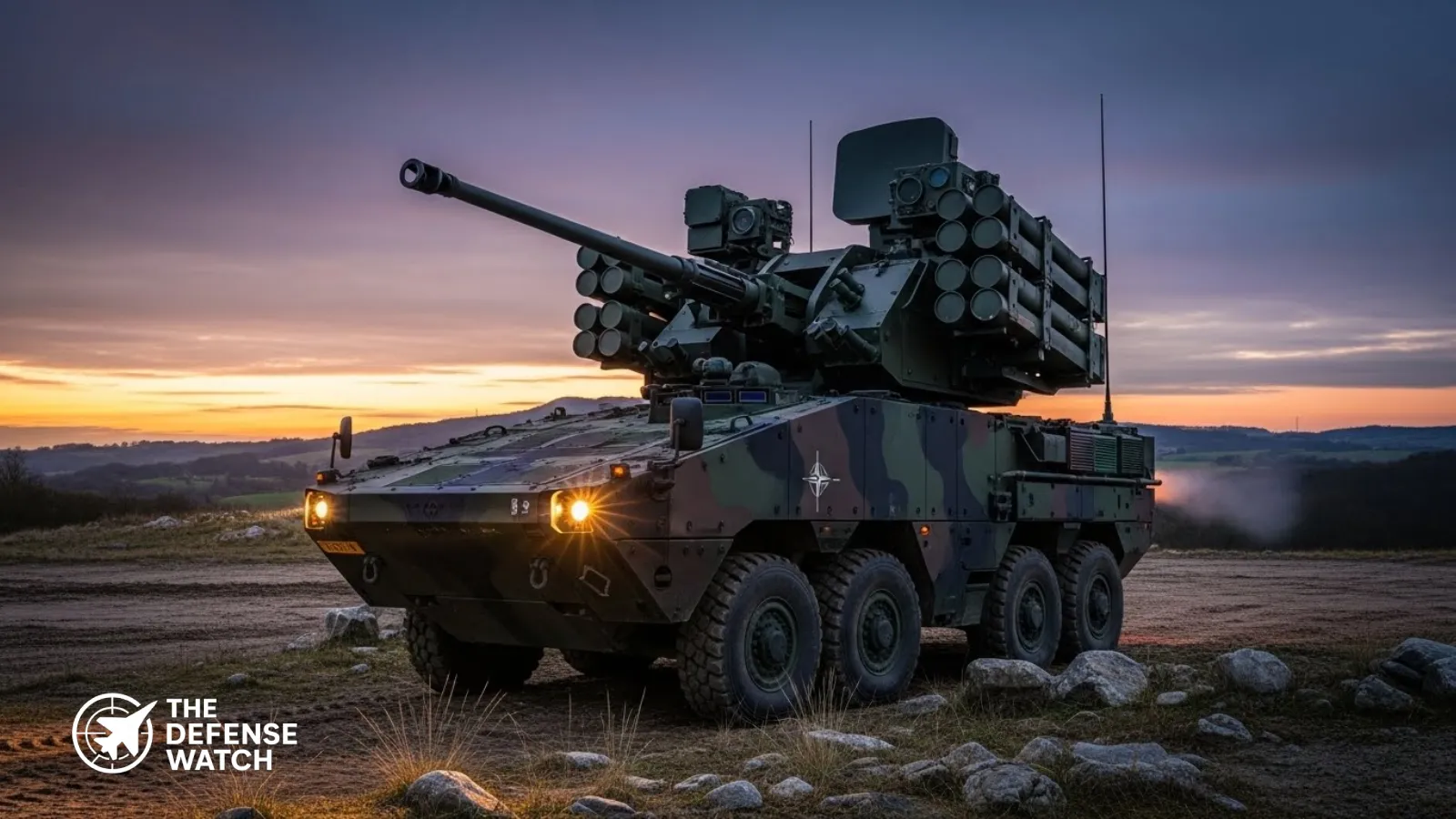
Netherlands Boosts Short-Range Air Defense with Skyranger 30 Anti-Drone Cannons
The Netherlands Ministry of Defense has signed a contract for the purchase of Skyranger 30 anti-drone cannon systems from German defense firm Rheinmetall, with the total value below 1 billion euros, government and industry sources confirmed this week. The deal was finalized on December 12, 2025, in the Netherlands capital region, with deliveries to begin in late 2028 and conclude by the end of 2029.
Context of the Order
The contract forms a central element of the Dutch effort to strengthen its short-range air defense against unmanned aerial threats, including small drones that have become commonplace on modern battlefields. NATO members have accelerated similar procurements in response to lessons learned in conflicts such as the war in Ukraine.
The acquisition will supply both mobile and stationary variants of the Skyranger 30 system. Mobile units will be mounted on tracked platforms suitable for manoeuvring ground forces, while static installations will protect key fixed sites.
Details of the Contract
Under the terms of the contract, Rheinmetall Air Defense will deliver a double-digit number of Skyranger 30 systems to the Dutch armed forces, though exact unit totals have not been officially published. The contract’s value is described as in the high triple-digit million euro range, allowing it to remain under the 1 billion euro figure previously flagged in Dutch parliamentary discussions.
Delivery of the first systems is scheduled for late 2028, with project completion targeted by the end of 2029. The Swiss subsidiary of Rheinmetall will build the first three prototypes, after which serial production and assembly will occur in part at Rheinmetall’s facility in Ede in the Netherlands. Dutch industry participation is expected to include integration, maintenance, and logistical support roles.
The contract includes weapon platforms, tactical control nodes, hook-lift transport platforms for stationary deployment, and full logistics support. It also covers classroom simulators and integration with existing Dutch air defense command structures.
Skyranger 30 System Capabilities
The Skyranger 30 is a short-range air defence system built around a 30 mm revolver cannon capable of firing programmable airburst ammunition. It is designed to engage unmanned aerial vehicles weighing up to 600 kilograms at ranges up to five kilometres. Onboard sensors include radar and electro-optical tracking suites that allow the system to detect, track, and engage low-flying threats.
While the system is principally kinetic in nature, it can also be networked into broader air defense architectures. Its modular design permits installation on various vehicle types or deployment as a static defence point.
Strategic Importance for Dutch Defense
The Dutch Ministry of Defense has said the Skyranger 30 order will complement existing short- and medium-range air defense assets. The systems are expected to protect combat units, critical infrastructure, and key locations such as the port of Rotterdam, Europe’s largest port and a strategic node for military logistics. Ir
State Secretary for Defense Gijs Tuinman previously informed the Dutch parliament that the government planned to acquire 22 units under an earlier budget outline. While the final contract value and configurations differ from those initial estimates, the core aim remains to fill a capability gap in countering drones and other low-altitude threats.
In the interim, the Dutch armed forces are procuring off-the-shelf combat counter-unmanned aerial systems to provide short-term mobile anti-drone capacity ahead of the Skyranger 30’s entry into service. These systems will continue to be used alongside the new platforms.
Industrial and Alliance Implications
The Skyranger 30 order reinforces the Netherlands’ role in European air defense cooperation and underlines Rheinmetall’s position in the gun-based air defense market. Industrial partnerships between Rheinmetall’s Swiss business and the Dutch facility at Ede are expected to benefit local employment and support infrastructure.
Radars and other sensor technologies from European partners, including systems supplied under separate agreements, will enhance the Skyranger’s detection and tracking range, supporting integration into a broader networked air defense posture across NATO.
What’s Next
With deliveries set to start in late 2028, the Netherlands will begin a phased deployment of the Skyranger 30 systems as part of its layered air defense strategy. The capability is expected to strengthen protection for both military forces and critical national infrastructure against the evolving threat of unmanned aerial systems.

8 comments
[…] of five Lynx KF41 infantry fighting vehicles to Ukraine under a contract signed late last year. The order is valued in the mid-double-digit million euro […]
[…] both intelligence gathering and strike missions. The program could lead to a contract worth up to 1 billion euros over 10 years if requirements are […]
[…] 1 (Concept Assessment and Preliminary Design) and Phase 2 (Full Development) would total roughly 6 billion euros. The new submission raises that figure to 18.6 billion euros at 2025 […]
[…] more than the submarine build contract alone, which industry sources estimate at over 10 billion euros. The total value of potential investments could rise sharply depending on partner commitments […]
[…] with the UK variant tied closely to the British Army’s Boxer mechanized infantry vehicle program. Rheinmetall BAE Systems Land, the UK based joint venture, is expected to play a central role in any future production and […]
[…] plans for a freedom tax. The surcharge on income and corporate taxes is expected to raise about 5 billion euros a year for defense. Implementation depends on parliamentary negotiations, as the coalition holds 66 […]
[…] under the Rheinmetall BAE Systems Land partnership, the Challenger 3 program focuses on restoring overmatch against peer adversaries […]
[…] simultaneous deployment coincides with Spain’s F-100 Mid-Life Upgrade Program (MLU), a 3.2 billion euro modernization effort launched in December 2025. The program aims to maintain the frigates’ […]