• Home
  • About
  • Defense Systems
  • Manufacturer
  • Comparisons
  • Compare 
  • Tools
TheDefenseWatch.com
  • Aerospace & Aviation
  • Military & Ordnance
  • Naval & Maritime
  • Cyber & Space Defense
  • Policy & Strategy
  • Global News
  • Tools Library
    • Smart Calculator
    • Drone Flight Time Calculator
    • Drone Range Calculator
    • Counter-Drone Jammer Effective Range Calculator
    • Counter-Battery Radar Detection Calculator
    • Artillery Fire Correction Calculator
    • Thermal Camera Detection Range Calculator
    • Missile Range & Time-of-Flight Calculator
    • Radar Detection Range Calculator
    • FPV Strike Drone Payload vs Range Calculator
    • Loitering Munition Endurance Calculator
    • Sniper Ballistic Drop & Windage Calculator
    • Bullet Drop Calculator
    • U.S. Army Combat Fitness Test (ACFT) Calculator
    • Military Pension Calculator
    • Military Retirement Calculator
    • Military Pension Calculator
    • Large Number Calculator
Font ResizerAa

TheDefenseWatch.com

The Defense Watch | U.S. & Global Defense News, Analysis & Military Updates

Search
  • Home
  • About
  • Defense Systems
  • Manufacturer
  • Comparisons
  • Compare 
  • Tools

Stay Updated

Get the latest update

Subscribe

Explore

  • Drone
  • Fighter Jets & Military Aircraft
  • Hypersonic Weapons
  • Aircraft Carriers
  • Strategic History & Missions
  • Tools Library
Home » US Air Force Launches First Uncrewed Fighter Jets — YFQ-42A and YFQ-44A Begin Flight Testing
Global News

US Air Force Launches First Uncrewed Fighter Jets — YFQ-42A and YFQ-44A Begin Flight Testing

TeamDefenseWatch
Last updated: September 9, 2026 10:20 am
TeamDefenseWatch
Share
2 Min Read
YFQ-42A and YFQ-44A
SHARE

US Air Force Unveils First Uncrewed Fighter Jets in CCA Program

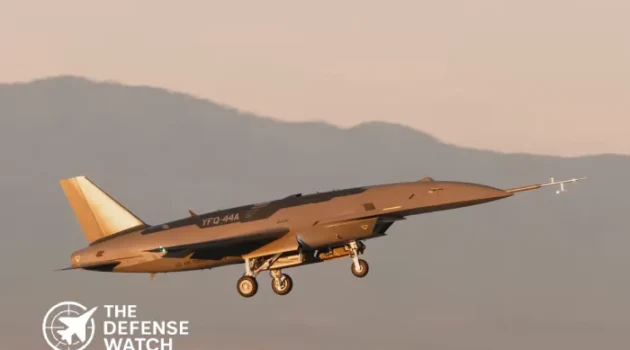
On March 3, 2025 the US Air Force formally designated two jet-powered unmanned fighters — YFQ-42A and YFQ-44A — under its newly launched Collaborative Combat Aircraft (CCA) initiative.

Contents
  • US Air Force Unveils First Uncrewed Fighter Jets in CCA Program
  • Background: An Evolving Vision for Air Combat
  • YFQ-42A and YFQ-44A: What We Know
    • YFQ-42A (General Atomics)
    • YFQ-44A (Anduril “Fury”)
  • What This Means: Redefining Air Combat
  • What’s Next: Testing, Production, Planning
  • Implications

Less than a year later, both prototypes have taken to the skies: YFQ-42A achieved its maiden flight in August 2025, followed by YFQ-44A on October 31, 2025.

Together these jets mark the first time the service has fielded uncrewed platforms with a formal “fighter” designation.

Background: An Evolving Vision for Air Combat

The CCA program emerged as part of the Air Force’s broader push toward the next generation of air dominance, blending human-piloted aircraft with autonomous drones to expand mission flexibility and survivability in contested environments.

- Advertisement -

Under the official US military aircraft designation system, the “Y” prefix denotes prototype status, “F” indicates a fighter mission, and “Q” signals an uncrewed system. Thus YFQ-42A and YFQ-44A are the first uncrewed jets to carry a formal fighter label.

The aim is to complement existing frontline aircraft — such as the F-35 Lightning II — with swarms of lower-cost, high-performance drones that can assume risky roles, extend sensor coverage, conduct electronic warfare or strike missions, and multiply combat mass without putting pilots in danger.

YFQ-42A and YFQ-44A: What We Know

YFQ-42A (General Atomics)

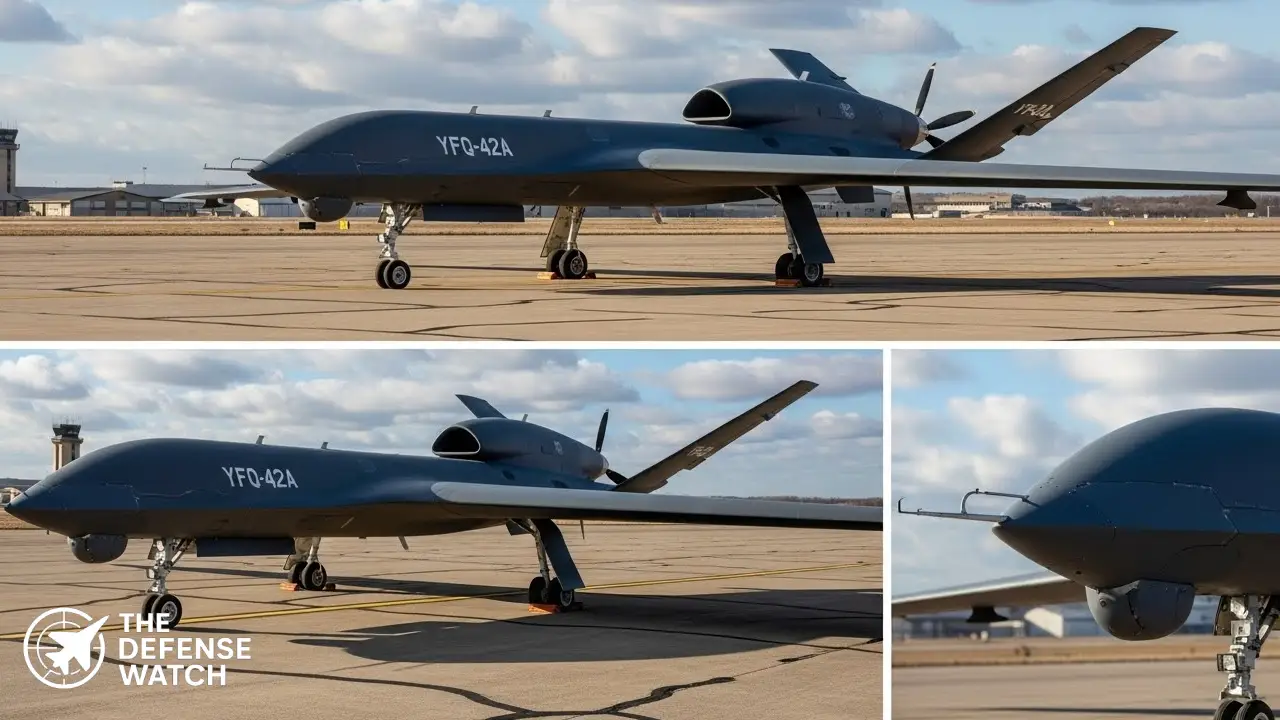
  • Built by General Atomics Aeronautical Systems (GA-ASI), the YFQ-42A traces its roots to the earlier XQ-67A demonstrator from the Air Force Research Laboratory’s Off-Board Sensing Station program.
  • The jet features a stealth-informed design with a streamlined fuselage, dorsal-mounted air intake, and twin canted V-tails. It carries weapons in internal bays — including air-to-air missiles such as the AIM-120 AMRAAM.
  • Its architecture is modular, built to support different mission profiles including air-to-air combat, strike, electronic warfare, and surveillance — depending on payload and configuration.
  • According to GA-ASI, the design provides “affordable mass” — lower unit cost and higher deployability than manned fighters — making it suitable for high-risk missions where attrition is possible.
  • Flight testing kicked off in August 2025 at a classified site in California.
  • YFQ-42A Drone

    YFQ-42A Drone

    • Maximum Speed: Mach 1 class
    • Endurance: 6 to 8 hours
    • Operational Range: 1,500 km
    • Payload Capacity: 1,500 kg
    • View Details →
    8.0

    YFQ-44A (Anduril “Fury”)

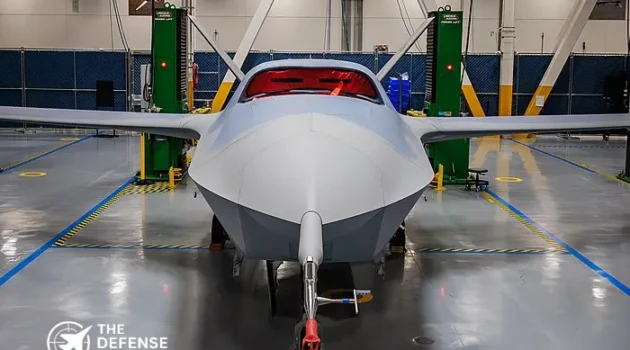
    • Developed by Anduril Industries, YFQ-44A — internally known as “Fury” — represents a clean-sheet, jet-powered combat drone design. Anduril acquired the original design from Blue Force Technologies in 2023.
    • The aircraft incorporates swept trapezoidal wings, a chin-mounted air inlet, a cruciform tail, and external hardpoints. It relies on a Williams FJ44-4M turbofan engine, giving thrust around 4,000 lbf (roughly 17.8 kilonewtons).
    • Estimated performance puts it at near-supersonic speed (around Mach 0.95) at altitudes up to 50,000 feet, and capable of withstanding up to 9 g maneuvers.
    • On Oct 31, 2025, YFQ-44A completed its first semi-autonomous flight at Southern California Logistics Airport. During the flight the aircraft carried out its mission plan, managed flight control and throttle autonomously, and returned to land under operator supervision.
    • Anduril says the development from clean-sheet design to first flight took just 556 days, showing a rapid development pace unusual in modern military aviation.
    • YFQ-44A Drone

      YFQ-44A Drone

      • Maximum Speed: ~900 km/h (Estimated High-Subsonic)
      • Endurance: 6–10 hours
      • Operational Range: 1,200+ km
      • Payload Capacity: 400–500 kg (Modular)
      • View Details →
      8.3

      What This Means: Redefining Air Combat

      With the introduction of YFQ-42A and YFQ-44A, the Air Force is signalling a shift toward manned-unmanned teaming. These drones are not meant just as remote-controlled recon platforms, but as fully capable combat assets that can fly alongside — or ahead of — crewed fighters.

      The fighter designation alone marks a doctrinal change. According to Air Force leadership, the move reflects a broader transition to what some call “affordable mass” — deploying larger numbers of cheaper, attritable platforms rather than fewer high-cost, high-risk manned jets.

      Additionally, these uncrewed fighters could expand mission flexibility. They might handle dangerous strike or suppression tasks, act as decoys, perform electronic warfare, or extend sensor and weapons coverage — all while reducing risk to pilots.

      By pairing with existing fighters such as F-35, the drones could offer significant force multiplication — potentially enabling one pilot to control multiple unmanned wingmen in future combat formations.

      What’s Next: Testing, Production, Planning

      Both YFQ-42A and YFQ-44A remain in a developmental phase. After their first flights, the next steps will involve more flight tests, integration trials with manned fighters, and evaluation of autonomy, weapons delivery, sensor packages, and survivability in contested environments.

      If testing proceeds successfully, the Air Force may move toward production later in the decade under the CCA program’s Increment 1 deliverables. Observers expect future CCAs may number in the hundreds — or possibly thousands — providing a radically expanded air-combat force structure.

      Implications

      The successful flight tests of YFQ-42A and YFQ-44A mark the start of a new chapter in U.S. airpower. As these uncrewed fighters advance through evaluation and integration, they could significantly reshape how air combat is fought — blending human-led decision-making with autonomous execution, increasing force flexibility, and lowering risk to pilots.

      If adopted at scale, CCAs may shift military investment away from expensive, high-end manned jets toward fleets of attritable, capable drones that deliver combat mass with lower cost per unit and higher operational risk tolerance.
TAGGED:Collaborative Combat Aircraftunmanned fightersUSAF DronesYFQ-42AYFQ-44A
Share This Article
Facebook Copy Link Print
ByTeamDefenseWatch
TeamDefenseWatch is the official editorial byline of TheDefenseWatch.com. Working under one umbrella, TheDefenseWatch.com, the team delivers verified, factual reporting on global defense, military technology, aerospace systems, and security developments. Articles are sourced from official statements, defense industry releases, and trusted media, with editorial review to ensure accuracy and clarity.Contact: info@TheDefenseWtach.com
3 Comments
  • Pingback: China Conducts First Flight of Jet Powered Swarm Carrier Drone, Signals New UAV Warfare Shift
  • Pingback: Indra Upgrades Meteor Missile Datalink to Extend Range Coverage and Countermeasure Resistance | TheDefenseWatch.com
  • Pingback: UK Carrier Drone Plan Advances Without Catapults, MoD Confirms Future RN Drone Strategy | TheDefenseWatch.com

Leave a Reply Cancel reply

Your email address will not be published. Required fields are marked *

F-22 Reptor

Latest Defense Systems

  • B61 Nuclear Bomb B61 Nuclear Bomb
  • Japan E-767 Airborne Japan E-767 Airborne
  • Remington 870 Shotgun Remington 870 Shotgun
  • RUTA B1 Cruise Missile RUTA B1 Cruise Missile
  • XQ-67A Drone XQ-67A Drone
  • B-25 Mitchell Bomber B-25 Mitchell Bomber
  • F-100 Super Sabre F-100 Super Sabre
  • North American F-86 Sabre North American F-86 Sabre
  • North American XB-70 Valkyrie North American XB-70 Valkyrie

Recent Compares

  • J-10C vs JF-17 Thunder: Which Fighter Is More Capable? J-10C vs JF-17 Thunder: Which Fighter Is More Capable? View Comparison →
  • Tejas vs Gripen: Key Differences and Capabilities Tejas vs Gripen: Key Differences and Capabilities View Comparison →
  • Tejas vs MiG-21 Bison: How India Replaced Its Iconic Supersonic Fighter Tejas vs MiG-21 Bison: How India Replaced Its Iconic Supersonic Fighter View Comparison →
  • F-35 vs F-16: Stealth, Sensors and Combat Roles F-35 vs F-16: Stealth, Sensors and Combat Roles View Comparison →
  • Tejas Fighter Jet vs F-16 Fighting Falcon: Capability Compared Tejas Fighter Jet vs F-16 Fighting Falcon: Capability Compared View Comparison →
  • Rafale Fighter Jet vs F-16 Fighting Falcon : Which Fighter Has the Edge? Rafale Fighter Jet vs F-16 Fighting Falcon : Which Fighter Has the Edge? View Comparison →
  • Su-57 Fighter Jet vs J-20 Fighter Jet: Stealth and Air Combat Compared Su-57 Fighter Jet vs J-20 Fighter Jet: Stealth and Air Combat Compared View Comparison →
  • Mirage 2000 vs Tejas Mk1A: Legacy Combat Power vs Indigenous Modernization Mirage 2000 vs Tejas Mk1A: Legacy Combat Power vs Indigenous Modernization View Comparison →
  • Rafale Fighter Jet vs F-22 Raptor: Which Air Dominance Fighter Has the Edge? Rafale Fighter Jet vs F-22 Raptor: Which Air Dominance Fighter Has the Edge? View Comparison →
  • Tejas Fighter Jet vs. Rafale Fighter Jet: India’s Indigenous Fighter Meets France’s Proven Multirole Combat Aircraft Tejas Fighter Jet vs. Rafale Fighter Jet: India’s Indigenous Fighter Meets France’s Proven Multirole Combat Aircraft View Comparison →

Recent Posts

  • Remington 870 in Military Service: Mark 1 to MCS
  • Boeing Receives $16.9 Million Contract Modification for Japan’s E-767 AWACS Support
  • Lockheed Martin Wins $80 Million Air Force Mission Planning Software Contract
  • Pakistan Tests Indigenous Fa’az Air-to-Air Missile for First Time
  • Operation Unified Resolve Reports 70% Drop in Rio Grande Valley Border Crossings

You Might Also Like

Slovenia armored vehicles
Global News

Slovenia Delays Patria AMV XP Armored Vehicle Purchase Amid Political Debate

September 8, 2026
air defense systems
Global News

Russian Air Defenses Shoot Down Eight Drones Approaching Moscow, Mayor Says

November 24, 2025
Ukraine war
Global News

Europe Risks Perpetual War in Ukraine — Why Washington May Pull Back

November 27, 2025
Ukraine blackouts Feb 11
Global News

Russia Strikes Ukraine Energy Grid Forcing Nationwide Blackouts On February 11

February 11, 2026

Logo

Copyright © 2026 TheDefenseWatch.com

Helpful Links

  • Home
  • About Us
  • Privacy Policy
  • Terms of Use / Disclaimer
  • U.S. Privacy Notice – CCPA Compliance

Defense Systems

  • Defense Systems
  • Comparisons 
  • Manufacturer
  • Tactical Calculators

Popuplar

Which 5 Air Forces Possess the Costliest Fighter Jet Fleets in the World
Evolving Strategic Value: Carrier Strike Groups in the Indo-Pacific’s Future Security Architecture
Autonomous Weapon Systems Spark U.S. Ethics Debate Amid Rapid Military AI Integration

We report on developments involving military forces, governments, defense companies, research organizations, and security institutions around the world. 

Welcome Back!

Sign in to your account

Username or Email Address
Password

Lost your password?