US Air Force Unveils First Uncrewed Fighter Jets in CCA Program
On March 3, 2025 the US Air Force formally designated two jet-powered unmanned fighters — YFQ-42A and YFQ-44A — under its newly launched Collaborative Combat Aircraft (CCA) initiative.
Less than a year later, both prototypes have taken to the skies: YFQ-42A achieved its maiden flight in August 2025, followed by YFQ-44A on October 31, 2025.
Together these jets mark the first time the service has fielded uncrewed platforms with a formal “fighter” designation.
Background: An Evolving Vision for Air Combat
The CCA program emerged as part of the Air Force’s broader push toward the next generation of air dominance, blending human-piloted aircraft with autonomous drones to expand mission flexibility and survivability in contested environments.
Under the official US military aircraft designation system, the “Y” prefix denotes prototype status, “F” indicates a fighter mission, and “Q” signals an uncrewed system. Thus YFQ-42A and YFQ-44A are the first uncrewed jets to carry a formal fighter label.
The aim is to complement existing frontline aircraft — such as the F-35 Lightning II — with swarms of lower-cost, high-performance drones that can assume risky roles, extend sensor coverage, conduct electronic warfare or strike missions, and multiply combat mass without putting pilots in danger.
YFQ-42A and YFQ-44A: What We Know
YFQ-42A (General Atomics)
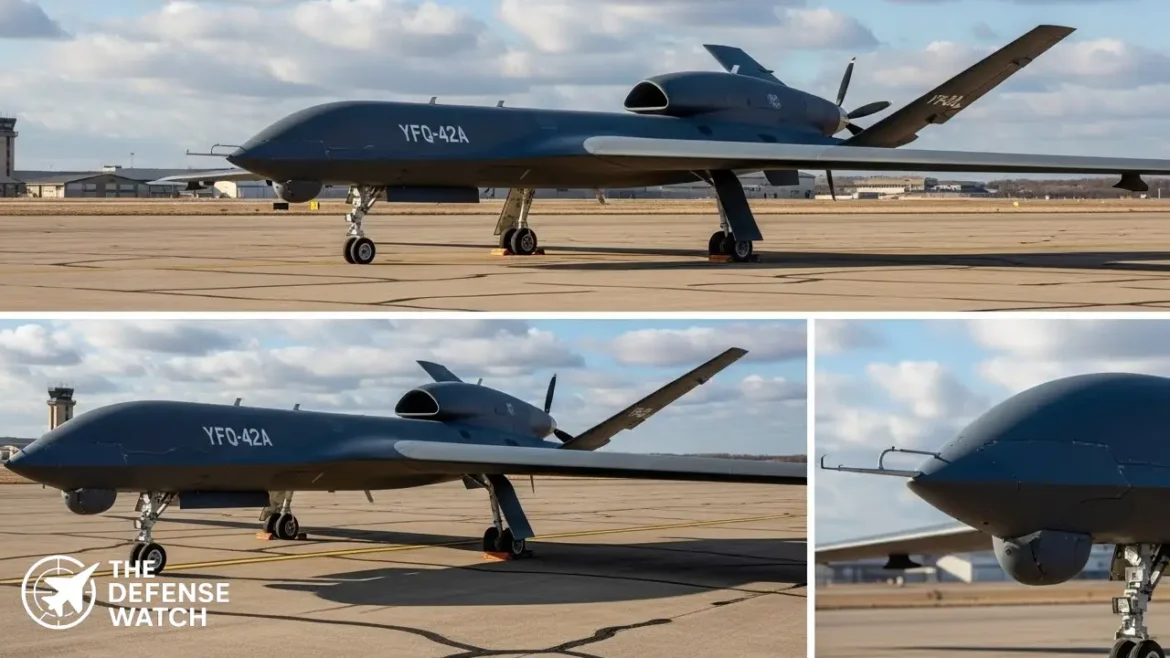
- Built by General Atomics Aeronautical Systems (GA-ASI), the YFQ-42A traces its roots to the earlier XQ-67A demonstrator from the Air Force Research Laboratory’s Off-Board Sensing Station program.
- The jet features a stealth-informed design with a streamlined fuselage, dorsal-mounted air intake, and twin canted V-tails. It carries weapons in internal bays — including air-to-air missiles such as the AIM-120 AMRAAM.
- Its architecture is modular, built to support different mission profiles including air-to-air combat, strike, electronic warfare, and surveillance — depending on payload and configuration.
- According to GA-ASI, the design provides “affordable mass” — lower unit cost and higher deployability than manned fighters — making it suitable for high-risk missions where attrition is possible.
- Flight testing kicked off in August 2025 at a classified site in California.
YFQ-44A (Anduril “Fury”)
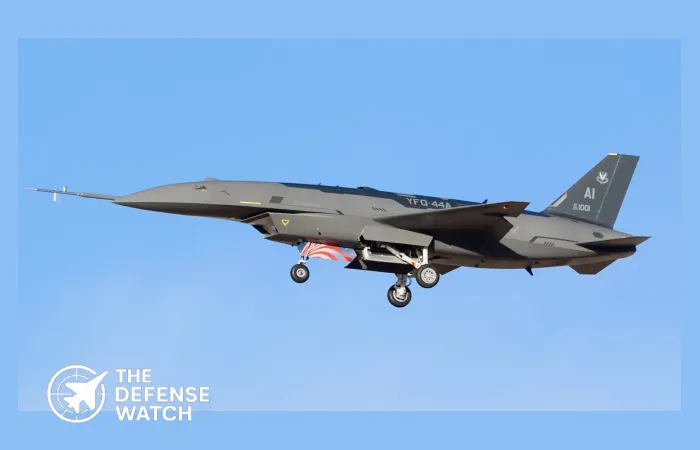
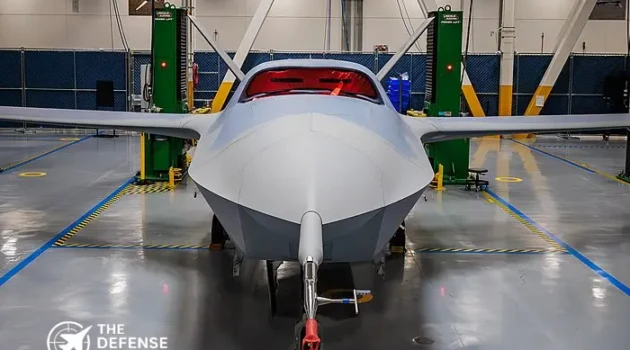
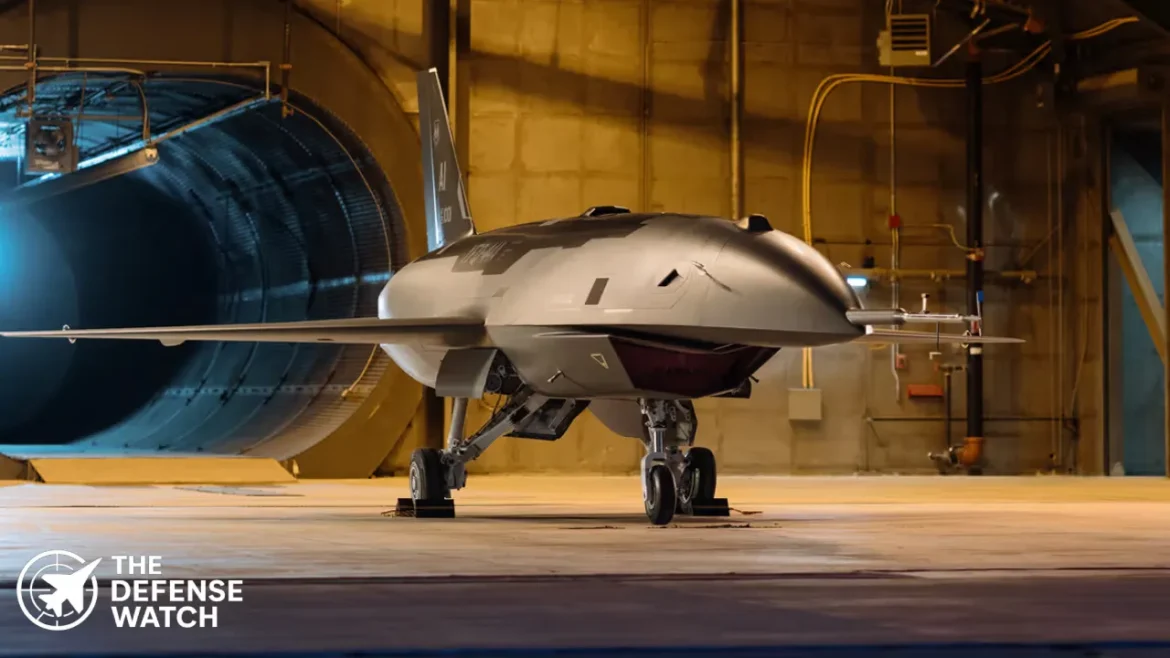
- Developed by Anduril Industries, YFQ-44A — internally known as “Fury” — represents a clean-sheet, jet-powered combat drone design. Anduril acquired the original design from Blue Force Technologies in 2023.
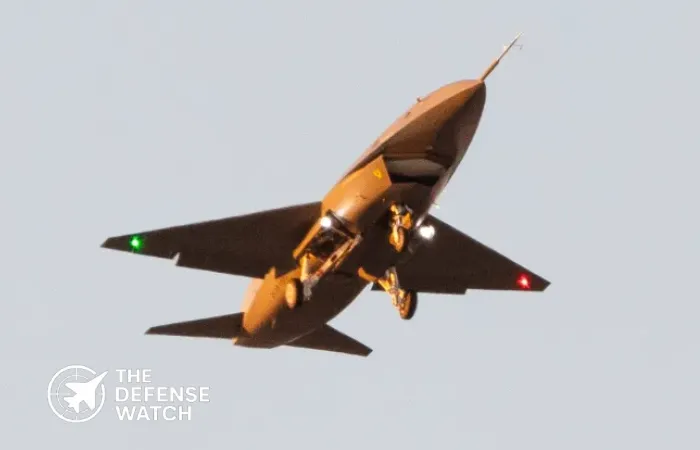
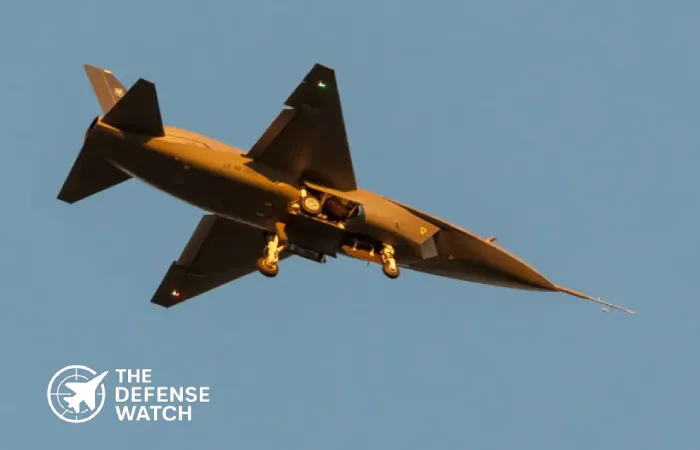
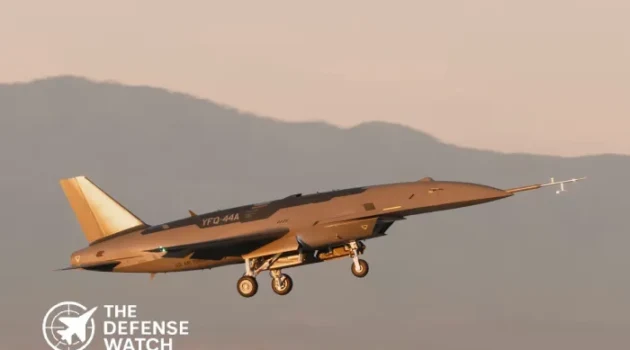
- The aircraft incorporates swept trapezoidal wings, a chin-mounted air inlet, a cruciform tail, and external hardpoints. It relies on a Williams FJ44-4M turbofan engine, giving thrust around 4,000 lbf (roughly 17.8 kilonewtons).
- Estimated performance puts it at near-supersonic speed (around Mach 0.95) at altitudes up to 50,000 feet, and capable of withstanding up to 9 g maneuvers.
- On Oct 31, 2025, YFQ-44A completed its first semi-autonomous flight at Southern California Logistics Airport. During the flight the aircraft carried out its mission plan, managed flight control and throttle autonomously, and returned to land under operator supervision.
- Anduril says the development from clean-sheet design to first flight took just 556 days, showing a rapid development pace unusual in modern military aviation.
What This Means: Redefining Air Combat
With the introduction of YFQ-42A and YFQ-44A, the Air Force is signalling a shift toward manned-unmanned teaming. These drones are not meant just as remote-controlled recon platforms, but as fully capable combat assets that can fly alongside — or ahead of — crewed fighters.
The fighter designation alone marks a doctrinal change. According to Air Force leadership, the move reflects a broader transition to what some call “affordable mass” — deploying larger numbers of cheaper, attritable platforms rather than fewer high-cost, high-risk manned jets.
Additionally, these uncrewed fighters could expand mission flexibility. They might handle dangerous strike or suppression tasks, act as decoys, perform electronic warfare, or extend sensor and weapons coverage — all while reducing risk to pilots.
By pairing with existing fighters such as F-35, the drones could offer significant force multiplication — potentially enabling one pilot to control multiple unmanned wingmen in future combat formations.
What’s Next: Testing, Production, Planning
Both YFQ-42A and YFQ-44A remain in a developmental phase. After their first flights, the next steps will involve more flight tests, integration trials with manned fighters, and evaluation of autonomy, weapons delivery, sensor packages, and survivability in contested environments.
If testing proceeds successfully, the Air Force may move toward production later in the decade under the CCA program’s Increment 1 deliverables. Observers expect future CCAs may number in the hundreds — or possibly thousands — providing a radically expanded air-combat force structure.
Implications
The successful flight tests of YFQ-42A and YFQ-44A mark the start of a new chapter in U.S. airpower. As these uncrewed fighters advance through evaluation and integration, they could significantly reshape how air combat is fought — blending human-led decision-making with autonomous execution, increasing force flexibility, and lowering risk to pilots.
If adopted at scale, CCAs may shift military investment away from expensive, high-end manned jets toward fleets of attritable, capable drones that deliver combat mass with lower cost per unit and higher operational risk tolerance.
Anduril’s YFQ-44A Drone Wingman Completes First Flight in Key CCA Milestone
Anduril Industries has successfully conducted the first flight of its YFQ-44A autonomous drone, marking a major milestone in the U.S. Air Force’s Collaborative Combat Aircraft (CCA) program. The company confirmed the achievement this week, noting that the prototype performed as expected during its inaugural sortie at a U.S. test range.
A Milestone for the CCA Program
The YFQ-44A is one of the Air Force’s leading prototypes under development for the CCA effort—an initiative designed to field autonomous “loyal wingman” aircraft capable of operating alongside crewed fighters such as the F-35A and next-generation platforms. The successful flight demonstrates steady progress toward developing unmanned systems that can conduct sensing, strike support, electronic warfare, and distributed operations.
According to Anduril, the test flight validated core aerodynamics, autonomy software, and safety architectures that will inform later risk-reduction phases. While specific flight parameters were not disclosed, the company described the data collected as “high-quality and mission-relevant.”
Background: The Rise of Autonomous Combat Aviation
The CCA program is one of the U.S. Air Force’s most ambitious modernization efforts. The initiative seeks to introduce an operational fleet of affordable, expendable, and highly autonomous drones that can support or augment piloted aircraft during combat missions. These systems are designed to be modular, AI-enabled, and adaptable to a range of missions—from reconnaissance to kinetic engagements.

Anduril’s YFQ-44A is part of a competitive field that includes multiple defense contractors working on parallel CCA prototypes. The Air Force expects operational platforms to enter service later in the decade, with the first production awards anticipated within the next few years.
Technical Features and Development Goals
While detailed specifications of the YFQ-44A remain undisclosed for security reasons, Anduril has emphasized several foundational design principles:
- Autonomous mission execution: The drone is built to operate with limited human supervision, leveraging advanced onboard processing and AI-driven decision-making.
- Open-architecture mission systems: The platform is designed to support rapid payload integration and capability upgrades.
- Cost-efficient production: CCA systems must be affordable at scale, enabling the Air Force to field them in large numbers for distributed operations.
The company stated that the first flight marks the beginning of a broader series of test sorties focused on validating control laws, sensor integration, and collaborative behaviors between unmanned and manned aircraft.
Industry and Air Force Perspectives
U.S. Air Force officials have repeatedly emphasized the importance of the CCA initiative in future air warfare concepts. The service envisions operational units deploying multiple autonomous wingmen per crewed aircraft, enabling greater mission flexibility, survivability, and target coverage.
Defense industry analysts note that Anduril’s rapid development approach—leveraging digital engineering, modular systems, and commercial software practices—positions the company as a disruptive competitor in the traditionally hardware-driven aerospace sector.
The YFQ-44A’s flight also illustrates the Air Force’s shift toward fielding systems at a faster pace, echoing recent service guidance prioritizing speed over extended development timelines. Industry experts say that early flight demonstrations help reduce program risk and strengthen the company’s position in future down-select phases.
What Comes Next
With the first flight completed, Anduril will now proceed with envelope expansion, integrated payload testing, and multi-vehicle autonomy trials. The company plans to increase flight tempo as the program advances toward more complex demonstrations, including teaming operations with crewed fighters and other CCA prototypes.
The Air Force has indicated that the next major step for the CCA program will involve selecting companies for low-rate production development, following competitive evaluations of autonomy performance, cost, mission adaptability, and manufacturing readiness.
The YFQ-44A’s successful first flight brings the service closer to fielding autonomous wingmen capable of supporting combat airpower in contested environments—an operational shift that could reshape U.S. aerial warfare strategy in the years ahead.