

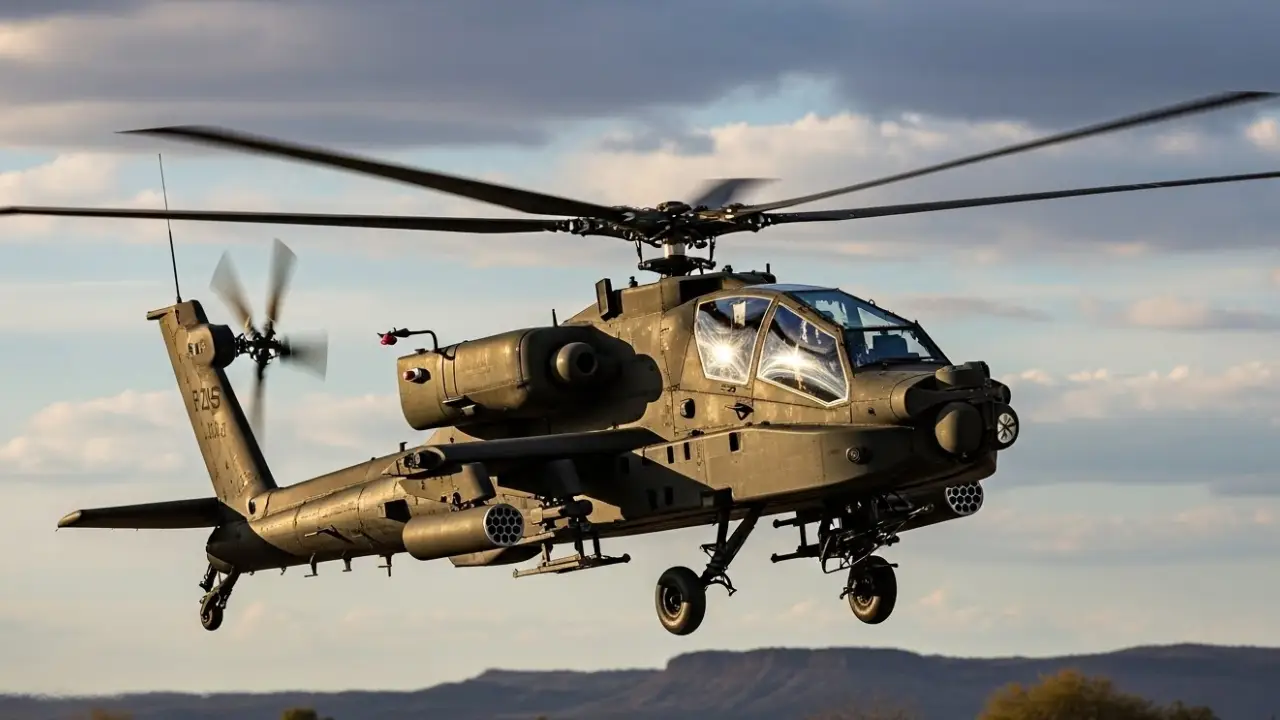
Boeing announced it had been awarded a U.S. Army Foreign Military Sales (FMS) contract worth nearly US$4.7 billion to manufacture new-build AH-64E Apache attack helicopters and related support equipment for allied nations, including a landmark order of 96 helicopters for the Polish Armed Forces.
Deliveries are slated to begin in 2028, marking the largest single Apache purchase by a non-U.S. country in the program’s history.
Background: The AH-64E Program and Global Demand
The AH-64 Apache series has served as a mainstay attack helicopter for the United States Army since the mid-1980s. The current variant, the AH-64E, features upgraded engines, composite rotors, advanced sensors, networking capabilities, and modular open-systems architecture, making it suitable for modern multi-domain warfare.
As of 2025, more than 1,300 Apache helicopters are in operation globally.
In recent years, demand has surged among partner nations seeking proven, high-capability attack helicopters rather than unproven or high-risk systems. The AH-64E’s mix of lethality, versatility, and maturity has kept it at the center of many modernization plans.
Contract Details
- The contract was awarded to Boeing’s Mesa, Arizona production facility, with work expected to run through May 30, 2032.
- The package includes not only AH-64E helicopters but also “Longbow” crew trainers, spare parts, accessories, and related support equipment.
- The initial tranche — drawing from export customers including Poland, Egypt, and Kuwait — was reportedly worth about US$2.3 billion.
- For Poland, the 96-aircraft order will make it the 19th global operator of the Apache and the largest fleet outside the United States.
- Poland has already begun training pilots and maintenance crews in anticipation of the deliveries; the country currently leases eight AH-64Es from the U.S. Army.
- As part of the deal, Boeing and the Polish Ministry of National Defence reportedly signed offset agreements: Polish industry will participate in maintenance and support operations, and Boeing will help establish training programs and a composite-materials laboratory locally.
“This important agreement allows us to begin building one of the largest and most formidable Apache fleets that the world has ever seen,” said Christina Upah, vice president of Boeing’s Attack Helicopter Programs, in the official company statement.
Why It Matters: Strategic and Industrial Implications
Sustaining Apache Production into the 2030s
The new contract secures continued operation of Boeing’s Mesa production line deep into the 2030s — a critical factor for long-term supply, sustainment, training, and future upgrades.
Given the AH-64E’s MOSA-enabled (Modular Open Systems Architecture) framework, the platform can continue to evolve with upgrades in sensors, weapons, communications, and networking — offering partners a cost-effective, low-risk path to modern attack aviation capabilities.
Growing Reliance on Proven Rotary-Wing Aviation
While many militaries explore unmanned systems and futuristic platforms, the Apache’s robust combat-proven record, multi-role versatility, and integration capabilities within modern networked warfighting architectures continue to drive demand.
For Poland — and potentially Egypt and Kuwait — the acquisition enhances strike, reconnaissance, and counter-drone capabilities, while anchoring national aviation modernization efforts around a mature, interoperable platform.
Industrial Offset and Local Defense Industry Participation
The offset elements of the deal provide opportunities for domestic maintenance, training, and composite-materials work in Poland — an incentive for countries aiming to build or sustain local defense-industrial capacity rather than remain purely reliant on foreign suppliers.
Policy and Geopolitical Perspective
The deal comes amid evolving security dynamics across Europe and the Middle East, where several allied nations are re-evaluating and reinforcing their defense postures. For Poland, a NATO member that has significantly increased defense spending following the conflict in Ukraine, the acquisition of Apaches signals a commitment to strengthening its land-air warfare capabilities.
From a U.S. and Boeing perspective, the FMS contract reinforces the strategic role of U.S.-made attack helicopters in allied defense networks, while supporting U.S. defense-industry supply chains and export revenues.
By sustaining Apache production into the 2030s, the program remains relevant even as militaries globally invest heavily in unmanned systems and next-generation platforms — reflecting a continued belief in the value of crewed, multi-role attack helicopters in complex, contested environments.
What’s Next
As Poland prepares to receive its first AH-64E deliveries starting in 2028, training for pilots and maintainers is already underway. Local industry participation under the offset agreement may lead to increased domestic capability for maintenance and support — potentially strengthening Poland’s defense autonomy.
Meanwhile, Boeing’s Mesa facility will ramp up production, sustain its workforce, and remain ready to meet future orders or upgrades — keeping the AH-64E relevant even as emerging technologies and evolving battlefield requirements reshape global military aviation.
For defense observers, the contract reinforces the continuing centrality of the AH-64E Apache in allied attack-aviation planning and provides a benchmark for future export deals and modernization efforts by other partner nations.


23 comments
[…] response to evolving global threats and shifts in its defense procurement strategy. The use of U.S. foreign military sales (FMS) has been a conventional way for Canada to acquire advanced Western weapons […]
[…] remain limited: the Royal Cambodian Air Force reportedly only fields a small fleet of light-attack helicopters (notably the Harbin Z-9), leaving it largely unable to respond in […]
[…] Pakistan’s air combat fleet since the early 2000s. The jets were initially supplied under earlier Foreign Military Sales programs that included aircraft and sustainment packages. Over the years Pakistan has sought […]
[…] Ship design, adapted to meet Saudi operational requirements. The program was approved under a U.S. Foreign Military Sales agreement and includes four frigates, training, logistics support, and long term […]
[…] enhanced version of the existing Taurus KEPD 350 missile, which has a 270nm (500km) range. The new contract builds on a previous deal from last year that covered maintenance and capability updates for Germany’s […]
[…] Fiscal year 2026 Other Procurement Navy funds account for 67 percent of the total obligation. Foreign Military Sales funds from Canada represent 16 percent, while fiscal year 2026 operations and maintenance Navy […]
[…] TopOwl Digital Display helmet builds on a proven legacy system used across multiple helicopter programmes. It synthesises terrain imagery with sensor and camera data, and improves light […]
[…] agreed upon by both governments. Baghdad has increasingly pushed for a recalibration of the foreign military presence following years of domestic political […]
[…] systems are produced by U.S.-based Anduril Industries and are being procured under U.S. Foreign Military Sales […]
[…] continues to deliver P 8A aircraft to international customers under Foreign Military Sales agreements, with sustained production supporting both US and allied […]
[…] the time of the award, $52,382,136 in Fiscal Year 2022 Foreign Military Sales funds for Taiwan were obligated. Additional funding is expected to be applied over the life of the […]
[…] aircraft operating as so-called loyal wingmen. These platforms are intended to fly with crewed Apache AH-64E helicopters and conduct tasks such as reconnaissance, surveillance, electronic warfare, target acquisition and […]
[…] one help preserve skilled manufacturing labor and ensure production continuity for the Army and foreign military sales […]
[…] F-35 program now includes nine partner nations and several foreign military sales customers. The aircraft’s advanced sensors, stealth characteristics, and networked capabilities […]
[…] State Department has cleared a proposed Foreign Military Sale (FMS) that would provide Spain with upgraded Aegis weapon systems and related equipment for its […]
[…] CH-53K helicopters were acquired through a Foreign Military Sales agreement between Israel and the US government, signed several years ago. The aircraft are […]
[…] attack unfolded early Friday morning inside a residential building in northwest Moscow. According to the Moscow prosecutor’s office, an unknown gunman approached […]
[…] readiness. Previous joint drills have included large-scale air assaults involving CH-47 Chinooks, Apache attack helicopters, and transport aircraft, and combined arms operations with ground and air units to strengthen joint […]
[…] work is funded through the Foreign Military Sales program and managed by Naval Air Systems Command at Patuxent River, Maryland. The contract […]
[…] According to procurement officials, the payment follows established protocols within the U.S. Foreign Military Sales program and aligns with Canada’s projected fleet delivery schedule extending through […]
[…] Covers Foreign Military Sales customers across Europe, Middle East, and […]
[…] The missile has already progressed through testing phases, and the Army has begun initial fielding efforts. Production increases aim to support both U.S. inventory requirements and potential future foreign military sales. […]
[…] deployment of integrated “multi-layered” defensive packages in the theater. U.S. AH-64 Apache attack helicopters and MH-60R Sea Hawks, operating from both land bases and carrier decks, neutralized six IRGC […]