

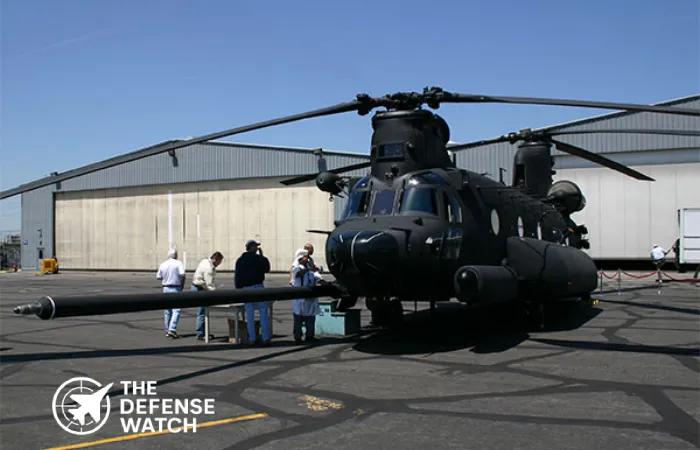
U.S. Special Operations Command Orders More MH-47G Block II Chinooks
The U.S. Special Operations Command (USSOCOM) awarded Boeing a $877,742,891 delivery order to procure additional MH-47G Block II heavy-lift helicopters. The contract stipulates that most of the manufacturing activity will occur through late 2030, under the contracting activity based at MacDill Air Force Base.
Background: Why MH-47G Matters
The MH-47G is the special operations version of Boeing’s venerable CH-47 Chinook, tailored for the demanding missions of U.S. Army Special Operations Aviation Command (USASOAC), notably the 160th Special Operations Aviation Regiment (SOAR), also known as the Night Stalkers.
Derived from earlier MH-47 variants (D and E), the Block II brings critical upgrades: a reinforced airframe, redesigned “fat” fuel tanks, advanced avionics, and systems optimized for extended-range, high-threat, and night operations.
These helicopters support insertion, extraction, resupply, in-flight refueling, and even airborne command‐and‐control. Their low-level capability — paired with infrared suppression and countermeasure suites — makes them uniquely suited for clandestine and high-risk special operations.
Contract Details and Context
- The $877.7 million award represents a “delivery order,” meaning this is not a standalone contract but a continuation or extension of an existing procurement pathway.
- Production is expected to carry on until November 2030, giving Boeing and USASOAC a clear roadmap for the near term.
- This new order builds on a series of prior contracts:
- In March 2025, Boeing secured a $240 million deal to remanufacture five MH-47G Block II helicopters, with deliveries expected to begin in 2027.
- In June 2024, a $115 million contract for two additional MH-47G Block II Chinooks was awarded.
- Looking further back, in December 2023, Boeing received a $271 million award to remanufacture six MH-47G Block II airframes.
- According to these cumulative contracts, 51 MH-47G Block II helicopters are now under contract.
MH-47G Capabilities and Specifications
Key specifications and capabilities of the MH-47G Block II include:
- Powerplant: Two Honeywell T55-GA-714A turboshaft engines (approx. 4,734 hp each)
- Dimensions: Fuselage length ~ 15.9 m; total length with rotors ~ 30.2 m; rotor diameter ~ 18.8 m
- Fuel & Range: Internal fuel capacity around 7,828 liters; mission radius approx. 630 km; aerial refueling capability extends mission duration.
- Avionics: Digital cockpit compatible with night-vision goggles, Common Avionics Architecture System (CAAS), inertial/doppler navigation, GPS, and advanced radar.
- Defensive Systems: Infrared exhaust suppressors, missile warning system, electronic countermeasures, laser warning receiver, and flare dispensers.
- Armament and Personnel Systems: M134 minigun (7.62 mm) at forward doors, M240D machine guns in rear windows, fast-rope insertion/extraction, rope ladders, rescue hoist, and a personnel location system.
Expert & Policy Perspectives
From a defense policy standpoint, this contract underscores the U.S. military’s long-term commitment to sustaining and modernizing its special operations aviation capabilities. Analysts note that the continuous procurement of Block II MH-47Gs aligns with SOCOM’s broader strategy to extend platform service life while ensuring mission-ready readiness for high-risk operations across the globe.
Heather McBryan, Boeing’s Cargo Programs VP and Program Manager, has previously emphasized the “unique and complex mission requirements” of USASOAC, framing the MH-47G Block II as a force multiplier for special operators.
Budget documents released by the U.S. Department of Defense also reflect planned procurement through 2030, reinforcing that this isn’t a one-off investment but part of a sustained modernization roadmap.
Strategic Implications and What’s Next
- Extended production timeline: With production stretching to 2030, Boeing and its supply chain are likely to maintain a stable industrial base for heavy-lift special operations helicopters.
- Sustained operational capacity: The Night Stalkers (160th SOAR) will continue to operate an upgraded and modernized fleet — enhancing readiness for global missions.
- Future growth potential: Given the modular design of the Block II, there is room for further technology insertions or upgrades as threat environments evolve.
- Budget consistency: The award aligns with SOCOM’s budget justification documents, suggesting future delivery orders may follow under similar procurement frameworks.


7 comments
[…] the Navy had deployed the salvage ship USNS Salvor (T-ARS 52) — a Safeguard-class vessel operated by the Military Sealift Command — to the site. Salvor is designed for heavy-lift and deep-sea salvage, with cranes capable of […]
[…] temperatures, high winds and limited visibility provide some of the harshest conditions for aircraft operations. The exercise integrated F-35A fighters from the 354th Fighter Wing with a range of assets from […]
[…] Abraham Lincoln, commissioned in 1989, is equipped to carry about 90 fixed-wing aircraft and helicopters. Defensive systems aboard include the Phalanx CIWS, Rolling Airframe Missiles and Sea Sparrow […]
[…] Sabena Aerospace award fits within a broader pattern of US and allied investments in sustainment and logistics for […]
[…] included a mock assault on a designated target, with troops fast-roped into position from RAF Chinook helicopters before advancing with armoured support. Upon securing the objective, forces withdrew to RAF Leeming […]
[…] assessment fulfilled multiple strategic objectives for U.S. European Command operations. Event organizers identified three primary goals: strengthening bonds between U.S. service members, […]
[…] testing the force’s ability to preserve assets through rapid deployment while sustaining combat operations. Commander Mathieu, deputy commander of Fighter Squadron 3/30 “Lorraine” based at Mont-de-Marsan, stated […]