• Home
  • About
  • Defense Systems
  • Manufacturer
  • Comparisons
  • Compare 
  • Tools
TheDefenseWatch.com
  • Aerospace & Aviation
  • Military & Ordnance
  • Naval & Maritime
  • Cyber & Space Defense
  • Policy & Strategy
  • Global News
  • Tools Library
    • Smart Calculator
    • Drone Flight Time Calculator
    • Drone Range Calculator
    • Counter-Drone Jammer Effective Range Calculator
    • Counter-Battery Radar Detection Calculator
    • Artillery Fire Correction Calculator
    • Thermal Camera Detection Range Calculator
    • Missile Range & Time-of-Flight Calculator
    • Radar Detection Range Calculator
    • FPV Strike Drone Payload vs Range Calculator
    • Loitering Munition Endurance Calculator
    • Sniper Ballistic Drop & Windage Calculator
    • Bullet Drop Calculator
    • U.S. Army Combat Fitness Test (ACFT) Calculator
    • Military Pension Calculator
    • Military Retirement Calculator
    • Military Pension Calculator
    • Large Number Calculator
Font ResizerAa

TheDefenseWatch.com

The Defense Watch | U.S. & Global Defense News, Analysis & Military Updates

Search
  • Home
  • About
  • Defense Systems
  • Manufacturer
  • Comparisons
  • Compare 
  • Tools

Stay Updated

Get the latest update

Subscribe

Explore

  • Drone
  • Fighter Jets & Military Aircraft
  • Hypersonic Weapons
  • Aircraft Carriers
  • Strategic History & Missions
  • Tools Library
Home » Hegseth And Marles Reinforce U.S.-Australia Alliance As ANZUS Marks 75 Years
Alliances & DoctrinesPolicy & Strategy

Hegseth And Marles Reinforce U.S.-Australia Alliance As ANZUS Marks 75 Years

Samuel Drake | Defense Analyst
Last updated: September 7, 2026 12:50 am
Samuel Drake | Defense Analyst
Share
8 Min Read
U.S.-Australia alliance
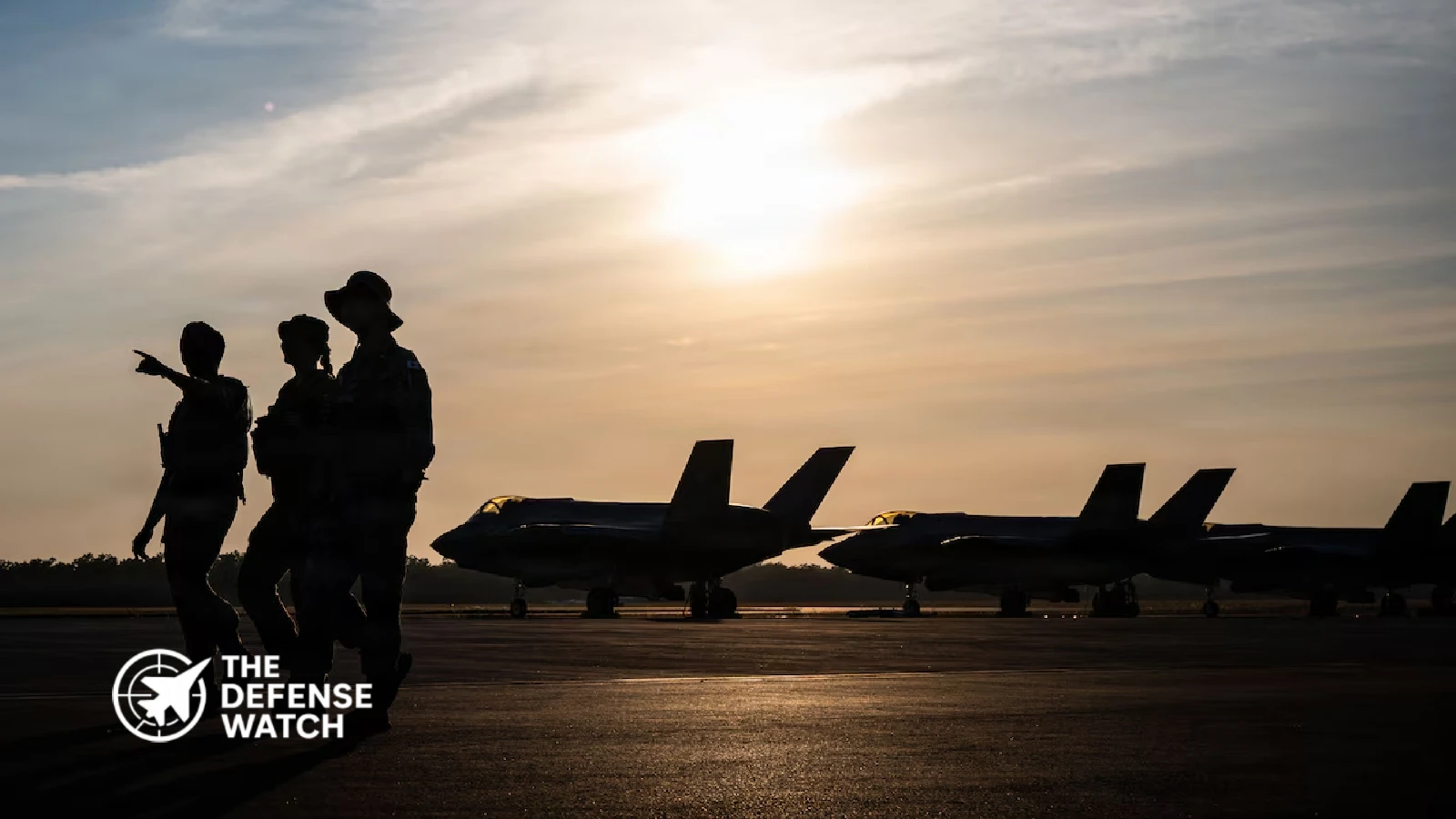
Members of the U.S. Air Force, Royal Australian Air Force and Japan Air Self-Defense Force patrol the flight line during a trilateral joint patrol as part of Exercise Southern Cross 26 at Royal Australian Air Force Base Darwin, Australia, July 10, 2026. (Image : DoW)
SHARE

U.S.-Australia Alliance Enters 75th Anniversary Year With Focus on Deterrence

The U.S.-Australia alliance is placing renewed emphasis on military interoperability and Indo-Pacific deterrence as Washington and Canberra mark the 75th anniversary of the ANZUS Treaty.

Contents
  • U.S.-Australia Alliance Enters 75th Anniversary Year With Focus on Deterrence
  • Takeaways
  • ANZUS Turns 75
  • Focus Shifts From Alliance History to Military Capability
  • Submarine Cooperation Moves Forward
  • A More Integrated Indo-Pacific Posture
  • What Comes Next

U.S. Secretary of War Pete Hegseth met Australian Deputy Prime Minister and Defense Minister Richard Marles at the Pentagon around the anniversary, with both officials highlighting the depth of their defense relationship and the need to maintain complementary military capabilities.

Takeaways

Washington and Canberra are using the 75th anniversary of ANZUS to reinforce defense cooperation and regional deterrence.

1. ANZUS Marks 75 Years

The Australia, New Zealand and United States Security Treaty was signed on September 1, 1951, creating a framework for security cooperation in the Pacific.

2. Hegseth Stresses Allied Capability

Hegseth emphasized that allies should invest in their own sovereign defense capabilities while ensuring their forces can operate together.

3. Submarine Cooperation Is Expanding

U.S. personnel are already supporting preparations at HMAS Stirling for Submarine Rotational Force-West, scheduled to begin from the end of 2027.

4. Joint Training Remains Central

Recent exercises including Southern Cross 26 and Talisman Sabre have expanded practical cooperation among Australia, the United States and regional partners.

Hegseth said the two countries share an assessment of an increasingly complex security environment and stressed that allies must both plan together and ensure their capabilities can work together if a conflict occurs.

Marles described the alliance as a cornerstone of Australia’s foreign and strategic policy, saying its importance remains particularly significant as the regional security environment becomes more challenging.

- Advertisement -

ANZUS Turns 75

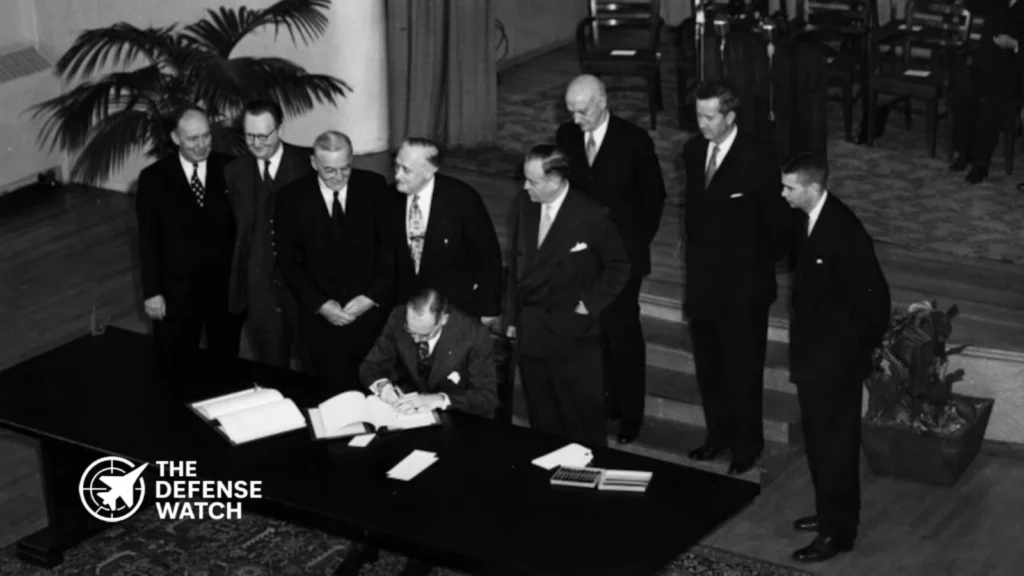
The ANZUS Treaty was signed in San Francisco on September 1, 1951, by Australia, New Zealand and the United States. It established a security framework intended to address threats to peace and security in the Pacific. The treaty entered into force in April 1952.

The alliance structure has changed over time. Since the 1980s, the practical defense relationship has centered primarily on bilateral cooperation between the United States and Australia, while Australia and New Zealand maintain their own close security relationship. Washington suspended its ANZUS security obligations to New Zealand in 1986 following Wellington’s restrictions on nuclear-capable and nuclear-powered U.S. Navy vessels.

For Australia and the United States, however, defense cooperation has continued to deepen through increasingly integrated planning, exercises, force posture arrangements and defense-industrial cooperation.

Australia’s government marked the anniversary on September 1 by describing ANZUS as a foundation of its enduring cooperation with the United States and New Zealand. It also highlighted efforts to develop an increasingly integrated and combat-capable Australian and New Zealand force.

Focus Shifts From Alliance History to Military Capability

The Pentagon meeting placed particular emphasis on what the alliance needs to deliver operationally.

Hegseth argued that capable allies should contribute to collective defense by investing in their own national security. He also pointed to alignment between U.S. and Australian defense strategies.

That emphasis reflects a broader shift in allied defense planning toward forces that can operate together across multiple domains rather than relying solely on individual platforms.

Recent Australian exercises illustrate that approach.

- Advertisement -

Exercise Southern Cross 26, held in northern Australia in July, brought together more than 1,000 personnel and up to 40 aircraft from Australia, the United States and Japan. The exercise focused on operating as a trilateral task force in a high-end warfighting environment, including dispersed operations, air-to-air refueling and multinational aircraft maintenance.

The U.S.-Australia relationship was also central to Exercise Talisman Sabre 2025. The large-scale exercise involved more than 40,000 personnel from 19 participating nations and included operations across the land, sea, air, cyber and space domains.

These activities provide practical opportunities for forces to test communications, logistics, command relationships and operational procedures alongside allied units.
U.S.-Australia alliance

Secretary of State Dean Acheson signs the Tripartite Security Treaty between the U.S., Australia and New Zealand in San Francisco, Sept. 1, 1951. (Image : DoW)

Submarine Cooperation Moves Forward

One of the most significant elements of the evolving U.S.-Australia alliance is undersea cooperation through AUKUS.

Hegseth and Marles welcomed the arrival of U.S. Navy personnel in Western Australia supporting preparations for Submarine Rotational Force-West, or SRF-West.

The rotational force is planned to operate from HMAS Stirling near Perth from the end of 2027. The arrangement is part of the AUKUS pathway for building Australia’s capacity to operate and sustain conventionally armed, nuclear-powered submarines.

Earlier U.S. Defense Department planning called for U.S. Virginia-class and British Astute-class submarines to rotate through Western Australia under SRF-West.

Marles said on September 3 that U.S. personnel were already at HMAS Stirling preparing for the start of SRF-West. He also said the broader effort includes developing infrastructure and maintenance capacity at Stirling and the planned Henderson Defense Precinct.

The submarine effort is closely connected to Australia’s longer-term AUKUS plans. The United States has previously outlined a pathway involving the eventual transfer of Virginia-class submarines to Australia, followed by the development of the SSN-AUKUS submarine with the United Kingdom.

A More Integrated Indo-Pacific Posture

The anniversary meeting comes as the U.S.-Australia alliance becomes increasingly connected to a wider network of regional partnerships.

Australia’s exercises with the United States and Japan demonstrate the growing importance of trilateral cooperation, while Talisman Sabre has provided a larger multinational framework for testing high-end military operations.

The focus is increasingly on interoperability, distributed operations, logistics and the ability to sustain forces across Australia’s large geographic area.

For Washington, Australia also provides an important location for strengthening the U.S. military posture in the Indo-Pacific. For Canberra, deeper cooperation with the United States supports Australia’s effort to build more capable sovereign defense forces while improving the ability to operate with its closest military partner.

Marles said the two governments also discussed expanding the breadth and complexity of their existing force-posture cooperation. He indicated that further details could emerge during the next Australia-U.S. Ministerial Consultations, or AUSMIN.

The significance of the 75th anniversary therefore extends beyond commemorating a treaty signed in 1951. The current emphasis is on ensuring that the alliance remains operationally relevant as both countries adapt their military forces to a more demanding Indo-Pacific security environment.

What Comes Next

The immediate priority will be translating political commitments into additional military capability and practical cooperation.

That includes preparations for SRF-West, continued AUKUS implementation, expanded exercises and further integration of Australian and U.S. forces.

The U.S.-Australia alliance has already developed well beyond the treaty framework established 75 years ago. Its current direction is defined increasingly by the ability of the two militaries to plan, train, operate and sustain forces together.

For Washington and Canberra, that practical integration is becoming a central element of their approach to deterrence in the Indo-Pacific.


TAGGED:ANZUSU.S.-Australia Alliance
Share This Article
Facebook Copy Link Print
BySamuel Drake | Defense Analyst
Follow:
Samuel Drake is a defense analyst at TheDefenseWatch.com covering naval warfare, military ordnance, maritime technology, fleet modernization, and defense procurement. His reporting focuses on documented capabilities, procurement programs, and military technology.
Leave a Comment

Leave a Reply Cancel reply

Your email address will not be published. Required fields are marked *

Latest Defense Systems

  • SU-57 Felon Stealth Fighter SU-57 Felon Stealth Fighter
  • Boeing F/A-XX Fighter Boeing F/A-XX Fighter
  • JF-17 Thunder Fighter Jet JF-17 Thunder Fighter Jet
  • Gaurav Glide Bomb Gaurav Glide Bomb
  • F-47 Fighter Jet F-47 Fighter Jet
  • Spirit UAS Spirit UAS
  • GBU-43/B MOAB Bomb GBU-43/B MOAB Bomb
  • John F. Kennedy Aircraft Carrier John F. Kennedy Aircraft Carrier
  • Voyager Tanker Voyager Tanker

Recent Compares

  • J-10C vs JF-17 Thunder: Which Fighter Is More Capable? J-10C vs JF-17 Thunder: Which Fighter Is More Capable? View Comparison →
  • Tejas vs Gripen: Key Differences and Capabilities Tejas vs Gripen: Key Differences and Capabilities View Comparison →
  • Tejas vs MiG-21 Bison: How India Replaced Its Iconic Supersonic Fighter Tejas vs MiG-21 Bison: How India Replaced Its Iconic Supersonic Fighter View Comparison →
  • F-35 vs F-16: Stealth, Sensors and Combat Roles F-35 vs F-16: Stealth, Sensors and Combat Roles View Comparison →
  • Tejas Fighter Jet vs F-16 Fighting Falcon: Capability Compared Tejas Fighter Jet vs F-16 Fighting Falcon: Capability Compared View Comparison →
  • Rafale Fighter Jet vs F-16 Fighting Falcon : Which Fighter Has the Edge? Rafale Fighter Jet vs F-16 Fighting Falcon : Which Fighter Has the Edge? View Comparison →
  • Su-57 Fighter Jet vs J-20 Fighter Jet: Stealth and Air Combat Compared Su-57 Fighter Jet vs J-20 Fighter Jet: Stealth and Air Combat Compared View Comparison →
  • Mirage 2000 vs Tejas Mk1A: Legacy Combat Power vs Indigenous Modernization Mirage 2000 vs Tejas Mk1A: Legacy Combat Power vs Indigenous Modernization View Comparison →
  • Rafale Fighter Jet vs F-22 Raptor: Which Air Dominance Fighter Has the Edge? Rafale Fighter Jet vs F-22 Raptor: Which Air Dominance Fighter Has the Edge? View Comparison →
  • Tejas Fighter Jet vs. Rafale Fighter Jet: India’s Indigenous Fighter Meets France’s Proven Multirole Combat Aircraft Tejas Fighter Jet vs. Rafale Fighter Jet: India’s Indigenous Fighter Meets France’s Proven Multirole Combat Aircraft View Comparison →

Recent Posts

  • Russian Fighter Jets in 2026: Su-57, Su-35, Su-30 and MiG-41 Compared
  • F/A-XX Navy Fighter: Boeing Wins Contract as Cost Tops $20 Billion
  • Starfighters Space Plans December F-104 Test for Starlaunch 1
  • Army Task Force Partners With Acquisition Office to Speed Counter-Drone Fielding
  • Hegseth Thanks New Recruits and ROTC Cadets During Knoxville Visit

You Might Also Like

Polish defense industry SAFE mechanism
Defense Budgets & PolicyPolicy & Strategy

Polish Defense Industry Backs EU SAFE Mechanism To Boost National Production And Exports

September 7, 2026
Swedish Air Force JAS 39 Gripen fighter aircraft during flight operations as Sweden announces fighter support package for Ukraine.
Defense Budgets & PolicyPolicy & Strategy

Sweden Moves To Arm Ukraine With Gripen Fighters As Air Defense Demands Grow

September 13, 2026
USAFE Headquarters bombing
Policy & StrategyStrategic History & Missions

USAFE Headquarters Bombing: 45 Years of Lessons in Force Protection at Ramstein

September 7, 2026
China defense budget 2026
Defense Budgets & PolicyPolicy & Strategy

China Defense Budget 2026 Rises 7% As Xi’s Military Purge Reshapes PLA Leadership

March 10, 2026

Logo

Copyright © 2026 TheDefenseWatch.com

Helpful Links

  • Home
  • About Us
  • Privacy Policy
  • Terms of Use / Disclaimer
  • U.S. Privacy Notice – CCPA Compliance

Defense Systems

  • Defense Systems
  • Comparisons 
  • Manufacturer
  • Tactical Calculators

Popuplar

Which 5 Air Forces Possess the Costliest Fighter Jet Fleets in the World
Evolving Strategic Value: Carrier Strike Groups in the Indo-Pacific’s Future Security Architecture
Autonomous Weapon Systems Spark U.S. Ethics Debate Amid Rapid Military AI Integration

We report on developments involving military forces, governments, defense companies, research organizations, and security institutions around the world. 

Welcome Back!

Sign in to your account

Username or Email Address
Password

Lost your password?