• Home
  • About
  • Defense Systems
  • Manufacturer
  • Comparisons
  • Compare 
  • Tools
TheDefenseWatch.com
  • Aerospace & Aviation
  • Military & Ordnance
  • Naval & Maritime
  • Cyber & Space Defense
  • Policy & Strategy
  • Global News
  • Tools Library
    • Smart Calculator
    • Drone Flight Time Calculator
    • Drone Range Calculator
    • Counter-Drone Jammer Effective Range Calculator
    • Counter-Battery Radar Detection Calculator
    • Artillery Fire Correction Calculator
    • Thermal Camera Detection Range Calculator
    • Missile Range & Time-of-Flight Calculator
    • Radar Detection Range Calculator
    • FPV Strike Drone Payload vs Range Calculator
    • Loitering Munition Endurance Calculator
    • Sniper Ballistic Drop & Windage Calculator
    • Bullet Drop Calculator
    • U.S. Army Combat Fitness Test (ACFT) Calculator
    • Military Pension Calculator
    • Military Retirement Calculator
    • Military Pension Calculator
    • Large Number Calculator
Font ResizerAa

TheDefenseWatch.com

The Defense Watch | U.S. & Global Defense News, Analysis & Military Updates

Search
  • Home
  • About
  • Defense Systems
  • Manufacturer
  • Comparisons
  • Compare 
  • Tools

Stay Updated

Get the latest update

Subscribe

Explore

  • Drone
  • Fighter Jets & Military Aircraft
  • Hypersonic Weapons
  • Aircraft Carriers
  • Strategic History & Missions
  • Tools Library
Home » Taiwan Deploys Battle-Tested HIMARS in Shoot-and-Soot Drill To Counter Chinese Invasion Threat
Asian Defense & Security

Taiwan Deploys Battle-Tested HIMARS in Shoot-and-Soot Drill To Counter Chinese Invasion Threat

Kaleem Sheikh | Regional Defense Correspondent
Last updated: September 7, 2026 7:20 am
Kaleem Sheikh | Regional Defense Correspondent
Share
5 Min Read
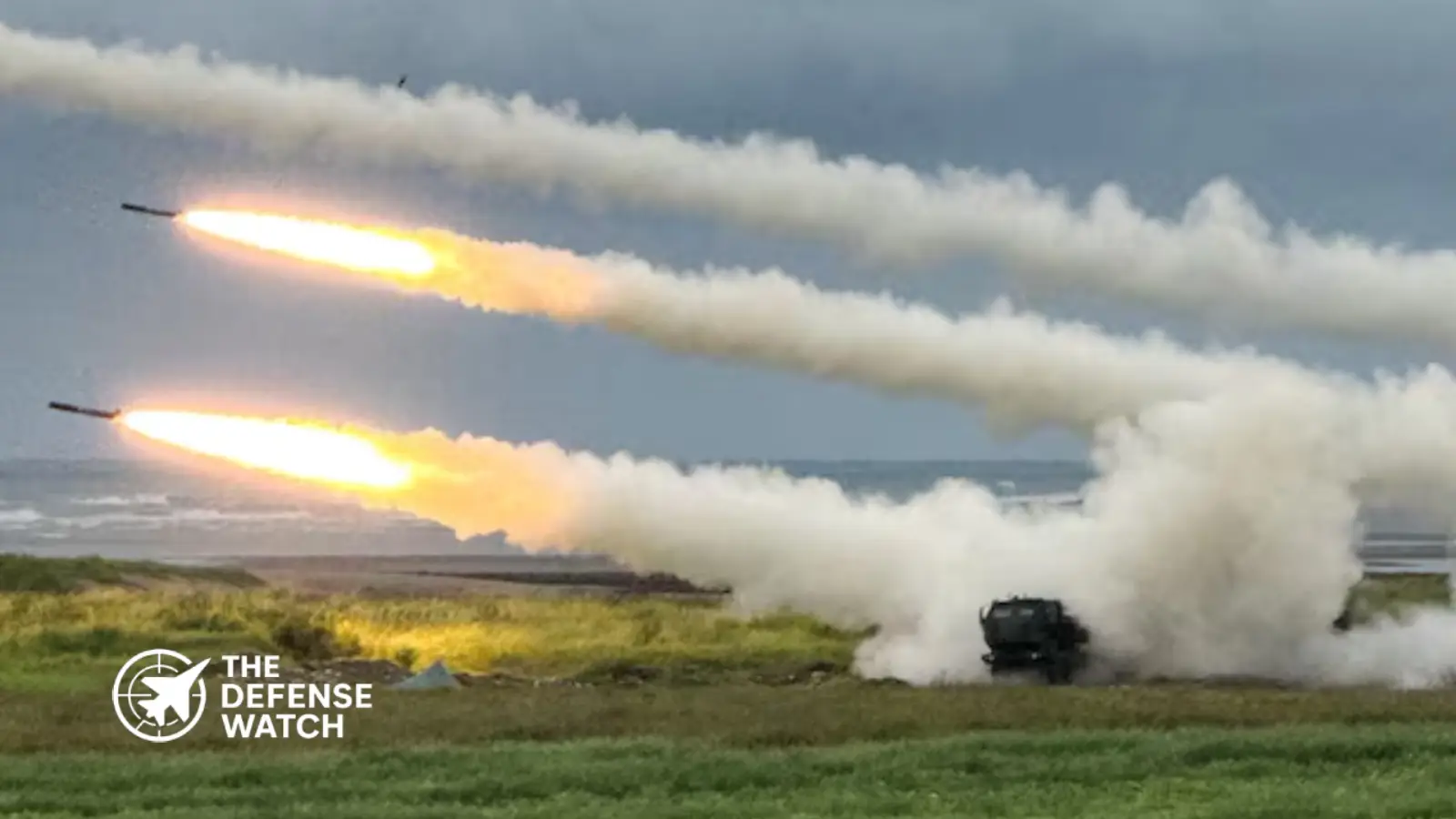
Taiwan HIMARS drill
SHARE

Executive Summary:

Taiwan’s armed forces conducted a live-fire exercise on June 10, 2026, in Taichung, firing newly acquired High Mobility Artillery Rocket Systems (HIMARS) to simulate strikes on an invading Chinese force. The drill emphasized rapid “shoot-and-scoot” maneuvers to enhance survivability against counter-battery fire. This demonstration underscores Taiwan’s push toward asymmetric warfare capabilities as part of its “porcupine strategy” to deter or complicate any potential cross-strait invasion.

(adsbygoogle = window.adsbygoogle || []).push({});

Taiwan HIMARS Live-Fire Exercise Highlights Mobile Defense Capabilities

Taiwan’s military on Wednesday fired its U.S.-supplied HIMARS during a coastal defense drill on the island’s west coast, marking the first use of the precision rocket system in that strategically vital area facing China.

Contents
  • Taiwan HIMARS Live-Fire Exercise Highlights Mobile Defense Capabilities
  • Context of Rising Tensions and Asymmetric Modernization
  • Broader Implications for Regional Security

The exercise simulated attacks on enemy landing forces, showcasing the launchers’ mobility and ability to fire and quickly reposition to evade detection and retaliation.

HIMARS Integration in Taiwan’s Defense Posture

Taiwan first test-fired the Lockheed Martin-built HIMARS off its east coast in 2025. Wednesday’s drill in central Taiwan’s Taichung represents an important step in operationalizing the system for scenarios most likely in a conflict: defending the western beaches and mudflats across the narrow Taiwan Strait.

- Advertisement -

Company commander Ko Ming-pin stated that the unit successfully demonstrated solid combat capabilities. The military highlighted the system’s “shoot-and-scoot” tactics—firing salvos and withdrawing before enemy radar can lock on—as significantly improving battlefield survivability.

(adsbygoogle = window.adsbygoogle || []).push({});

HIMARS, which has proven effective in Ukraine’s conflict with Russia, provides Taiwan with a highly mobile, precision-guided strike option. With a range of approximately 300 km (190 miles) using Army Tactical Missile System (ATACMS) munitions, the launchers could target coastal areas in China’s Fujian province, including ports and assembly points for amphibious forces.

Context of Rising Tensions and Asymmetric Modernization

China continues regular military activities around Taiwan, including daily incursions by warplanes and warships. Beijing views the democratically governed island as its territory and has not ruled out the use of force to achieve unification.

In response, Taiwan is modernizing its forces to emphasize asymmetric capabilities. The “porcupine strategy” aims to make the island difficult to conquer by deploying large numbers of mobile, survivable systems that can inflict disproportionate costs on a larger invading force.

HIMARS complements Taiwan’s domestically produced Thunderbolt-2000 multiple launch rocket systems. The two were integrated in this multi-day drill, with Thunderbolts fired on the preceding day. Together, they enable strikes on invading forces from ports of embarkation through landing zones.

(adsbygoogle = window.adsbygoogle || []).push({});

Analysis

The shift to west coast operations for HIMARS is noteworthy. Taiwan’s western shoreline is the most probable site for a Chinese amphibious assault due to its proximity to the mainland. Dispersing mobile rocket artillery here allows rapid concentration of firepower on vulnerable landing craft and follow-on forces while minimizing exposure to China’s advanced counter-battery and air defense systems.

Reports indicate Taiwan plans to acquire up to 111 HIMARS launchers and hundreds of ATACMS missiles. Forward deployment concepts for outlying islands like Penghu and Dongyin could further extend reach, forcing Chinese forces to operate from greater distances and complicating their timelines.

- Advertisement -

This approach aligns with lessons from Ukraine, where HIMARS has demonstrated the value of precision, mobility, and survivability against a numerically superior adversary. For Taiwan, the goal is not symmetric parity with the People’s Liberation Army but the ability to disrupt and attrit an invasion force long enough for potential international support to materialize or for the costs to become prohibitive for Beijing.

Taiwan’s defense reforms also address command and control challenges. Drills now incorporate more realistic, decentralized positioning rather than predictable fixed formations, increasing operational difficulty but better preparing forces for contested environments.

(adsbygoogle = window.adsbygoogle || []).push({});

Broader Implications for Regional Security

The exercise occurs amid persistent cross-strait tensions. Taiwan maintains that only its people can decide the island’s future, rejecting Beijing’s sovereignty claims.

For U.S. policymakers and defense observers, Taiwan’s progress with systems like HIMARS signals commitment to self-defense and interoperability with American equipment. Continued U.S. arms sales and training support remain central to this effort.

(adsbygoogle = window.adsbygoogle || []).push({});

While the drill itself is tactical, its timing and visibility serve a strategic communications purpose: demonstrating resolve and capability to both domestic audiences and potential adversaries.


TAGGED:Artillery & Missile SystemsAsian Defense & SecurityMilitary Exercises
Share This Article
Facebook Copy Link Print
ByKaleem Sheikh | Regional Defense Correspondent
Follow:
Kaleem Sheikh is a regional defense correspondent at TheDefenseWatch.com covering defense and security developments across Asia and the Middle East, including military operations, procurement, and regional security issues.
Leave a Comment

Leave a Reply Cancel reply

Your email address will not be published. Required fields are marked *

Latest Defense Systems

  • B-25 Mitchell Bomber B-25 Mitchell Bomber
  • F-100 Super Sabre F-100 Super Sabre
  • North American F-86 Sabre North American F-86 Sabre
  • North American XB-70 Valkyrie North American XB-70 Valkyrie
  • Northrop YF-23 Fighter Northrop YF-23 Fighter
  • P-51 Mustang Fighter Aircraft P-51 Mustang Fighter Aircraft
  • Rafale F5 Fighter Rafale F5 Fighter
  • Tomahawk Block V Missile Tomahawk Block V Missile
  • Tomahawk Block IV Missile Tomahawk Block IV Missile

Recent Compares

  • J-10C vs JF-17 Thunder: Which Fighter Is More Capable? J-10C vs JF-17 Thunder: Which Fighter Is More Capable? View Comparison →
  • Tejas vs Gripen: Key Differences and Capabilities Tejas vs Gripen: Key Differences and Capabilities View Comparison →
  • Tejas vs MiG-21 Bison: How India Replaced Its Iconic Supersonic Fighter Tejas vs MiG-21 Bison: How India Replaced Its Iconic Supersonic Fighter View Comparison →
  • F-35 vs F-16: Stealth, Sensors and Combat Roles F-35 vs F-16: Stealth, Sensors and Combat Roles View Comparison →
  • Tejas Fighter Jet vs F-16 Fighting Falcon: Capability Compared Tejas Fighter Jet vs F-16 Fighting Falcon: Capability Compared View Comparison →
  • Rafale Fighter Jet vs F-16 Fighting Falcon : Which Fighter Has the Edge? Rafale Fighter Jet vs F-16 Fighting Falcon : Which Fighter Has the Edge? View Comparison →
  • Su-57 Fighter Jet vs J-20 Fighter Jet: Stealth and Air Combat Compared Su-57 Fighter Jet vs J-20 Fighter Jet: Stealth and Air Combat Compared View Comparison →
  • Mirage 2000 vs Tejas Mk1A: Legacy Combat Power vs Indigenous Modernization Mirage 2000 vs Tejas Mk1A: Legacy Combat Power vs Indigenous Modernization View Comparison →
  • Rafale Fighter Jet vs F-22 Raptor: Which Air Dominance Fighter Has the Edge? Rafale Fighter Jet vs F-22 Raptor: Which Air Dominance Fighter Has the Edge? View Comparison →
  • Tejas Fighter Jet vs. Rafale Fighter Jet: India’s Indigenous Fighter Meets France’s Proven Multirole Combat Aircraft Tejas Fighter Jet vs. Rafale Fighter Jet: India’s Indigenous Fighter Meets France’s Proven Multirole Combat Aircraft View Comparison →

Recent Posts

  • Pratt & Whitney Begins $100 Million Polish Expansion for F-35 Engine Parts
  • Northrop Grumman Wins $43.9 Million Contract for Trident II Rocket Motor Facilities
  • Ukraine Drone Strikes Disrupt Russian Data Centers, Raising Questions About AI Infrastructure Security
  • Lockheed Martin Wins $114.6 Million Contract to Redesign F-35 Navigation Systems
  • Project Agincourt Pushes Pentagon to Speed Up Autonomous Weapons Fielding

You Might Also Like

Barracuda-500M cruise missile displayed during a U.S. defense industry production and testing event with Anduril branding visible.
Artillery & Missile SystemsDefense Contracts

U.S. And Anduril Move To Mass Produce Barracuda-500M Cruise Missiles Amid Indo-Pacific Pressure

September 12, 2026
Switzerland AGM artillery system
Artillery & Missile SystemsMilitary & Ordnance

Switzerland Moves To Deploy AGM Artillery System As It Replaces Aging M109 Fleet

September 7, 2026
PL 15 missile
Asian Defense & Security

PL-15 Missile’s Combat Debut Redefines Air Superiority: Pakistan Deploys China’s Long-Range BVRAAM in Live Engagement

September 8, 2026
Su-57E production India
Asian Defense & Security

India’s HAL Reaches 50 % Readiness for Su-57E Stealth Fighter Production

September 8, 2026

Logo

Copyright © 2026 TheDefenseWatch.com

Helpful Links

  • Home
  • About Us
  • Privacy Policy
  • Terms of Use / Disclaimer
  • U.S. Privacy Notice – CCPA Compliance

Defense Systems

  • Defense Systems
  • Comparisons 
  • Manufacturer
  • Tactical Calculators

Popuplar

Which 5 Air Forces Possess the Costliest Fighter Jet Fleets in the World
Evolving Strategic Value: Carrier Strike Groups in the Indo-Pacific’s Future Security Architecture
Autonomous Weapon Systems Spark U.S. Ethics Debate Amid Rapid Military AI Integration

We report on developments involving military forces, governments, defense companies, research organizations, and security institutions around the world. 

Welcome Back!

Sign in to your account

Username or Email Address
Password

Lost your password?