

Table of Contents
AI-enabled drones are increasingly central to U.S. military modernization efforts. By combining autonomy, machine learning, sensor fusion, and advanced communications, these unmanned aerial systems (UAS) are being used in multiple roles—from surveillance and reconnaissance (ISR) to autonomous target recognition and countering hostile drone threats. This article explores the leading use cases, ongoing programs, and strategic challenges involved in integrating AI-enabled drones into the U.S. armed forces.
Leading Use Cases of AI-Enabled Drones in U.S. Military
Intelligence, Surveillance, and Reconnaissance (ISR) with Autonomous Assistance
One of the foundational use cases for AI in UAS is enhancing ISR. Drones equipped with AI can process imagery, video, thermal, LiDAR, radar, and other sensor data in real time, identifying objects of interest or changes in terrain without needing constant human intervention. Systems like Shield AI’s V-BAT use autonomy software (e.g., Hivemind) to operate even in GPS- and communications-denied environments.
These capabilities help reduce human workload in high-volume ISR missions and enable faster responses to emerging threats.
Precision Targeting, Recognition & Decision Support
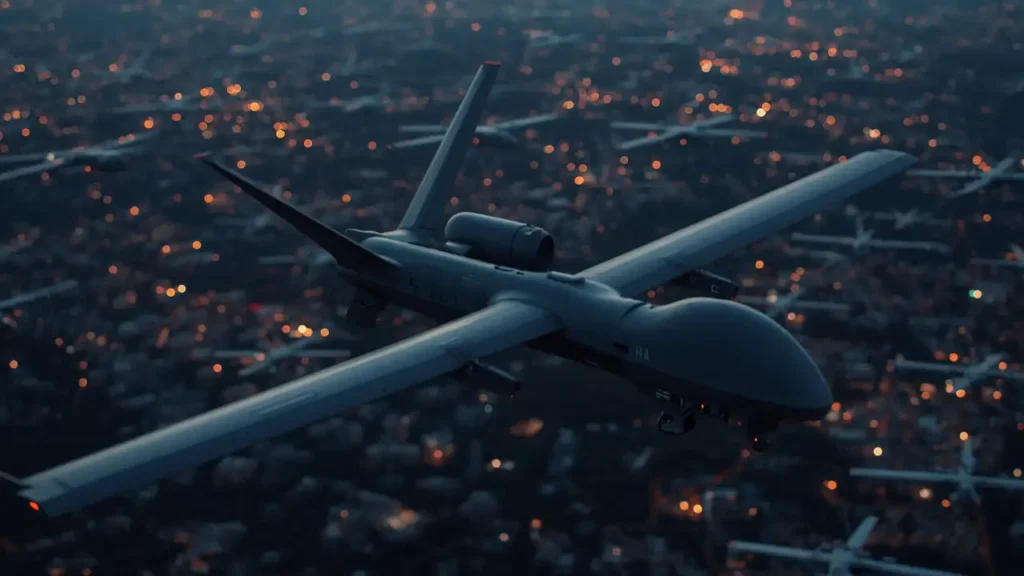
AI-enabled drones assist targeting via algorithms that help distinguish between different kinds of objects—friendly vs adversary, civilian infrastructure, etc.—and prioritize threats. One example is the Pentagon’s Project Maven, which uses machine learning, computer vision, and data fusion to help filter and identify targets from surveillance feeds. While humans still have to approve lethal force or strikes, the system accelerates the “find, fix, finish, exploit, analyze, and disseminate” chain.
Swarm Tactics and Coordinated Operations
Swarming—multiple drones operating together in coordination—is an area receiving heavy investment. Swarm UAS can cover more ground, complicate adversary defenses, and enhance redundancy. U.S. programs such as Replicator are designed to deploy large numbers of low-cost, attritable autonomous systems. These may work collaboratively for surveillance, target saturation, or decoy missions.
Counter-Drone and Air Defense Systems
With proliferation of small drones as threats (for reconnaissance, loitering munitions, or kamikaze attacks), the U.S. military is pushing AI-based counter-drone systems. The Replicator initiative includes counter-drone technologies that detect, analyse, and neutralize hostile UAS threats.
Another example is from the Naval Postgraduate School, which is developing AI to automate ship-defensive high energy laser systems. These use AI to rapidly assess incoming drone threats, track them, and aim defensive lasers accordingly.
Operations in Degraded or Denied Environments
AI-enabled drones are particularly valuable when GPS, communications, or command-and-control links are compromised or jammed. Autonomous navigation, waypoints, obstacle avoidance, and on-board decision-making allow UAS to continue missions even under contested conditions. Shield AI’s V-BAT, for example, is built to function in GPS/beyond line-of-sight challenged environments.
Strategic Programs & Initiatives
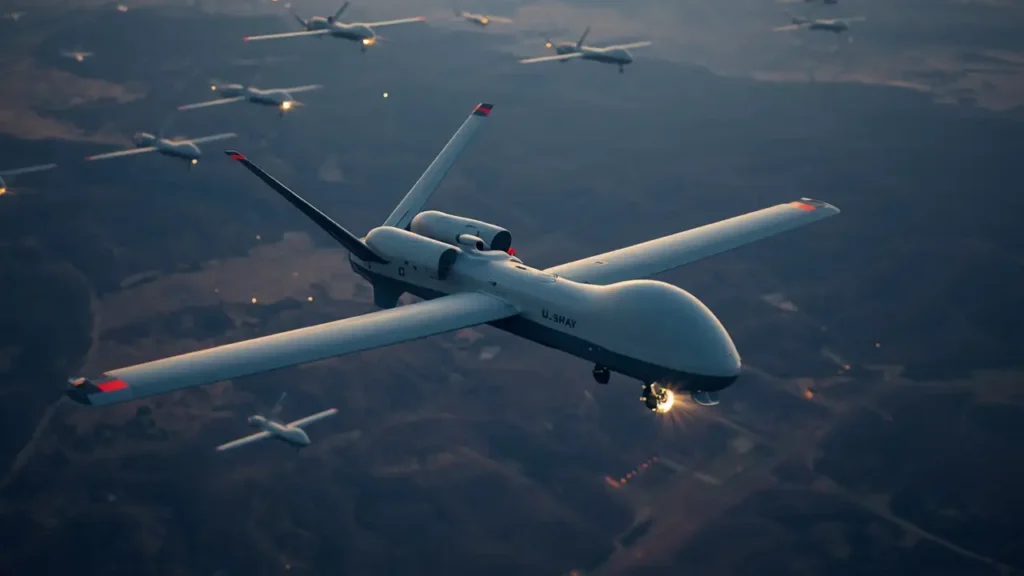
- Replicator: A U.S. DoD program aiming to field thousands of low-cost autonomous systems in coming years, both for offensive use (attritable drones) and for defensive roles like counter-drone.
- Project Maven: Focused on target recognition from imagery/sensor data, helping human operators make faster and more accurate decisions.
Analysis & Context
The deployment of AI-enabled drones reflects a shift in how the U.S. military views unmanned systems—not merely as remote cameras or missiles, but as intelligent agents within a networked battlespace. Several factors are driving this:
- Pace of warfare: AI and automation compress decision cycles. Adversaries are fielding drones and EW (electronic warfare), so response times using AI assistance become critical.
- Cost & attritability: Using lower-cost autonomous drones that can be “lost” (attritable) in high risk zones makes operations more acceptable than risking expensive manned platforms.
- Resilience: In contested environments where satellites, GPS, or comms may be disrupted, UAS with autonomous capabilities ensure continuity of operations.
However, challenges remain: ethical issues around autonomous targeting; ensuring reliability and safety; adversarial counter-measures (jamming, spoofing, deception); legal and policy constraints; and scaling production while maintaining trust and interoperability.
What’s Next? Trends to Watch
- Greater autonomy with human oversight: Fully autonomous lethal systems remain controversial; likely future is supervised autonomy, where humans retain control of “kill decisions.”
- Improved sensor fusion & AI robustness: More resilient against spoofing, deception, and able to operate in adverse weather or complex terrain.
- Swarms & attritable mass production: More investment in systems that are inexpensive, disposable, networked.
- Regulatory, doctrine & ethical frameworks: Policies will need catching up to technology—defining acceptable levels of autonomy, rules of engagement, accountability.
Conclusion
AI-enabled drones are becoming a core component of U.S. military strategy, across ISR, precision targeting, swarm operations, and defense against drones. While the promise is immense, getting autonomy, ethics, policy, and industrial capacity in alignment will be essential for these technologies to deliver reliably and responsibly in future conflicts.
FAQs
As of now, most AI-enabled systems are semi-autonomous. Humans commonly retain control over critical decisions, especially lethal force. Fully autonomous lethal drones are constrained by legal, ethical, and policy limits.
An “attritable” drone is a system that is designed to be low-cost and expendable. If lost or damaged in contested zones, the loss is acceptable compared to losing high-value or manned platforms.
U.S. programs use radar, electronic warfare, AI for detection, tracking, classification, and then deploy effectors (jammers, kinetic interceptors, lasers) to neutralize hostile drones. Some systems can autonomously detect and classify threats and assist in real-time defensive decisions.
Key concerns include proper distinction between combatants and civilians; whether AI decision making meets legal standards; accountability if AI malfunctions; ensuring transparency and oversight; and international norms.
Note: The images are AI-generated.

26 comments
[…] of THAAD batteries is key. Even deployed systems may not cover certain strategic areas (for example, in South Korea, the position of a THAAD battery […]
[…] boundaries for the testing, approval, and use of autonomous weapons. The directive insists that autonomous systems must be designed to allow commanders to exercise “appropriate levels of human judgment.” Yet […]
[…] several states have launched their own initiatives to supplement federal efforts, such as deploying National Guard assets equipped with reconnaissance drones to assist in interdiction […]
[…] give VisionWave the foundation to redefine how intelligence operates. Our goal is to bring trusted, autonomous systems to the center of mission execution — where every decision, in every moment, […]
[…] and aviation park further enhances the site’s suitability for testing and developing dual-use drone defense solutions — bridging military and civilian airspace […]
[…] of Infantry Squad Vehicles (ISVs) and expanded drone / unmanned systems capabilities at brigade and battalion […]
[…] Drone Operations: Can deploy, recover, and manage unmanned systems in the air. […]
[…] autonomous systems offer logistical and economic advantages — lower maintenance, modular payloads, and the ability […]
[…] already prioritizes rapid acquisition programs, including the Replicator Initiative—an effort to deploy thousands of autonomous systems within two […]
[…] Founded in 2017, Anduril Industries has rapidly become one of the Pentagon’s most influential defense tech innovators. Its flagship products—including autonomous surveillance towers, AI mission command software, and expeditionary counter-UAS systems—are now deployed by multiple U.S. services and allied militaries. […]
[…] its long-term success will depend on navigating multinational integration, cost control, and the deployment of compatible drone systems. With key treaties and agreements still pending and partner nations balancing industrial and […]
[…] drone technology evolves, counter-UAS strategies will likely expand to include swarming drone threats, stealth detection, and more automated engagement protocols. The certified team serves as a […]
[…] and integration timelines have not been publicly disclosed, sources indicate the first tranche of systems is expected to begin deployment in 2026, with full operational capability targeted by end-2028. If the deal proceeds at the […]
[…] Analysts note that as theatres of operations become more contested with longer-range fires and autonomous systems, real-time detection and correction capabilities move from niche to necessity. Moreover, local […]
[…] for early-stage firms, particularly those specializing in robotics, AI-enabled sensing, counter-UAS systems, and battlefield networking tools. Participation from Anduril, Shield AI, and other fast-growth […]
[…] the Ground Master 200 radar from Thales, and unmanned platforms including the X-Wing Interceptor drone from Alta Araes for counter-UAS missions and Delair’s DT-46 and UX-11 tactical UAVs for […]
[…] capabilities of the original F-16, including supersonic speeds and advanced maneuverability. The drones are equipped with telemetry and guidance systems to simulate enemy aircraft during exercises. Their use allows pilots to engage high-speed, […]
[…] a niche, they are not viewed as a standalone solution. The training aligns with a broader C-UAS strategy within the United States Marine Corps (USMC). Earlier in 2025, the service published its first […]
[…] Talon appears derived from Scaled Composites Model 437 — a compact optionally manned jet now used by Northrop to test autonomous systems. […]
[…] of a larger system. This software-centric strategy lets operators program mission intent, with the autonomous system handling navigation, timing, and role assignment across the […]
[…] as steps toward reducing operator workload and enabling a single crew to oversee multiple autonomous systems. As autonomy systems continue to evolve, open, government-defined reference architectures may help […]
[…] with plans to embed AI capabilities across intelligence, logistics, and combat platforms. The strategy calls for expanded autonomous systems deployment, including unmanned aerial vehicles, ground robots, and maritime platforms capable of operating in […]
[…] and support of sonobuoys for use with the Royal Navy’s Merlin Mk2 helicopters. These airborne systems deploy expendable acoustic sensors to detect, locate and track hostile submarines and other underwater […]
[…] Lightfish deployment validates CTF 66’s technological integration strategy and demonstrates the feasibility of operating advanced autonomous systems from partner nation platforms. The unmanned surface vessel operates with sophisticated sensors and […]
[…] aim to lock onto hostile UAVs with minimal external support, reflecting a shift toward autonomous counter-UAS tools able to operate in contested environments without heavy reliance on centralized command […]
[…] trends in China’s unmanned systems development, where robotics increasingly figure in army modernization plans alongside aerial and maritime autonomous systems. Earlier Chinese robotic dogs have been shown with small arms or grenade launchers in […]