Royal Navy Achieves Breakthrough in Helicopter-Drone Integration
The Royal Navy has successfully demonstrated helicopter-drone integration capabilities during trials that transformed a Wildcat helicopter into an airborne command center capable of controlling multiple unmanned systems in real-time.
The Eagles Eye trials, conducted at Predannack airfield on Cornwall’s Lizard Peninsula, marked the first time Royal Navy helicopters used live data from multiple drones to target a moving vehicle. A crew from 815 Naval Air Squadron received information almost instantaneously from surveillance drones and ground-based sensors through a multi-node mesh network.
The demonstration paves the way for complex operations involving crewed and uncrewed systems working together as part of what the Royal Navy calls a “hybrid air wing” concept. This approach integrates assets not only from different Royal Navy units but potentially from across UK Armed Forces and NATO allies.
Multi-Domain Network Architecture Enables Real-Time Control
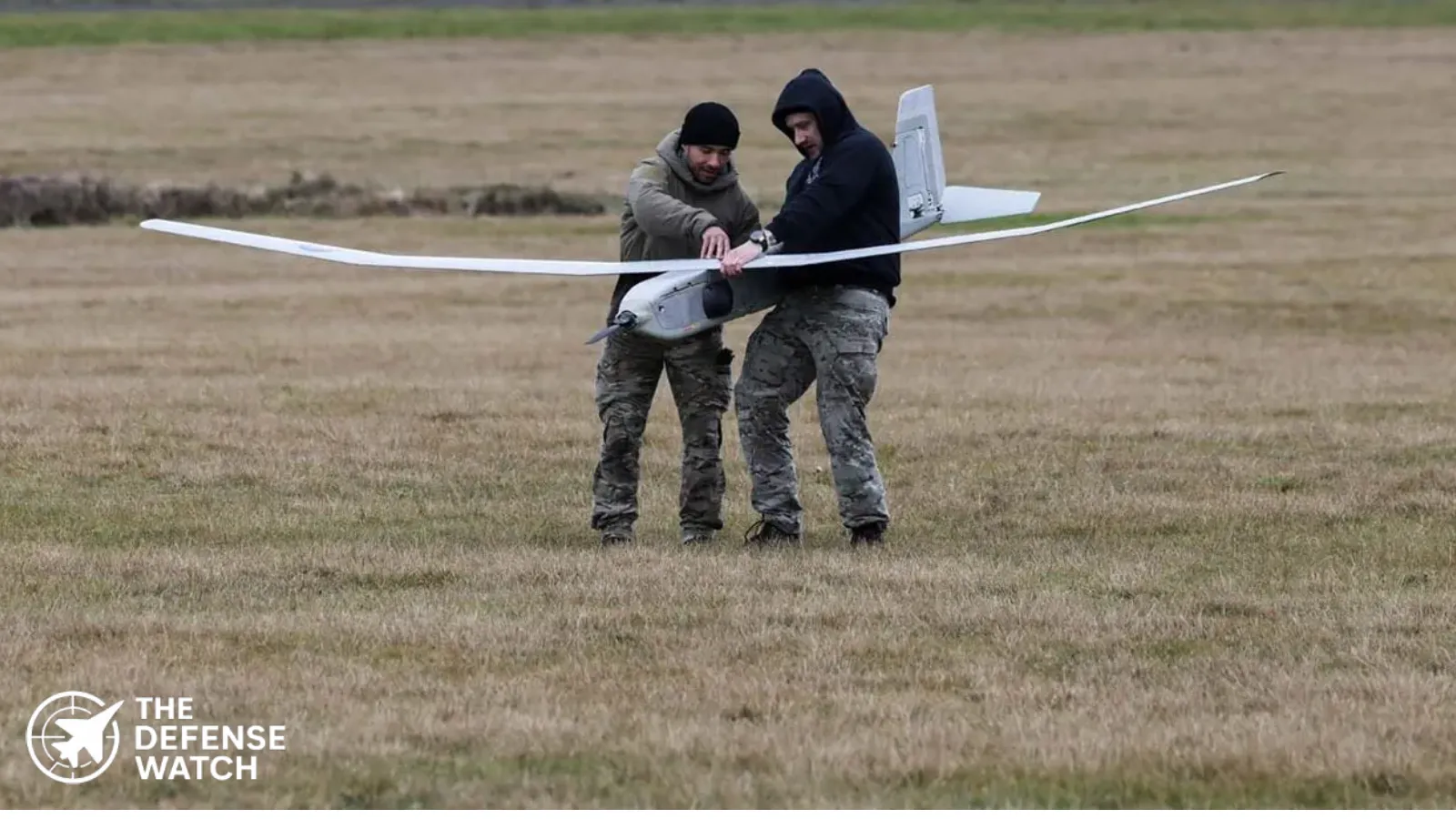
During the trials, the Wildcat crew operated the Navy’s Puma drone while simultaneously receiving video feeds from a smaller Providence system piloted by UAV Aerosystems. The aircraft processed data from both aerial platforms and ground-based sensors to locate and share target information across the network.
Lieutenant Commander Rhydian Edwards, Officer in Command of the Wildcat Maritime Force Operational Advantage Group based at RNAS Yeovilton, explained the significance of the achievement. He emphasized that remote data nodes transmitted and received information from any system on the mesh network, delivering it instantly to the aircraft while establishing foundations for tactical control of those systems.
The mesh network architecture provides decentralized communications with self-healing capabilities. If parts of the network are disrupted or fail, the system automatically finds alternative routes to securely transmit data between units and machines on the ground and in the air. This resilience makes the system significantly more survivable in contested electromagnetic environments.
Universal Translator Breaks Interoperability Barriers
The Eagles Eye trials addressed a persistent challenge in multi-platform operations. Edwards described the system as a universal translator that breaks the cycle of each new drone and sensor requiring its own unique interface. This standardization enables the Wildcat to integrate with any compatible system on the network without platform-specific modifications.
From the Wildcat’s cabin, aviators could sneak up on threats undetected before engaging with Martlet missiles. The Puma drone has been in service for more than six years with 700X Naval Air Squadron based at RNAS Culdrose, providing the trials with a proven platform for integration testing.
Commander Andrew Henderson, Commanding Officer of the Wildcat Maritime Force, stated the demonstration shows exactly where the force is heading as it embraces the Hybrid Navy model. He emphasized that success depends not just on individual drone capabilities but on network access.
Industry Partnership Drives Capability Development
The Eagles Eye initiative involved experts from multiple organizations working alongside Royal Navy personnel. Industry partners included specialists from 700X Naval Air Squadron, personnel from 847 Naval Air Squadron, and experts from MarWorks, TeleplanForsberg, General Dynamics, C3IA, UAV Aerosystems, and Collins Aerospace.
This collaborative approach reflects the complexity of integrating diverse systems into a cohesive operational capability. The trials required coordination between aviation specialists, communications experts, sensor operators, and software engineers to achieve the demonstrated level of integration.
The Royal Navy’s investment in mesh networking technology aligns with broader trends in military communications. Decentralized networks provide widespread coverage and enhanced survivability compared to traditional hub-and-spoke architectures that create single points of failure.
Operational Implications for Maritime Warfare
The ability to operate aircraft as airborne command centers for drone flotillas has significant implications for maritime operations. Helicopters and aircraft can now connect to any sensor across the communications network via a series of nodes, extending their effective sensor range far beyond their physical location.
The trials demonstrated over-the-horizon and beyond-line-of-sight capabilities, essential for operations in contested environments where adversaries may deny access to traditional communications infrastructure. By distributing sensor and communications functions across multiple platforms, the Royal Navy increases operational flexibility and reduces vulnerability to single-platform attrition.
The Wildcat Maritime Force plans to build on these results during upcoming exercises in Norway. Wildcat helicopters will operate alongside the Royal Norwegian Navy to test helicopter-drone teaming in fjord environments, focusing on threats from fast attack craft and other asymmetric challenges.
Part of Broader Hybrid Navy Transformation
The Eagles Eye trials support the Royal Navy’s broader transformation toward hybrid crewed-uncrewed operations. This initiative gained momentum following the successful first flight of Proteus, an autonomous full-size helicopter developed by Leonardo under a £60 million program.
The Proteus technology demonstrator, which flew from the same Predannack airfield earlier in January 2026, represents another component of the hybrid air wing concept. Designed and manufactured in Yeovil, the program supports approximately 100 highly-skilled British jobs while developing capabilities central to the Atlantic Bastion program.
The Atlantic Bastion strategy, announced by the Ministry of Defence, focuses on creating an advanced hybrid naval force to defend the UK and NATO allies against evolving threats. Autonomous and semi-autonomous systems enable the Royal Navy to find, track, and act against adversaries with unprecedented effectiveness across vast ocean areas.
Technical Foundation for Future Operations
The Eagles Eye trials validated technical approaches that will enable more sophisticated operations. The mesh network demonstrated during the trials provides the communications backbone for distributed operations where multiple platforms contribute sensor data and receive targeting information.
Future applications could include anti-submarine warfare operations where surface vessels, helicopters, submarines, and autonomous systems share detection data across a unified network. The ability to fuse information from diverse sensors and distribute it to decision-makers in near real-time significantly enhances operational effectiveness.
The trials also established initial tactics for helicopter-drone teaming. As Edwards noted, the Puma and Providence drones served as means to prove the system would work and develop foundational tactics. Future operations will likely involve larger numbers of drones with more diverse sensor suites and potentially autonomous decision-making capabilities.
Strategic Context and Allied Cooperation
The development of helicopter-drone integration capabilities occurs within a broader strategic context where Western militaries are investing heavily in uncrewed systems and artificial intelligence. The Royal Navy’s approach emphasizes interoperability not only within British forces but also with NATO allies.
The Eagles Eye trials demonstrated capabilities involving assets from the Royal Navy’s specialist drone squadron 700X and Wildcat personnel from 847 Naval Air Squadron. This cross-unit integration provides a template for larger-scale operations involving multiple services and allied forces.
The upcoming Norwegian exercises will test these concepts in challenging operational environments. Fjord operations present unique challenges including confined waters, complex terrain, and high-speed asymmetric threats. Successfully demonstrating helicopter-drone teaming in this environment will validate the concept’s applicability across diverse scenarios.
Modernization Through Incremental Innovation
The Royal Navy’s approach to developing hybrid capabilities reflects a strategy of incremental innovation building on existing platforms and systems. Rather than waiting for revolutionary new technologies, the service is enhancing current aircraft like the Wildcat with new networking and control capabilities.
The Puma drone used in the trials has operated with the Royal Navy for more than six years, demonstrating the service’s commitment to maturing technologies through sustained operational experience. This evolutionary approach reduces risk while building the institutional knowledge necessary for more advanced future systems.
The mesh networking technology demonstrated during Eagles Eye provides a foundation for increasingly sophisticated capabilities. As artificial intelligence and autonomous systems mature, the network architecture tested during these trials will enable those advanced capabilities to integrate seamlessly with existing crewed platforms.
Force Structure Implications
The successful Eagles Eye trials have implications for future Royal Navy force structure planning. The ability to extend helicopter capabilities through networked drones potentially increases the effective combat power of existing platforms without proportional increases in crew requirements.
This efficiency gain becomes particularly valuable as modern militaries face recruitment and retention challenges. Autonomous and semi-autonomous systems enable smaller crews to manage larger areas of operations by delegating routine surveillance and data collection tasks to uncrewed platforms.
The hybrid air wing concept also provides operational flexibility. Commanders can tailor the mix of crewed and uncrewed assets to specific mission requirements, employing drones for extended-duration surveillance while reserving crewed aircraft for missions requiring human judgment and decision-making.
Next Steps and Future Development
Following the successful Eagles Eye trials, the Royal Navy will continue developing helicopter-drone integration capabilities through operational testing and exercises. The Norwegian deployment will provide valuable data on system performance in challenging environmental conditions.
Future iterations may incorporate additional drone types, more sophisticated sensors, and enhanced autonomous capabilities. The modular approach demonstrated during Eagles Eye enables the Royal Navy to integrate new technologies as they mature without requiring fundamental system redesigns.
The trials also established procedures and training standards that will inform broader Royal Navy adoption of hybrid operations. Lessons learned regarding crew coordination, data management, and tactical employment will be incorporated into formal doctrine and training programs.
Conclusion
The Eagles Eye trials represent a significant milestone in the Royal Navy’s transformation toward hybrid crewed-uncrewed operations. By successfully demonstrating real-time helicopter control of networked drones, the service validated technologies and concepts that will shape future maritime aviation.
The mesh network architecture provides a resilient communications foundation for distributed operations. The universal translator approach to system integration enables rapid incorporation of new platforms without platform-specific modifications. Together, these capabilities position the Royal Navy to maintain operational advantage in increasingly contested electromagnetic environments.
As the service continues developing these capabilities through operational testing and allied exercises, the Eagles Eye trials will be recognized as a pivotal step toward realizing the full potential of hybrid air wings in maritime warfare.