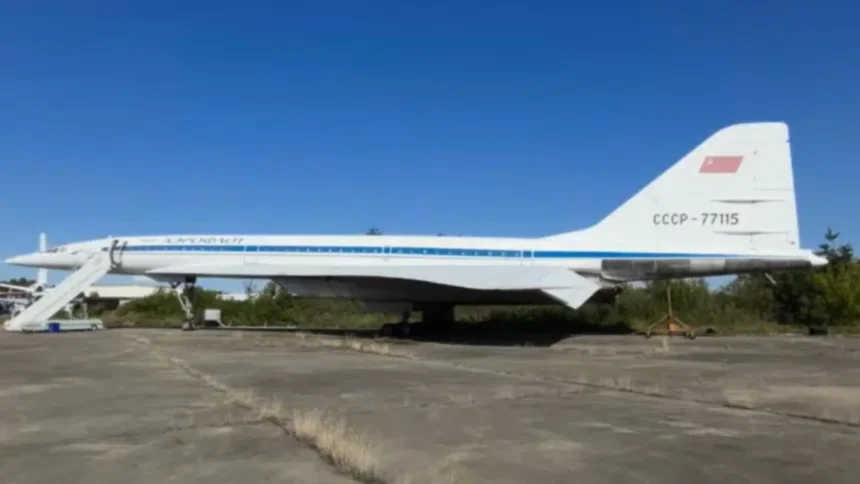
Russia is restoring a retired Tupolev Tu-144 supersonic airliner for static display, with recent maintenance work raising the possibility that the aircraft could return to public view if the MAKS International Aviation and Space Salon resumes in 2027.
The aircraft, registered CCCP-77115, is undergoing restoration at Zhukovsky near Moscow. Work documented in videos published by Russian volunteer Pavel Efter includes repairs to electrical systems, cockpit instruments, cabin lighting and the mechanism that raises and lowers the aircraft’s distinctive drooping nose.
The Aviationist reported the restoration on October 18, citing footage of the work and information shared by the volunteer. The reported objective is to preserve the aircraft for exhibition, not return it to flight.
No confirmed MAKS appearance has been announced for the Tu-144, and the air show’s anticipated 2027 return should not be treated as a finalized schedule.
Restoration focuses on preserving a Soviet supersonic icon
The Tu-144 was the Soviet Union’s attempt to establish a supersonic passenger transport capability during the Cold War. Developed by Tupolev, it became the first supersonic transport aircraft to fly, completing its maiden flight on December 31, 1968, ahead of the Anglo-French Concorde.
The aircraft was intended to combine high-speed passenger transportation with the technological prestige associated with advanced aerospace engineering. Its operational history, however, was short, and the program encountered serious technical, economic and reliability challenges.
The aircraft currently receiving attention at Zhukovsky is a Tu-144D, a later production variant. Recent restoration work has included the installation of a TA-6A auxiliary power unit, according to The Aviationist’s report.
An auxiliary power unit can provide electrical power for aircraft systems without requiring the main engines to operate. For a preserved aircraft, that capability can support demonstrations of selected onboard functions while the airframe remains stationary.
The restoration team has also worked on cabin lighting, electrical equipment, instrumentation and the nose and canard mechanisms. These efforts can improve the aircraft’s condition as a museum or air-show exhibit, but they do not establish that its propulsion system or flight-critical equipment is ready for operation.
Why the MAKS connection matters
Zhukovsky is closely associated with Russia’s aviation research and aerospace industry. It is also the traditional venue for MAKS, where aircraft manufacturers, research organizations and government-linked aviation companies have displayed aircraft and technologies.
The Tu-144 has previously served as a static attraction at the event. Its distinctive shape and place in supersonic aviation history make it a natural candidate for preservation displays, although its participation in a future show remains unconfirmed.
MAKS was last held in 2021. Russia subsequently postponed the event several times, and reporting in June 2026 indicated that the 2026 edition had been canceled, with a possible return in 2027.
That uncertainty matters when assessing the restoration. Maintenance work may be intended to preserve the aircraft regardless of the event’s schedule. The available reporting does not establish that the restoration was commissioned by MAKS organizers or that an official decision has been made to exhibit the aircraft at a future edition.
The distinction is important: preparations for static display are not proof of an announced air-show appearance.
What the Tu-144 can, and cannot, demonstrate
The restoration offers an opportunity to show visitors how a supersonic transport aircraft was designed and operated. The Tu-144’s drooping nose improved forward visibility during low-speed flight phases, while its retractable canard surfaces helped address aerodynamic and handling requirements.
These features make the aircraft valuable for aviation education. Visitors can see design choices that are difficult to understand from photographs or technical drawings alone.
However, the restoration should not be confused with an airworthiness program. The volunteer involved has reportedly clarified that the work is intended for static display, and there is no verified evidence that CCCP-77115 is being prepared for a return to flight.
A flying restoration would involve a different set of requirements, including engine and airframe assessments, component availability, maintenance documentation, regulatory approval and extensive technical testing. The aircraft’s age and the limited availability of original components would add to those challenges.
Even if selected systems can be powered and demonstrated on the ground, that does not establish that the aircraft can taxi or fly safely.
The Tu-144’s troubled commercial history
The Tu-144 entered passenger service in 1977 on a limited route between Moscow and Alma-Ata, now Almaty in Kazakhstan. Passenger operations ended in 1978 after a short period of service.
Its history was also shaped by the fatal crash of a Tu-144 at the Paris Air Show on June 3, 1973. The aircraft broke apart during a flight demonstration, killing all six people aboard and eight people on the ground.
The crash became one of the most prominent episodes in the program’s history, although the aircraft’s wider difficulties extended beyond that accident. High operating costs, fuel consumption, maintenance demands and technical problems limited its usefulness as a commercial airliner.
The Tu-144 program continued in research roles after passenger operations ended. One aircraft, converted into the Tu-144LL flying laboratory, was used in a joint Russian and U.S. research effort during the 1990s to investigate technologies relevant to future supersonic passenger transport.
That later work gave the aircraft a second role in aviation research, separate from its original commercial mission.
Preservation is not a revival of supersonic passenger service
The restoration of CCCP-77115 is primarily a heritage and preservation story. It does not indicate that Russia is reviving the original Tu-144 production program or returning the aircraft to commercial service.
Russia has separately discussed developing a new supersonic passenger aircraft, according to reporting on statements by United Aircraft Corporation leadership. That prospective program is distinct from work on the retired Tu-144, and its progress should be assessed through independently verified milestones rather than comparisons based on appearance or historical lineage.
For now, the most concrete development is the restoration of an existing aircraft and its systems for display. Whether it appears at a future MAKS event will depend on the air show’s schedule and any subsequent exhibition decision.
The Tu-144’s return to public display would preserve a significant chapter of Soviet aerospace history. It would not, by itself, demonstrate that the engineering, economic and operational challenges that limited the original aircraft have been overcome.