
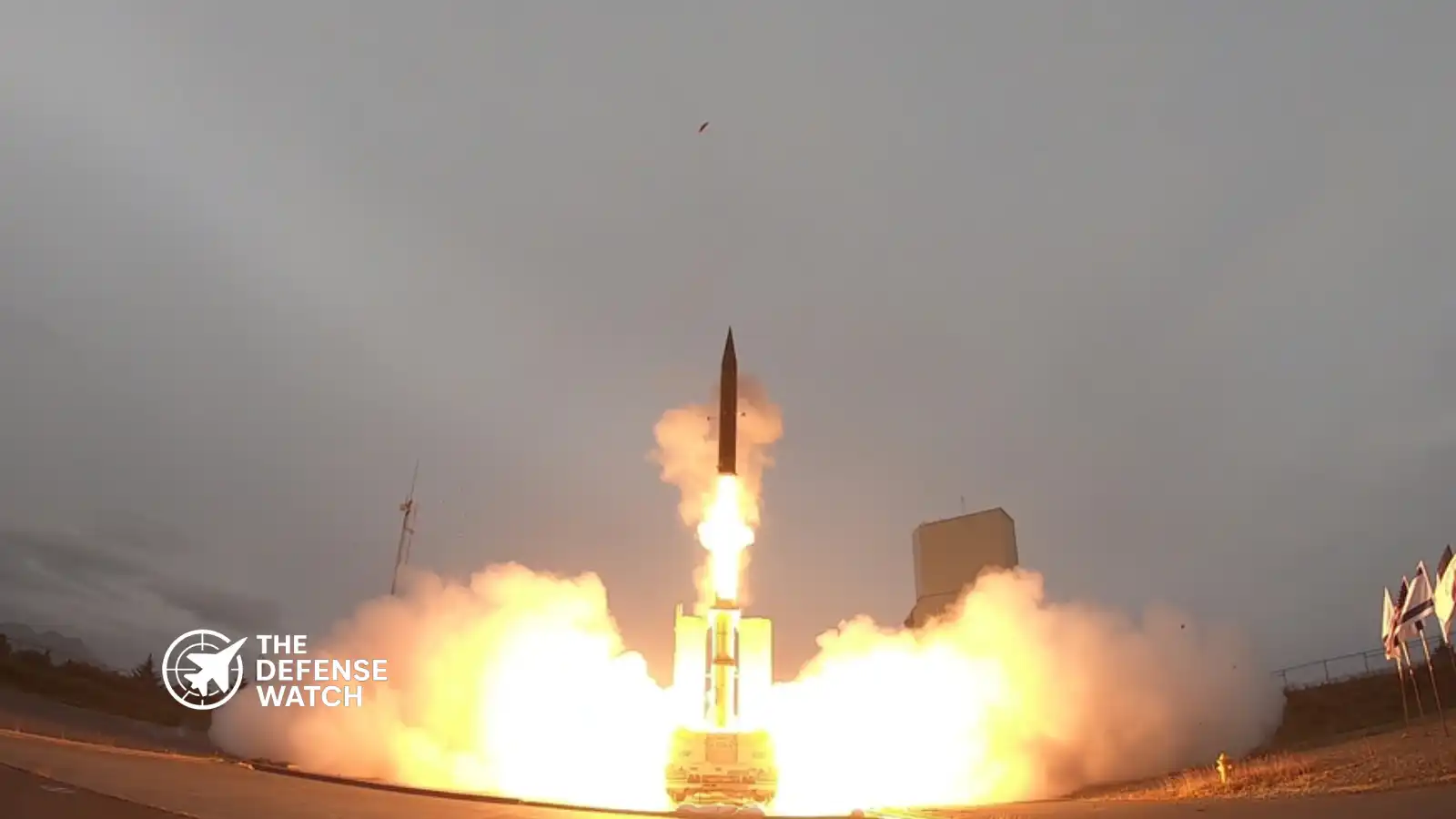
Israel Accelerates Arrow Interceptor Production To Reinforce Missile Defense
Israel’s decision to accelerate Arrow interceptor production marks a significant expansion of its missile defense posture, as the country adapts to evolving ballistic missile threats across the Middle East.
The Israeli Ministry of Defense has approved measures to increase manufacturing output of the Arrow interceptor family, a key component of the country’s layered air defense architecture. The move comes amid heightened regional tensions and a growing emphasis on preparedness for sustained, high-intensity conflict.
According to official statements and defense industry reporting, the acceleration effort focuses on boosting inventory levels and ensuring rapid replenishment capacity. This reflects lessons learned from recent conflicts, where high interceptor consumption rates have underscored the importance of industrial scalability.
- Israel approved accelerated production of Arrow missile interceptors to strengthen national air defense capacity.
- The decision reflects growing concerns over ballistic missile threats from Iran and regional actors.
- Arrow systems are designed to intercept long-range ballistic missiles outside the atmosphere.
- The move aims to ensure sustained operational readiness during prolonged high-intensity conflict scenarios.
- The program is jointly developed with U.S. support, reinforcing strategic defense cooperation.
Strategic Response To Expanding Missile Threats
The Arrow interceptor system is specifically designed to counter long-range ballistic missiles, including threats that travel outside the Earth’s atmosphere before reentry. This capability places it at the top tier of Israel’s multi-layered defense network, complementing systems like David’s Sling and Iron Dome.
The decision to expand Arrow production is widely viewed as a response to Iran’s advancing missile capabilities. Tehran has continued to develop and field increasingly sophisticated ballistic systems, including longer-range and more precise variants. These developments have shifted regional threat calculations, prompting Israel to prioritize strategic missile defense.
Defense analysts note that interceptor availability is as critical as system capability. In a prolonged conflict scenario, even advanced systems can face operational strain if interceptor stockpiles are insufficient. By accelerating production, Israel is aiming to mitigate this risk and maintain sustained defensive coverage.
Industrial Surge And U.S. Cooperation
The Arrow program is a joint initiative between Israel and the United States, with significant funding and technological collaboration from Washington. This partnership has enabled continuous upgrades to the system, including improvements in interception range, accuracy, and reliability.
Accelerating production will likely involve expanded industrial activity across Israel’s defense sector, particularly among key contractors responsible for missile manufacturing and system integration. While specific production figures have not been disclosed, the emphasis is clearly on increasing throughput and reducing delivery timelines.
From a strategic perspective, the move also aligns with broader U.S. concerns about missile proliferation in the Middle East. Strengthening allied missile defense capabilities is seen as a critical element of regional stability, particularly in deterring escalation.
Operational Implications For Future Conflicts
The expansion of Arrow interceptor production carries direct operational implications. In a high-threat environment, such as a multi-front conflict involving ballistic missile salvos, the ability to sustain interception rates becomes decisive.
Recent conflicts have demonstrated that missile defense systems can be overwhelmed if faced with large-scale, coordinated attacks. By increasing interceptor availability, Israel aims to maintain a credible defense against saturation tactics.
Additionally, the move signals a shift toward long-duration readiness. Rather than preparing for short, limited engagements, Israel is positioning its defense infrastructure for extended operations, where logistics and supply chains play a central role.
This approach reflects a broader trend in modern warfare, where industrial capacity and resilience are increasingly recognized as key components of military power.
Broader Regional And Strategic Context
The acceleration of Arrow interceptor production comes at a time of intensifying geopolitical competition in the Middle East. Iran’s missile development, combined with the proliferation of missile and drone technologies among non-state actors, has created a complex threat environment.
Israel’s response highlights the importance of layered defense systems capable of addressing a wide spectrum of threats, from short-range rockets to intercontinental ballistic missiles. The Arrow system, as the upper layer, plays a critical role in this architecture.
At the same time, the move underscores the growing importance of defense industrial policy. Ensuring rapid production and replenishment is no longer a secondary consideration, but a central element of national security planning.
Get real time update about this post category directly on your device, subscribe now.


