
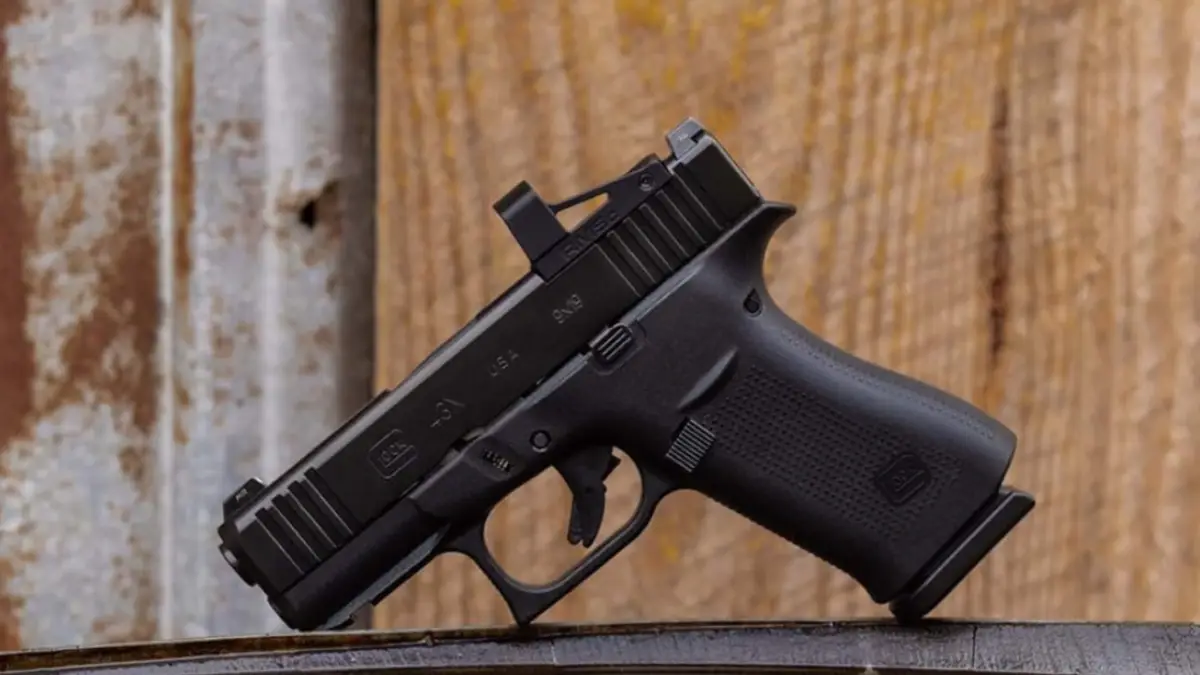
Glock 19: A Compact Icon of Modern Warfare
The Glock 19, chambered in 9×19mm NATO, has become one of the most widely used compact pistols in military and law enforcement service worldwide. Among its most prominent users are U.S. and allied Special Operations Forces (SOF), who employ the pistol in close-quarters battle (CQB) scenarios where reliability, compact size, and rapid deployment are essential.
Introduced in the late 1980s as a more compact version of the full-sized Glock 17, the Glock 19 balances portability with firepower, offering a 15-round magazine capacity in a lightweight, polymer-framed design. This combination has made it a standard sidearm not only for SOF but also for conventional military units, police agencies, and private security contractors across the globe.
Why Special Operations Forces Choose the Glock 19
Special operations units prioritize weapons that are lightweight, concealable, and extremely reliable under stress. The Glock 19 fulfills these requirements with its rugged simplicity—its striker-fired mechanism and limited external controls reduce the chances of malfunctions in high-stakes engagements.
The pistol’s compact size allows it to be carried as a secondary weapon during raids, reconnaissance missions, or protective security details. Operators often rely on it in situations where a rifle is impractical, such as urban CQB environments, aircraft operations, or close personal protection.
Additionally, the Glock 19 is compatible with suppressors and modern optics, further enhancing its adaptability to diverse mission profiles.
Global Military and Law Enforcement Adoption
The Glock 19 is not limited to U.S. SOF. It has been adopted by numerous NATO allies, special police units, and counterterrorism forces worldwide. Countries including the United Kingdom, Norway, and Israel field the pistol in their armed forces or elite security services.
Even within the United States, different branches and agencies—including the FBI and U.S. Customs and Border Protection—have selected the Glock 19 as a primary sidearm, citing its balance of size, accuracy, and reliability.
Technical Specifications of the Glock 19 (Gen 5 Model)
- Caliber: 9×19mm NATO
- Barrel Length: 4.02 in (102 mm)
- Overall Length: 7.36 in (187 mm)
- Height: 5.04 in (128 mm)
- Magazine Capacity: Standard 15 rounds, optional extended magazines
- Weight (unloaded): 23.63 oz (670 g)
These specifications illustrate why the Glock 19 is versatile enough to function as both a service pistol and a concealed-carry option, bridging the gap between compact and full-size handguns.
Analysis: Enduring Popularity of the Glock 19
The enduring dominance of the Glock 19 highlights a larger trend in modern sidearm selection: simplicity, modularity, and global interoperability matter as much as raw firepower. While newer competitors such as the SIG Sauer P320 (adopted by the U.S. military as the M17/M18) are gaining traction, the Glock 19 continues to hold a strong position due to its decades of combat-proven reliability and widespread user familiarity.
For SOF, the Glock 19 is not just a backup weapon—it is a trusted lifeline in CQB environments, where split-second decisions can determine mission success or failure.
Source : Official Glock Military and Law Enforcement Information
FAQs
Its compact size, reliability, and ability to function in CQB make it ideal for elite units.
The Glock 19 is a more compact version, with a shorter barrel and grip, making it easier to conceal and carry.
Yes, while the SIG Sauer M17/M18 has replaced the Beretta M9 as the standard issue, SOF units and law enforcement still widely field the Glock 19.
Get real time update about this post category directly on your device, subscribe now.

28 comments
[…] Space Force is designed not as a duplication of NASA or civilian space programs, but as a dedicated military organization responsible for ensuring freedom of operation in […]
[…] Los Angeles-class, are designed to hunt enemy ships, conduct intelligence missions, and support special operations. Nuclear propulsion gives them unmatched endurance and speed, making them a permanent presence in […]
[…] or assets in outer space—or extension of space-based tools in support of terrestrial military operations. It encompasses non-aggressive military use (e.g., surveillance satellites, communication relays, […]
[…] The U.S. Global Positioning System (GPS), Russia’s GLONASS, Europe’s Galileo, and China’s BeiDou are prime examples of space militarization. These systems are not designed to attack but instead provide strategic and tactical advantages to armed forces. […]
[…] Chinese shipbuilding capacity has surged, with projections that by 2035 the PLAN may outnumber U.S. battle force ships by a wide margin—forecasting up to 475 battle-force ships against 305–317 for the U.S. […]
[…] of transition brigades testified that these additions are reshaping how infantry operates. In one training rotation at the Joint Multinational Readiness Center, 90 percent of fire missions […]
[…] represent one of the most clandestine forms of force projection. A submarine can covertly carry special operators close to denied coastlines or under contested areas, minimizing exposure to enemy surveillance or […]
[…] option for 40 more. The systems are produced in the UK and Europe and tailored to meet the British Armed Forces’ requirements. The GBSR capability is intended to detect and classify moving threats — including […]
[…] IAF officials have also indicated that the base could support a wide range of platforms, including special operations aircraft, UAVs, and rotary-wing assets, all critical for high-altitude […]
[…] Vladimir Padrino López stated that the exercise involves roughly 200,000 personnel drawn from the armed forces and bolivarian militias. The deployments are nationwide, spanning coastal zones, riverine regions […]
[…] imaging infrared (IIR) seekers, thrust-vectoring capabilities, and off-boresight targeting, many forces still operate large stocks of M-variant missiles due to their lower cost and widespread […]
[…] operations: The force includes maritime strike units, but also integrates Marines and potentially special operations. This underscores a hybrid strategy combining counter-narcotics, intelligence, and […]
[…] endurance and low acoustic signature are key attributes driving Army interest, particularly as forces adapt to dispersed and multi-domain operational requirements. The drone is expected to complement existing unmanned platforms used by ground […]
[…] design, combining vertical-takeoff electric motors with a gasoline cruise engine. This allows operation from compact sites — as small as 20 × 20 meters — without runways or catapults. Its medium-tactical endurance, internal […]
[…] there is no confirmed evidence that these weapons are fully operational, analysts note that North Korean displays under Kim Jong Un have historically led to either testing […]
[…] & capacity: Crew of three (commander, driver, weapons operator) + space for six dismounted infantry […]
[…] response, some armed forces have turned to a low-tech but effective solution: shotguns. The M1014, a 12-gauge semi-automatic […]
[…] — like LPDs, LHAs, and LHDs — and small landing craft or connectors. Large ships offer robust force projection but are expensive to operate and ill-suited for high-risk littoral environments where ports may be unavailable. Smaller craft […]
[…] sets. Its ability to be configured within minutes from a light attack role with guided and unguided weapons to a special operations profile with fast-rope and hoist gear is a central part of its operational […]
[…] Lightweight Torpedo to improve detection, tracking, and engagement of modern submarine threats. The weapon is designed to operate in shallow and deep-water environments, with improved processing and guidance systems compared to […]
[…] report states that U.S. forces had already begun operational movements when the order was reversed. Iranian airspace was later reopened, and U.S. aircraft […]
[…] Gen Alexus Grynkewich noted that recent field visits to the High North demonstrated how Nordic forces operate under extreme conditions and integrate across […]
[…] its armored fleet over the past decade, with the Terrex family playing a central role in mechanized infantry operations and overseas […]
[…] Armed Forces operations have concluded,” the Polish military stated in official communications. “We thank NATO Air Command and the Royal Netherlands Air Force […]
[…] designed to suppress and degrade enemy air defenses. Its presence in Jordan places a highly specialized capability within operational reach of several regional theaters. U.S. Central Command has not released detailed mission […]
[…] a strategic goal, given Taiwan’s aim to match the pace of technological change and ensure its forces can operate effectively in a contested […]
[…] Special Reconnaissance operations to provide intelligence and situational awareness […]
[…] engineers emphasized semi-autonomous combat modes with a human operator in the loop for weapons release. The missile-armed dog could add new options for infantry units in confined environments […]