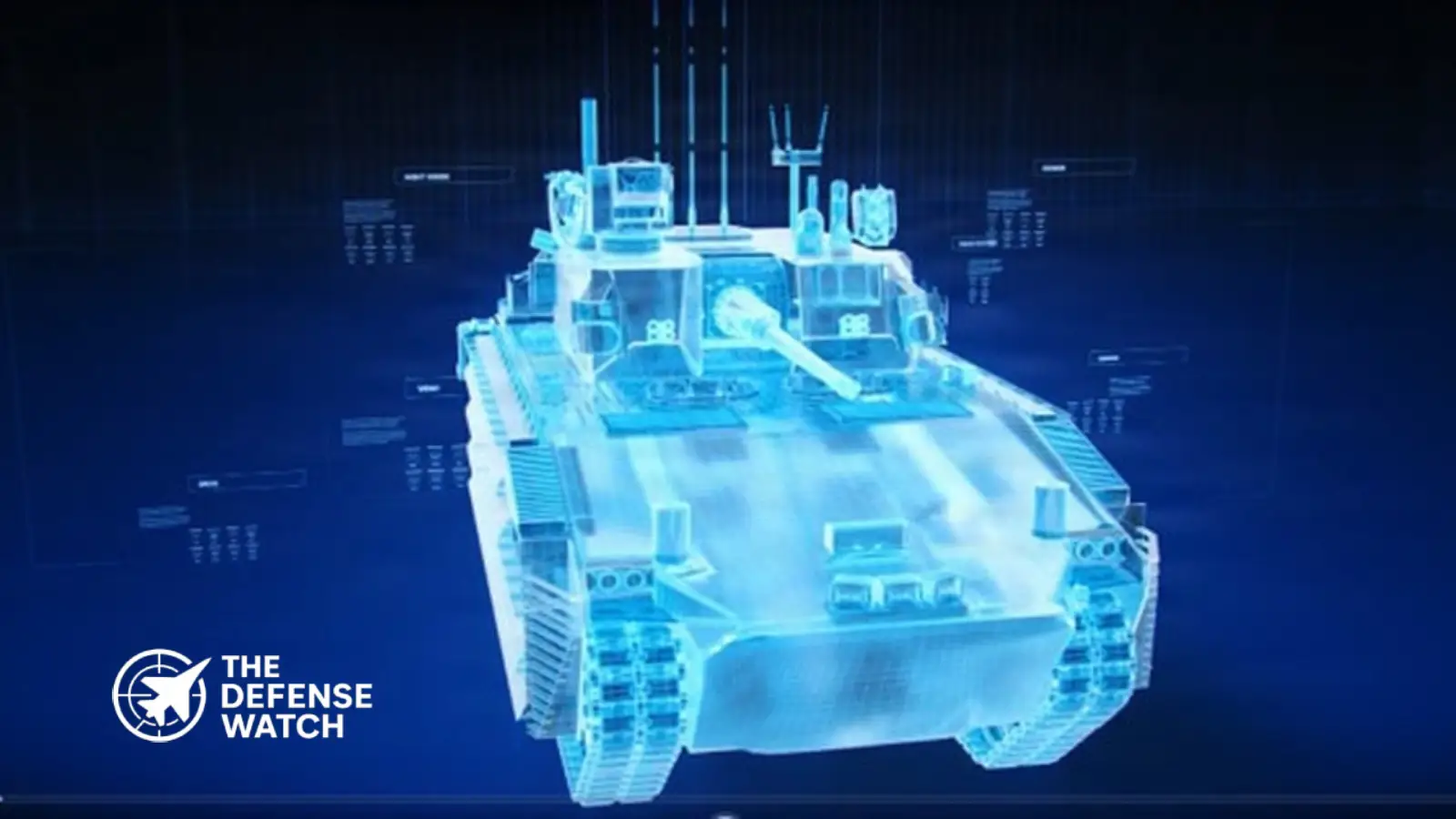
General Dynamics Adds AI Voice Control to Abrams, XM30
For crews operating increasingly software-heavy armored vehicles, the problem is no longer limited to driving, observing terrain and operating weapons. Radios, cameras, tactical displays, sensors and uncrewed systems can each require their own controls. General Dynamics Land Systems and Primordial Labs are now working on an interface intended to bring some of those functions together through spoken commands.
The companies announced a master teaming agreement on October 7 to expand Primordial Labs’ Anura natural-language command and control software across General Dynamics Land Systems combat vehicles. The effort is aimed at platforms including the Abrams and the company’s next-generation combat vehicles, with the XM30 program among the most relevant applications.
The agreement does not mean that current Abrams tanks or XM30 prototypes have suddenly received an operational AI voice-control system. It establishes cooperation to integrate and expand the technology. General Dynamics said Anura can interact with vehicle subsystems such as sensors, displays, communications and uncrewed systems, but did not announce a fielding date, vehicle quantity or program cost.
The real target is crew workload
Anura is designed to translate a crew member’s stated intent into actions by connected systems. Instead of navigating separate menus or dedicated controls, a soldier could use natural language to request an action involving a compatible sensor, radio, display or uncrewed platform.
Primordial Labs describes Anura as a human-machine interface that combines natural-language understanding with an autonomous agent. The company says the software can operate at the tactical edge without server reachback, an important distinction for military vehicles expected to operate in communications-denied environments.
That architecture matters because a voice interface is only useful on a combat vehicle if it continues functioning when external communications are disrupted. Local processing does not remove the need for communications between a vehicle and an external drone or robot, but it can prevent the voice interface itself from depending on a cloud service.
The companies also present the system as a way to address the growing number of digital functions being placed inside modern armored vehicles. General Dynamics said natural-language control could help reduce physical and cognitive workload as vehicle crews become smaller and their systems become more complex.
XM30 already has a voice-control requirement in its development history
The connection to XM30 is particularly significant because the Army has already been examining voice commands as part of the vehicle’s software development.
An Army fiscal year 2026 research and development budget document identified a Software Acquisition Pathway effort called Banshee, described as providing voice commands for enhanced operations of the XM30’s two-person crew. The same budget documentation links the broader work to the vehicle’s modular and open digital architecture.
That means the General Dynamics and Primordial Labs agreement is not simply adding a voice assistant to an otherwise unchanged vehicle concept. It fits into a wider Army effort to make the XM30’s digital architecture capable of accepting new software and technologies as they mature.
The Army describes XM30 as a minimally manned, open-architecture combat vehicle intended to replace the Bradley Fighting Vehicle. Its program documentation also says the vehicle is expected to operate with semi-autonomous systems and control maneuver robotics as part of combined-arms formations.
For a two-person crew, reducing the number of physical interfaces becomes more important. A crew member who has to shift attention between driving, observation, communications, tactical information and robotic systems has fewer opportunities to maintain awareness outside the vehicle.
Abrams is moving toward the same software problem
The Abrams application is tied to the Army’s separate M1E3 modernization effort.
The Army’s M1E3 program is intended to replace the M1A2 SEPv3 with a redesigned platform that places greater emphasis on reduced weight, crew efficiency, modular architecture and integration of new technologies. Army leadership has described the M1E3 as having a three-person crew, compared with four on the current Abrams configuration.
The Army’s Abrams program office also identifies improved crew efficiency and integration of new technologies among the objectives of the M1E3 modernization effort.
That creates a similar design challenge to XM30. Removing crew members does not automatically remove their workload. It increases the importance of automation and interfaces that allow the remaining crew to manage more functions without constantly changing between controls.
Natural-language control could therefore become an enabling technology rather than a standalone capability. Its value would depend on whether it reduces workload without introducing new problems in reliability, command ambiguity or operator trust.
This is not a voice-controlled weapons system
One of the most important distinctions is what Anura is not being presented as doing.
Breaking Defense reported after interviews with the companies that the initial concept excludes weapon firing and direct fire-control tasks. The reported applications instead include communications, radio-network selection, reports and camera views, as well as interaction with other automated systems.
That boundary is technically and operationally important. A voice command that changes a radio channel or selects a camera view can be verified before execution using relatively straightforward controls. A mistaken command affecting a weapon system would introduce a fundamentally different safety and authorization problem.
The distinction also separates this technology from the idea of a conversational AI independently making combat decisions. Primordial Labs says Anura is not based on generative AI in the conventional chatbot sense. Its product information describes a more constrained natural-language and autonomy architecture intended to translate operator intent into structured actions.
That does not eliminate risk. Speech recognition must work around engine noise, vibration, radio traffic and multiple people speaking inside an armored vehicle. The system must also distinguish an intended command from ordinary crew conversation and provide clear feedback about what action it is preparing to execute.
Public information released with the teaming agreement does not establish performance figures for those conditions, including command latency, recognition accuracy under battlefield noise or the maximum number of simultaneous users.
Anura’s earlier work is mostly outside armored vehicles
Primordial Labs has developed Anura primarily around human-machine control of uncrewed systems.
The company says the software can control drones, sensors and mission software through natural-language commands and has demonstrated integrations involving systems such as Teal and Skydio platforms. Its product architecture is intended to be platform and sensor agnostic.
The U.S. Army has also highlighted Primordial Labs’ work on voice-controlled multi-agent systems as part of broader autonomy experimentation. The Army’s Program Integration and Technology office recently cited the company’s work on natural-language voice control for tactical UAS teaming and related human-machine concepts.
Moving that interface into a crewed armored vehicle presents a different test environment. The software would have to operate alongside vehicle mission computers and communications equipment while meeting the Army’s requirements for safety, cybersecurity, reliability and human control.
The agreement therefore has more significance as an integration effort than as evidence that voice control is already ready for widespread armored-force deployment.
The open architecture question
XM30’s modular open architecture gives the Army a path for introducing software capabilities after the basic vehicle design is established. Army procurement documents specifically identify the vehicle’s open architecture as a means of allowing developing technologies to be incorporated as they mature.
That approach could also reduce the risk that a single interface becomes permanently tied to one vehicle configuration. If natural-language control can be integrated through standardized interfaces, the same basic interaction model could potentially move between different sensors, displays, communications systems and robotic platforms.
But that remains a development objective rather than a demonstrated fleet-wide capability.
General Dynamics said the agreement will expand Anura across its land-system portfolio, while Primordial Labs describes the software as platform agnostic. Neither company announced a production commitment, a specific integration schedule or a fielding decision with the October 7 announcement.
For the Army, the more important test will be whether soldiers can use the interface reliably under realistic operating conditions. If the technology reduces the time crews spend managing secondary systems, it could help make smaller crews practical. If it creates additional verification steps or unreliable commands, the benefit could be much smaller.
The technology is therefore best understood as another layer in the Army’s effort to reduce crew workload while expanding the number of systems a combat vehicle can control. The General Dynamics and Primordial Labs agreement moves that concept closer to major armored platforms, but it does not yet establish when, or in what configuration, the capability will enter operational service.