
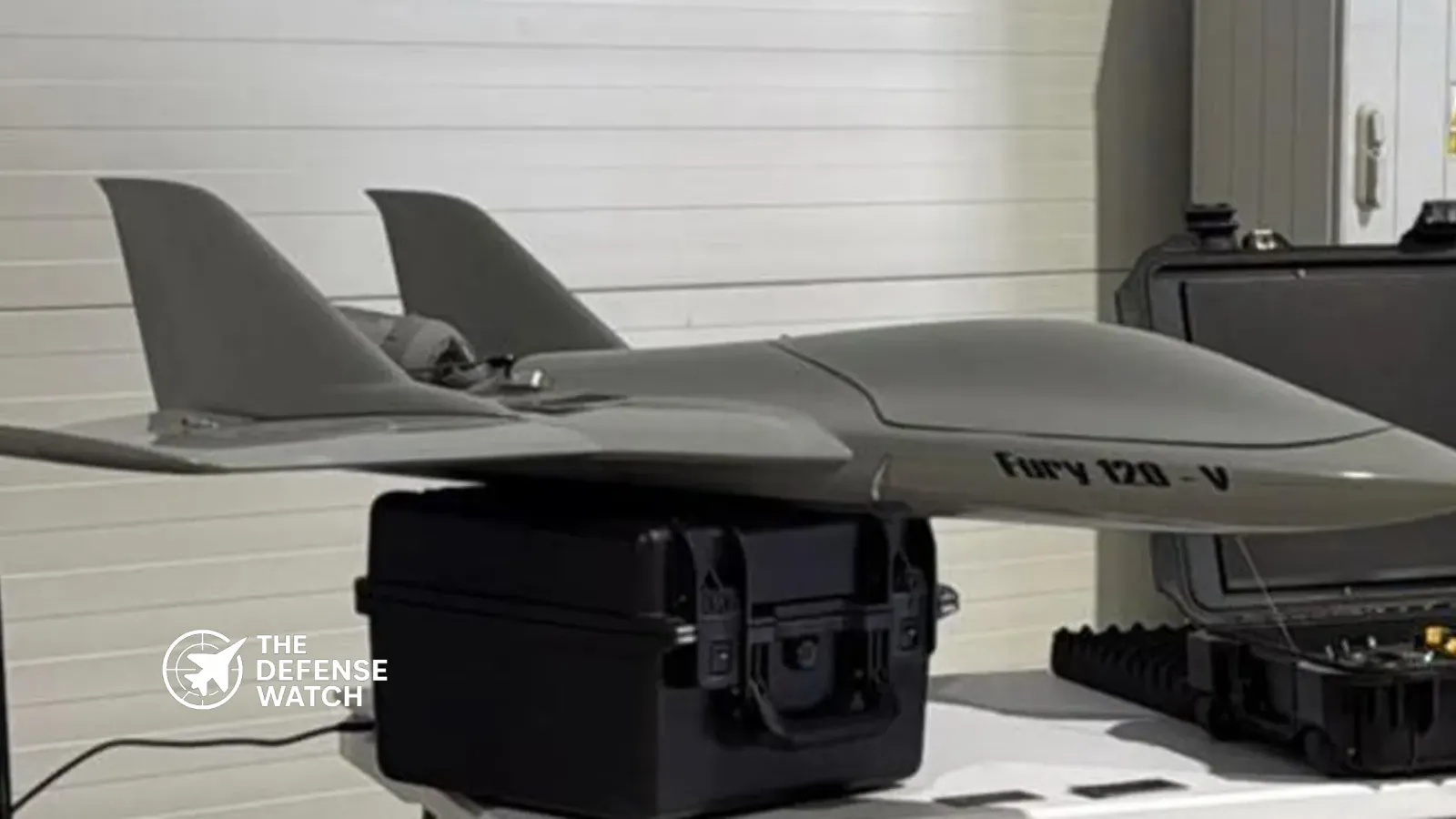
France Develops Fury 120 Interceptor to Counter Shahed-Type Drones
France has revealed the Fury 120 interceptor drone, a jet-powered unmanned system designed to engage and defeat Shahed-type attack drones used by Russia and others.
Developed by French precision-machining firm ALM Meca, Fury 120 aims to provide a high-speed solution to the growing challenge of low-cost, one-way attack UAVs that have strained air defense systems.
Jet-Powered Interceptor Concept
Fury 120 measures about 1.1 meters in length with a wingspan just over one meter. It is powered by a kerosene microjet engine that reportedly enables maximum speeds of approximately 700 kilometers per hour (435 miles per hour). That puts its top speed at roughly three times that of many potential targets such as Iranian-designed Shahed drones and their Russian Geran derivatives used in Ukraine.
The platform also reportedly withstands sustained maneuvers up to 20 G, which, according to French sources, enhances trajectory correction and intercept flexibility in constrained and dynamic airspace.
Industrial and Development Pathway
Unlike most large European defense systems, the Fury 120 was developed outside France’s official procurement framework with private funding by ALM Meca, a small-to-medium enterprise specializing in precision machining. The program reportedly moved from concept to prototype in under a year.
A research associate at the Saint-Cyr Coëtquidan Military Academy’s research center, advising ALM Meca, has said no direct European equivalent to Fury exists at this stage, highlighting a niche in rapid, high-speed drone interception.
Operational Context
The drive toward interceptor drones like Fury 120 reflects the broader challenge of defending against mass-launched, low-cost attack UAVs. Since 2022, Iranian-designed Shahed drones and Russian derivatives have been widely used in Ukraine, prompting militaries to explore both traditional and nontraditional counter-UAV responses.
These threats can saturate conventional air defense systems and deplete expensive surface-to-air missiles. As a result, militaries are experimenting with cheaper, scalable intercept solutions including dedicated interceptor UAVs and autonomous counter-drone systems.
Strategic Implications
If taken beyond prototype into a fielded capability, Fury 120 could offer a complementary tool in layered air defense architectures, particularly where low-altitude, slow, or predictable UAV threats are poured in large volumes. High-speed interceptors may reduce dependence on missiles for low-value threats, preserving more capable systems for complex targets.
Future work may involve integration with ground-based sensors, radar cues, and electro-optical tracking, as well as evaluation of endurance and logistical support for microjet-powered UAVs.
Get real time update about this post category directly on your device, subscribe now.
