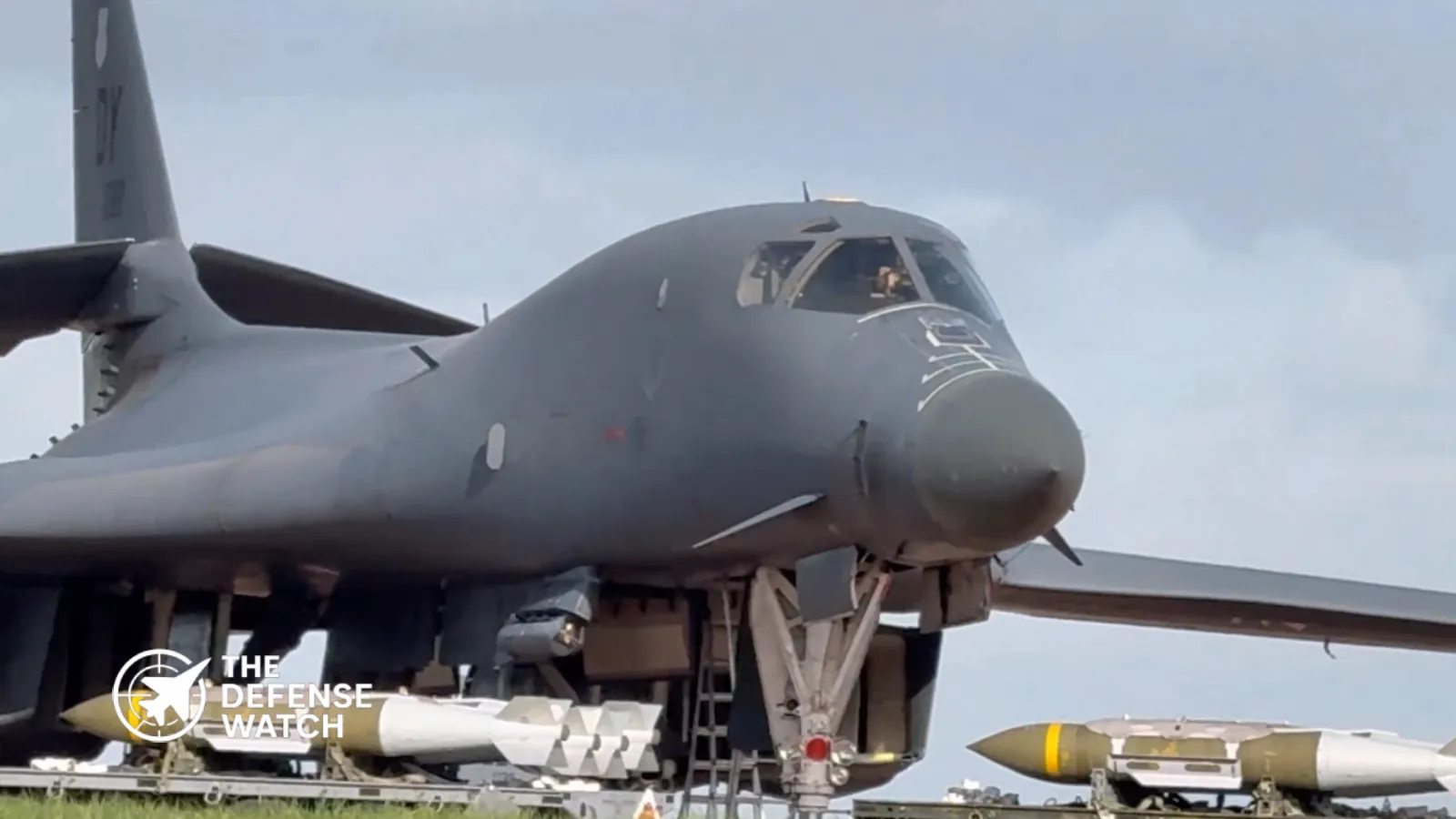
- The United States currently has about 15 strategic bombers deployed at RAF Fairford in the United Kingdom.
- Video footage shows B 1B bombers being loaded with bunker penetrating JDAM guided bombs.
- The shift suggests improved air superiority over parts of Iran, enabling direct bomber strikes on hardened facilities.
- The deployed force reportedly includes 12 B 1B bombers and 3 B 52 strategic bombers operating from the UK.
- Analysts view the development as a possible expansion of US targeting against underground infrastructure.
US B 1B Bombers At RAF Fairford Load Bunker Buster JDAMs For Iran Strike Missions
US B 1B bombers deployed at RAF Fairford are now being loaded with bunker buster JDAM guided bombs, according to newly released footage showing preparations for strike missions connected to operations against Iran. The images suggest that American forces may now be targeting hardened underground sites rather than relying only on stand off cruise missiles.
Video circulating from RAF Fairford shows US Air Force ground crews loading heavy precision guided bombs onto B 1B Lancer bombers. The activity signals a possible shift in operational conditions over Iran, where the ability to conduct direct bomber strikes would indicate improved control of contested airspace.
The Big Picture
The deployment of long range US bombers to the United Kingdom reflects a broader strategy of projecting global strike power while maintaining operational flexibility. RAF Fairford has long served as a key forward operating location for US bomber task forces supporting operations in Europe, the Middle East, and North Africa.
The current force presence is notable in scale. Reports indicate that around 15 strategic bombers are currently operating from the base. This includes 12 B 1B Lancer aircraft and three B 52 Stratofortress bombers.
Such deployments form part of the US Air Force bomber task force concept, which rotates strategic bombers through allied bases to demonstrate deterrence, maintain readiness, and provide rapid strike capability against emerging threats.
In the current context, the bomber presence also supports US military operations connected to escalating tensions and ongoing strikes involving Iran.
What Is Happening
Recent footage from RAF Fairford shows US B 1B bombers being loaded with bunker penetrating Joint Direct Attack Munition bombs. These weapons convert conventional gravity bombs into precision guided munitions using satellite guidance.
The bombs seen in the footage appear configured for attacks on hardened targets such as underground bunkers, fortified command posts, or weapons storage sites.
The B 1B Lancer is capable of carrying large payloads of precision weapons and can deliver them at high speed over long distances. Although the aircraft no longer carries nuclear weapons, it remains one of the most capable conventional strike platforms in the US Air Force inventory.
The presence of bunker buster JDAMs indicates that American planners may be preparing to strike infrastructure protected by reinforced concrete or buried facilities.
Previous phases of the campaign reportedly relied heavily on long range cruise missiles launched from aircraft or naval platforms. Those weapons allow strikes without entering contested airspace.
Direct bomber delivered weapons require greater air superiority.
Why It Matters
The appearance of bunker penetrating JDAMs on B 1B bombers suggests that operational conditions may have shifted in favor of US forces.
Cruise missiles are often used in the early stages of a campaign to destroy air defenses and command nodes. Once those systems are degraded, aircraft can move closer to targets and deliver heavier payloads more efficiently.
Direct bomber strikes also allow larger volumes of ordnance to reach a target area in a single sortie. A B 1B can carry dozens of precision guided bombs in one mission.
That capability significantly increases strike density against hardened infrastructure such as underground missile facilities, storage bunkers, and military headquarters.
For Iran, which has invested heavily in buried facilities and hardened sites, bunker penetrating weapons pose a serious threat.
Strategic Implications
The concentration of US bombers at RAF Fairford highlights Washington strategic emphasis on long range strike capability. Forward basing allows bombers to reach targets across the Middle East without relying solely on regional bases that may be politically sensitive or vulnerable to retaliation.
The deployment also reinforces the role of bomber task forces in modern US deterrence strategy. By positioning strategic bombers closer to conflict zones, the Pentagon can rapidly scale up strike operations while maintaining global reach.
Operationally, the use of bunker buster JDAMs suggests the United States may be attempting to degrade Iran military infrastructure more deeply than earlier phases of the campaign.
Underground facilities often house missile stockpiles, command centers, and nuclear related infrastructure.
Destroying those sites requires precision weapons capable of penetrating reinforced structures.
Competitor View
Iran has long built key military facilities underground specifically to survive air strikes. The use of bunker penetrating bombs signals that US planners are targeting these hardened assets.
From Tehran perspective, bomber operations launched from Europe expand the geographic scope of the conflict. The ability of US bombers to operate from distant bases complicates Iranian efforts to deter or disrupt the campaign.
Russia and China are also likely monitoring the operation closely. Both countries track US bomber deployments as indicators of American power projection capabilities and operational doctrine.
Large scale bomber deployments to forward bases demonstrate the flexibility of the US strategic strike network.
What To Watch Next
Several indicators will reveal whether the campaign is expanding further.
Additional bomber deployments to RAF Fairford or other allied bases could signal a prolonged air campaign. Satellite imagery may also reveal increased sortie rates or changes in aircraft weapons configurations.
Another key indicator will be whether other strike platforms join the effort. Carrier aviation, stealth aircraft, or long range strike drones could complement bomber operations.
Military analysts will also watch for signs of intensified targeting against hardened infrastructure inside Iran.
Capability Gap
Bunker penetrating weapons address a specific operational challenge. Many high value military assets today are located underground to protect them from air attack.
Traditional bombs often fail to destroy these facilities unless they achieve precise penetration before detonation.
JDAM equipped penetrator bombs provide greater accuracy and destructive effect against reinforced structures.
However, these weapons still require aircraft to operate close enough to the target area. That creates exposure to air defense systems if those defenses remain active.
Even with air superiority, hardened underground complexes can remain difficult to fully neutralize.
The Bottom Line
The loading of bunker buster JDAMs onto US B 1B bombers at RAF Fairford signals a possible shift toward deeper strikes against hardened Iranian military infrastructure.
Get real time update about this post category directly on your device, subscribe now.