
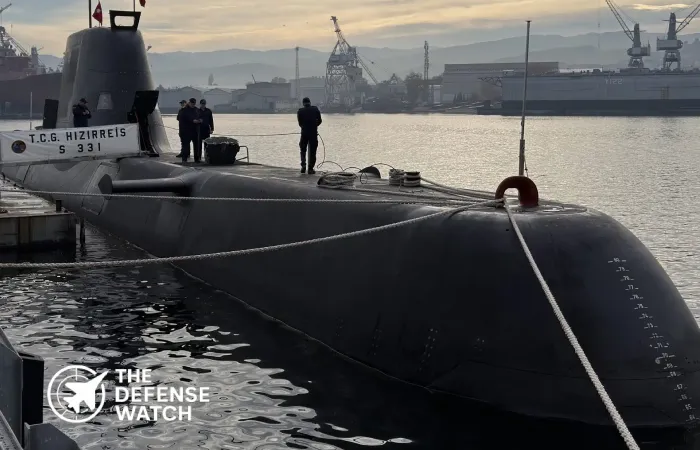
Formal Delivery of Hızırreis
On November 27, 2025, at Gölcük Naval Shipyard in northwestern Türkiye, the submarine TCG Hızırreis (S-331) was formally handed over to the Turkish Navy, becoming the second operational vessel in the Reis-class (Type 214TN) under the New Type Submarine Project (YTDP).
The handover ceremony was attended by representatives of the procurement authority Savunma Sanayii Başkanlığı (SSB), the shipyard Gölcük Naval Shipyard (GNSY), the Turkish Navy, and German builder ThyssenKrupp Marine Systems (TKMS). According to TKMS, Hızırreis completed months of harbour and sea acceptance trials before transfer, confirming the project remains within the expected cost and schedule envelope.
Background: Why the Reis-Class Matters
The induction of Hızırreis builds on Türkiye’s ongoing effort to modernize its submarine fleet, shifting from older Type 209 boats to a modern, AIP-equipped diesel-electric design. The lead boat, TCG Piri Reis (S-330), entered service in August 2024.
Derived from the German Type 214 design, the Type 214TN integrates substantial domestic content — reportedly around 80 percent — incorporating Turkish-built combat systems, sensors, and weapons.
For Ankara, the class is more than a platform upgrade: it underpins a broader maritime strategy aimed at strengthening deterrence and control across the Black Sea, Eastern Mediterranean, and Aegean — regions where undersea capabilities increasingly define strategic advantage.
Hızırreis: Technical Profile & Capabilities
Design and Propulsion
- TCG Hızırreis measures approximately 67–68 meters in length, with a beam of 6.3 meters and a submerged displacement of roughly 2,000 tons.
- The submarine combines a traditional single-hull architecture optimized for low acoustic signature with modern diesel-electric propulsion supplemented by an air-independent propulsion (AIP) system. The AIP uses polymer electrolyte membrane fuel cells and high-capacity batteries, enabling prolonged submerged operations without the need to snorkel.
- Because of this AIP and large battery reserve, Hızırreis can remain submerged for days or even up to weeks, reducing exposure to radar, satellite, and aerial surveillance — a major tactical advantage in contested maritime domains.
Sensors & Combat Systems
- The submarine is equipped with a modern combat management system from TKMS’s ISUS family, integrated with Turkish-made subsystems sourced from national defense firms such as Aselsan, STM, Havelsan, TÜBİTAK BİLGEM and MilSOFT.
- This includes sonar, communications, and sensor suites enabling undersea surveillance, target detection, tracking and engagement — making Hızırreis a critical node in Türkiye’s underwater surveillance and strike architecture.
Armament
- Hızırreis carries eight 533 mm torpedo tubes located in a forward weapons module. Its armament includes heavyweight torpedoes and domestically developed heavy torpedo Akya heavy torpedo, as well as the submarine-launched variant of the anti-ship missile Atmaca anti‑ship missile (often referred to in Turkish sources as “Sub-Atmaca” or AKATA).
- In the longer term, integration of the cruise missile Gezgin cruise missile remains a stated ambition — a capability that would expand the class’s role beyond anti-ship and anti-submarine warfare into deep-strike against coastal or inland targets.
- The submarine can also lay naval mines, adding a sea-denial and area-denial function to its mission set.
Program Timeline & Domestic Industrial Effort
- The YTDP contract dates back to 2009 between Türkiye’s procurement agency SSB and TKMS; the first boat was constructed at Gölcük starting 2015, launched in 2019, and commissioned in 2024 after sea trials starting in late 2022.
- Hızırreis was launched on May 25, 2023, underwent outfitting and sea trials during 2024–2025, and completed acceptance testing prior to handover.
- TKMS remains responsible for design, material supply, and supervising both construction and testing phases. Handover marks the start of an 18-month warranty period as Hızırreis enters front-line service.
- According to publicly available schedules, four more Reis-class submarines remain under construction — with the third boat, TCG Muratreis, already launched in May 2025.
Strategic Impact: What Hızırreis Means for Türkiye and Regional Dynamics
From a strategic standpoint, the entry of Hızırreis into service significantly boosts the underwater combat potential of the Turkish Navy. Combined with Piri Reis already operational, Ankara now fields two stealthy, AIP-equipped submarines — a jump in undersea warfare capability after decades of reliance on older Type 209 boats.
These stealth submarines enhance Türkiye’s ability to conduct intelligence, surveillance and reconnaissance (ISR), covert tracking, area denial, and maritime strike — capabilities especially relevant in contested zones such as the Bosphorus-Dardanelles, Aegean sea lanes, the Eastern Mediterranean, and the Black Sea.
For NATO, the addition of Type 214TN boats reinforces indigenous AIP submarine capability inside the alliance. Given tensions in the Black Sea — where underwater operations are increasingly pivotal — the modernized Turkish undersea fleet could shift regional underwater deterrence dynamics.
Domestically, the project underscores success in localization: major Turkish defense firms now supply combat systems, sensors, and weapons, laying a foundation for future indigenous submarine programs. Indeed, according to remarks by the commander of the Turkish Naval Forces, development of nuclear-powered submarines is planned after completion of the current Reis-class and future national build under the MİLDEN submarine program.
What to Watch Next
- Delivery schedules for the remaining four Reis-class boats: the third submarine, TCG Muratreis, is already launched — sea trials and handover timing will signal whether Türkiye can sustain roughly one new submarine per year, as initially envisaged.
- Integration of Atmaca submarine-launched missiles (and potentially the Gezgin land-attack cruise missile) will markedly raise the class’s strike potential, extending reach beyond sea-control into littoral strike and sea denial.
- Development pace and design path of the upcoming MİLDEN program — including whether nuclear propulsion becomes a long-term goal — will illustrate Ankara’s ambitions for a strategic undersea force.
- Reactions from regional navies and alignment within NATO: increasing submarine numbers and stealth capabilities might trigger counter-ASW investments, increased patrols, and shifts in naval posture across the Black Sea and Eastern Mediterranean.
Closing: A Milestone in Türkiye’s Undersea Strategy
The formal commissioning of TCG Hızırreis marks a tangible step forward for Türkiye’s submarine modernisation efforts. As the second operational vessel in the Reis-class, Hızırreis enhances the Turkish Navy’s underwater stealth, endurance and strike capabilities — offering a potent undersea tool for surveillance, deterrence, and maritime control in key theaters.
More broadly, the handover underscores Türkiye’s growing defense-industry maturity: a largely domestically equipped AIP submarine built through a binational partnership, stepping stones to future fully indigenous and possibly nuclear-powered designs.
With four more submarines on the way — and key weapon integrations pending — Hızırreis is not just a milestone, but a signal: Türkiye is serious about establishing a sustained, modern, and versatile undersea presence across the Black Sea, Eastern Mediterranean, and beyond.
Get real time update about this post category directly on your device, subscribe now.


1 comment
[…] investment in conventional submarine capabilities even as it advances newer programs such as the Reis-class […]