
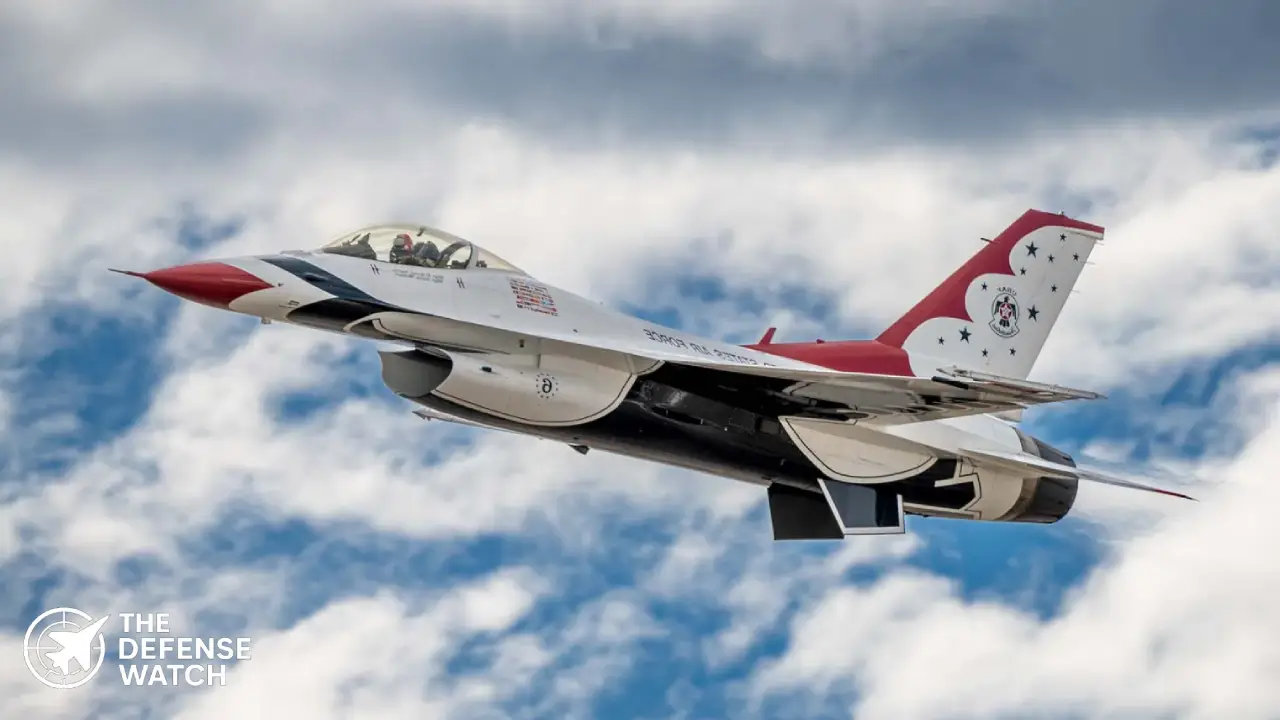
What Happened: Crash During Training Mission
On December 3, 2025, at approximately 10:45 a.m. Pacific Standard Time, a United States Air Force (USAF) Thunderbirds F-16C Fighting Falcon crashed near Trona Airport in the Mojave Desert, Southern California.
The pilot — the sole occupant — successfully ejected and landed by parachute. He was recovered by rescue personnel and transported to a hospital in Ridgecrest with non-life-threatening injuries.
Emergency services, including the San Bernardino County Fire Department, assisted the response with fire suppression and securing the crash site. No injuries on the ground or threat to nearby communities have been reported.
The incident remains under investigation, with authorities awaiting deeper analysis and official findings from the 57th Wing Public Affairs Office.
Context: The Thunderbirds and F-16C in Training
The Thunderbirds are the USAF’s premier aerial demonstration squadron, renowned for high-precision flying and formation aerobatics. Their fleet includes the F-16C Fighting Falcon, a fourth-generation multirole fighter.
Each year, typically during the winter months, the unit conducts intensive training from Nellis Air Force Base (Nevada) to prepare for the coming air show season. These sessions involve frequent sorties over training ranges and controlled airspace — sometimes including remote desert regions such as the Mojave Desert.
Flying at high speeds and under rigorous conditions, even in controlled airspace, carries inherent risk. History records previous incidents involving demonstration-team jets, underscoring the thin margin for error when operating high-performance fighters under demanding flight regimes.
Crash Details: Location, Ejection, and Response
According to official and local reports:
- The crash occurred on a dry lakebed just south of Trona Airport, roughly 27 miles southeast of Naval Air Weapons Station China Lake.
- The F-16C belonged to the Thunderbirds demonstration team and the flight originated from Nellis AFB.
- Upon incident onset, the pilot ejected safely; he remains in stable condition and is receiving follow-up medical care.
- San Bernardino County Fire Department — along with China Lake emergency crews — responded to the crash, extinguishing a post-impact fire and securing the scene. No civilian casualties or environmental hazards have been publicly reported at this time.
As of writing, the cause of the crash remains unknown. Official investigation by the 57th Wing is underway, and no further information has been released about potential technical failures, pilot error, or environmental factors leading to the incident.
Significance: Risks for Demonstration Squadrons
The crash highlights the inherent risks associated with demonstration-team operations, even outside of airshow performances — during routine training missions in remote areas. The use of the F-16C by the Thunderbirds reflects ongoing reliance on legacy fourth-generation fighters, underscoring continued value in training readiness.
For the USAF, any loss of aircraft — especially in high-profile units such as the Thunderbirds — represents a material and reputational cost. The F-16 remains a mainstay fighter globally, and maintaining pilot proficiency under demanding conditions is vital. At the same time, this incident may prompt renewed scrutiny of safety protocols, maintenance practices, and training risk mitigation measures.
Furthermore, the crash emphasizes the safety challenges posed by operations over remote desert terrain, where rescue response, recovery of wreckage, and environmental controls (e.g., handling hazardous materials such as hydrazine used in the F-16’s emergency power unit) demand coordination among multiple agencies.
What’s Next: Investigation and Implications
The 57th Wing Public Affairs Office has promised further updates as the investigation continues. Until the Board of Inquiry releases its findings, the precise cause — whether mechanical failure, pilot error, or other factors — remains speculative.
In the near term, the crash may affect the Thunderbirds’ readiness schedule ahead of the 2026 airshow season. Replacement aircraft may need to be assigned, and maintenance and safety reviews could disrupt other training flights.
More broadly, the incident may influence USAF leadership’s evaluation of demonstration-team risk, potentially accelerating discussions around next-generation aircraft for aerobatic and training units — especially as the broader fleet ages and strategic needs evolve.
Get real time update about this post category directly on your device, subscribe now.

2 comments
[…] (99 FTS), known as the “Red Tails,” which will spearhead integration of the trainer into the USAF pilot […]
[…] Fighter Squadron 22 also crashed during routine flight operations from the same carrier. Both pilots ejected safely and were recovered in stable […]