
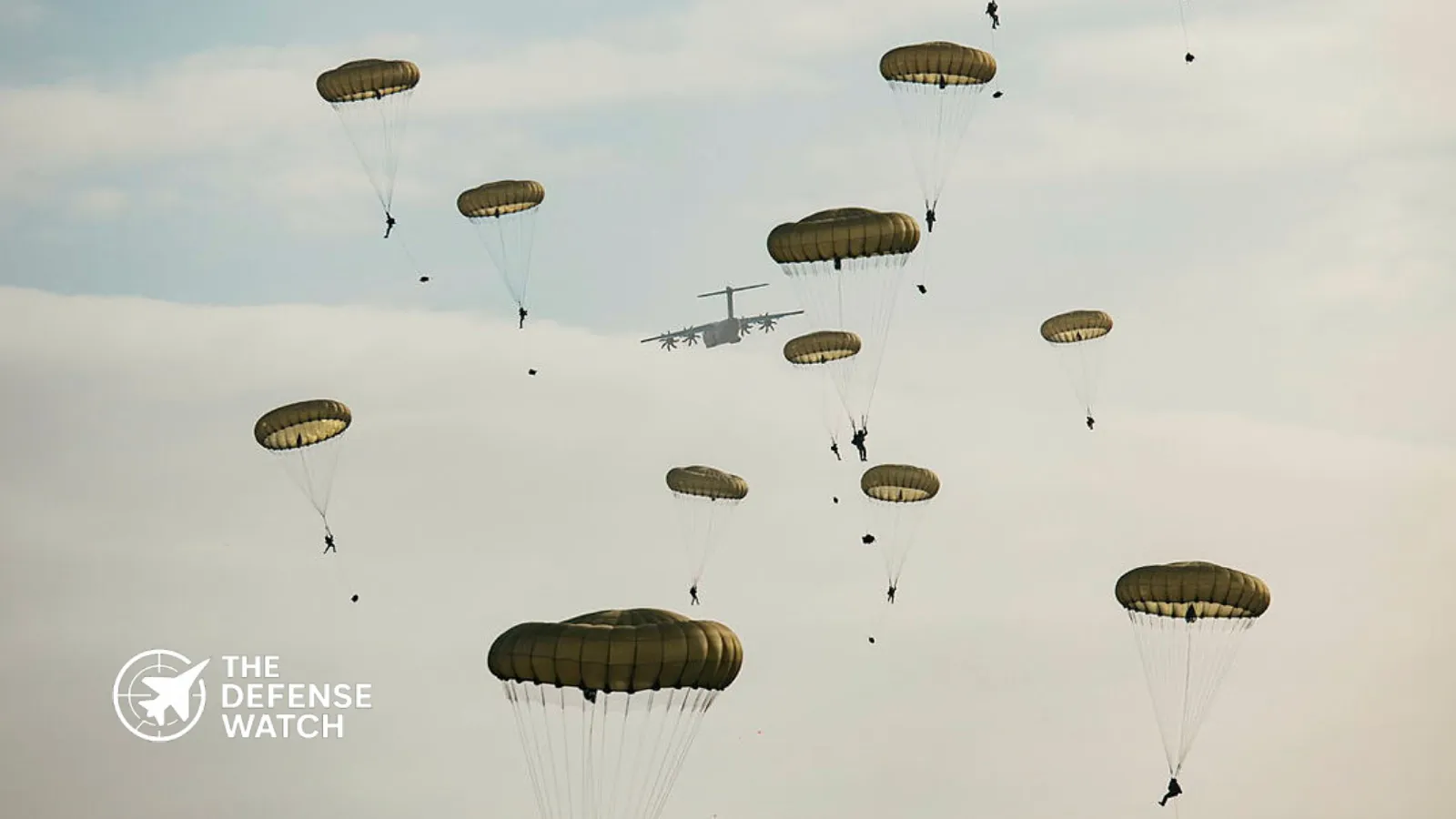
- The British Army conducted its largest parachute jump exercise in over a decade.
- Hundreds of airborne troops were deployed in a coordinated mass drop operation.
- The exercise tested rapid deployment, coordination, and operational readiness.
- Aircraft and airborne units operated jointly to simulate real-world combat insertion.
- The drill reflects renewed emphasis on high-readiness forces amid evolving security challenges.
British Army Parachute Jump Signals Renewed Focus On Rapid Deployment
The British Army parachute jump conducted recently marks the largest airborne operation by the British Army in more than a decade, underscoring a renewed emphasis on rapid deployment capabilities and high-readiness forces.
Hundreds of paratroopers took part in a coordinated mass drop, designed to simulate real-world combat insertion scenarios. The exercise brought together airborne infantry, transport aircraft, and support elements in a synchronized operation aimed at testing operational readiness under realistic conditions.
This large-scale British Army parachute jump reflects a broader shift within UK defense planning, where speed, flexibility, and expeditionary capability are becoming increasingly central.
Scale And Coordination Highlight Operational Readiness
The exercise involved a complex airborne assault scenario, with troops deploying from military transport aircraft in rapid succession. Such operations require precise timing, coordination between air and ground elements, and the ability to establish a foothold immediately upon landing.
Airborne forces are typically among the first units deployed in a crisis. Their ability to insert behind enemy lines or secure key terrain quickly makes them a critical component of modern military strategy.
By conducting its largest British Army parachute jump in years, the UK is demonstrating that it retains the capability to deploy significant combat power at short notice. This is particularly relevant in scenarios where forward basing is limited or access is contested.
Strategic Context: Why Airborne Forces Matter Again
The renewed focus on airborne operations comes amid shifting geopolitical dynamics and increased emphasis on rapid response forces across NATO. Countries are investing more in units that can deploy quickly without relying on established infrastructure.
For the UK, airborne forces serve as a key element of its global response posture. They can be deployed independently or as part of a larger coalition force, supporting missions ranging from deterrence to high-intensity conflict.
The scale of this British Army parachute jump suggests that planners are preparing for scenarios where early entry forces must operate in contested environments. This includes potential operations in Eastern Europe, the High North, or other regions where rapid insertion could be decisive.
Operational Lessons And Capability Development
Large-scale exercises like this are not just demonstrations. They are critical for identifying gaps in capability and improving coordination across units.
Key areas likely assessed during the operation include:
- Aircraft loading and deployment efficiency
- Paratrooper dispersion and landing accuracy
- Communication between airborne and ground units
- Speed of assembling combat-ready formations after landing
These lessons feed directly into future doctrine and training cycles, ensuring that airborne units remain effective in modern combat environments.
The British Army parachute jump also highlights the importance of maintaining interoperability with allies. Airborne operations often involve multinational forces, particularly within NATO frameworks.
Air Mobility And Force Projection
Airborne operations depend heavily on transport aircraft and logistical support. While the exercise details did not specify all platforms involved, such operations typically rely on assets from the Royal Air Force, including heavy-lift and tactical transport aircraft.
This integration of air and land forces is essential for force projection. It allows the UK to respond quickly to emerging threats without the need for prolonged deployment timelines.
In practical terms, the ability to conduct a large British Army parachute jump enhances the UK’s credibility as a rapid reaction force contributor within NATO and other alliances.
What This Means For Future Operations
The scale and execution of this operation indicate that airborne forces remain a priority within UK defense strategy. While modern warfare increasingly includes cyber and space domains, traditional capabilities like airborne insertion continue to play a vital role.
This exercise sends a clear signal that the UK is investing in readiness and operational flexibility. It also demonstrates the continued relevance of airborne forces in scenarios where speed and surprise are critical.
As global security challenges evolve, the ability to deploy forces quickly and effectively will remain a key determinant of military effectiveness. The British Army parachute jump serves as a reminder that even long-established capabilities are being adapted to meet modern demands.
Get real time update about this post category directly on your device, subscribe now.
