
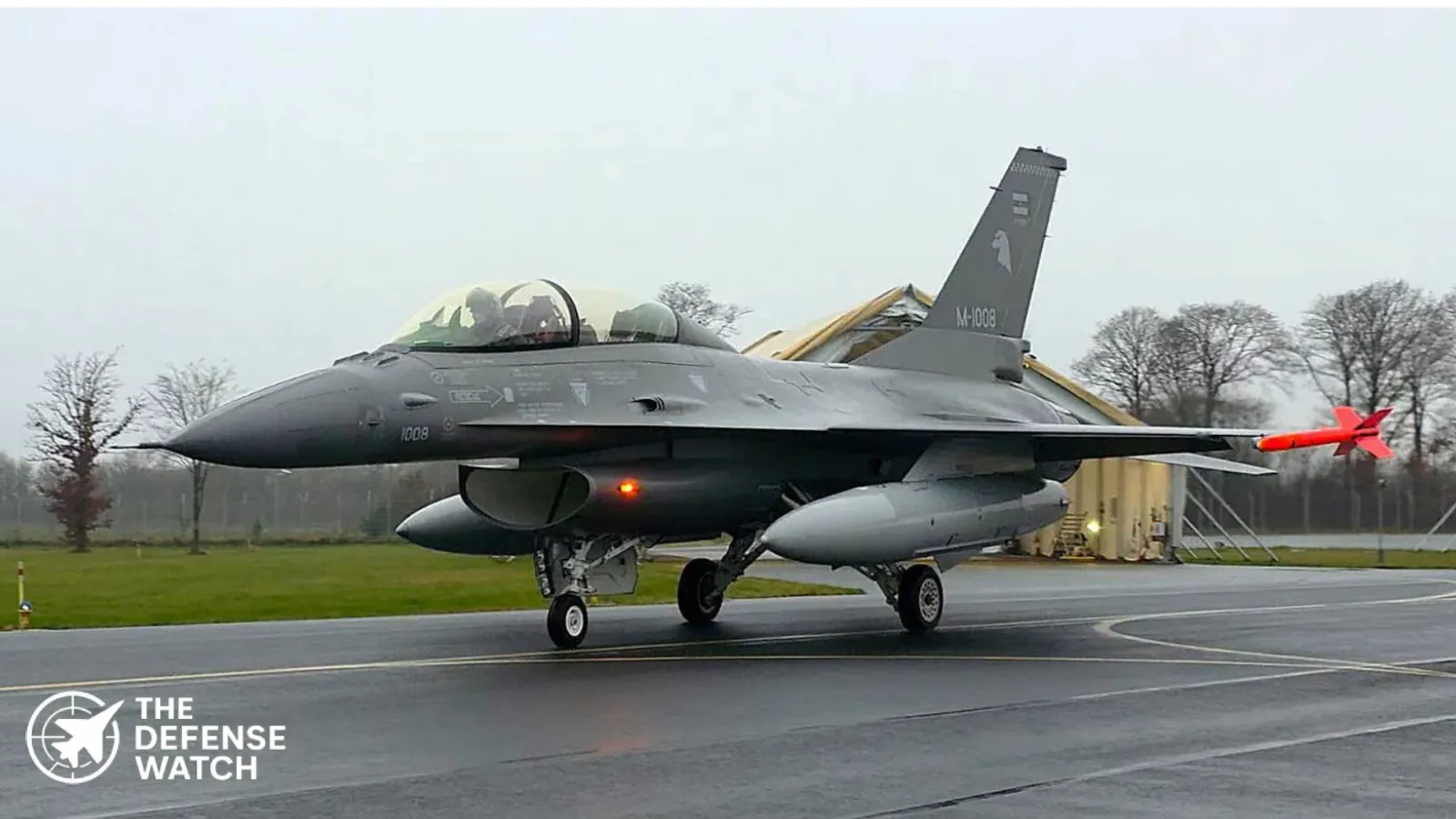
On December 5, 2025, six second-hand Lockheed Martin F-16 Fighting Falcon fighters arrived in Argentina after a trans-Atlantic ferry flight from Denmark. The arrival marks the first delivery under the country’s deal to buy ex-Royal Danish Air Force (RDAF) F-16s, restoring a supersonic fighter capability to the Fuerza Aerea Argentina (FAA) for the first time in over a decade.
An official induction ceremony followed on December 6 at the base in Córdoba Province, where top government figures welcomed the jets.
Why This Matters
Argentina had lacked modern jet-powered fighters since it retired its last supersonic fleet. The delivery of these F-16s ends a significant capability gap, giving the country renewed reach in air defense, interception, and multi-role strike. The arrival signals a major step in the FAA’s broader modernization plan.
Background: From Mirage to F-16
After retiring its Dassault Mirage III fighters in 2015, the FAA relied largely on aging subsonic jets such as the Douglas A-4 Skyhawk and locally assembled trainers.
Efforts to acquire new fighters over the years — including proposals involving aircraft such as the Saab Gripen, IAI Kfir and FA-50 — were blocked by export restrictions tied to the fallout from the 1982 Falklands War. Those restrictions limited Argentina’s access to advanced military hardware for decades.
The 2024 agreement with Denmark changed that. Under the deal, Argentina is acquiring a total of 24 operational F-16AM/BM aircraft, plus one non-flying airframe for training and ground instruction.
Delivery Details
- The first batch comprises four two-seat F-16BM and two single-seat F-16AM jets.
- The jets departed from Denmark’s Skrydstrup Air Base on November 28, 2025. The ferry route included technical stops in Zaragoza, Spain; the Canary Islands; and Natal, Brazil.
- The trans-Atlantic flight was supported by aerial refueling from three Boeing KC-135 Stratotanker aircraft.
- The jets landed at Área Material Río Cuarto (ARMACUAR) base. The FAA plans to deploy them at first from Río Cuarto, with a later move to a permanent base at Tandil Air Base once infrastructure upgrades finish.
Capabilities and Modernization
According to the Argentine Defense Ministry, the new F-16s come equipped with advanced avionics, an electronic warfare suite, and a modern weapons package. The multirole jets are intended for air defense, suppression of enemy air defenses, maritime strike, close air support, reconnaissance, and dynamic targeting tasks.
The acquisition follows a broader push to upgrade the air force fleet and restore long-lost capabilities. The deal includes not only the aircraft, but also spare parts, maintenance support, and training arrangements.
Policy and Strategic Significance
The delivery of these F-16s comes after a long period during which export restrictions effectively left Argentina without modern combat jets. The 2024 agreement and the 2025 delivery suggest a shift in the political and diplomatic environment surrounding arms transfers to Buenos Aires.
The US also played a role: previous export rules were relaxed, allowing this third-party transfer of U.S.-made aircraft from Denmark.
For the FAA, joining the global F-16 user community may open opportunities for future training, interoperability with partner air forces, and access to maintenance and upgrade support.
What Comes Next
Deliveries of the remaining aircraft are planned to continue through 2028. Once fully integrated, the 24-jet fleet — plus the static trainer — will significantly enhance Argentina’s air defense reach and deter potential threats.
Meanwhile, the FAA will need to finalize infrastructure upgrades at Tandil and Río Cuarto bases, establish maintenance and training pipelines, and integrate the jets operationally into its command structure.
Get real time update about this post category directly on your device, subscribe now.


7 comments
[…] Air Force officials describe the upgrade as essential to give the B-52 the ability to maintain situational awareness, precise targeting, and reliable all-weather navigation in modern combat environments. […]
[…] move reflects broader training trends among Western air forces, where synthetic environments and simulation are used to reduce flight hours for routine tasks and […]
[…] array system already used on U.S. Navy aircraft. By adapting this technology for the B-52, the Air Force aims to deliver improved target detection, higher resolution mapping, and stronger resistance to […]
[…] defense capabilities of a NATO ally and preserving interoperability with U.S. and allied forces. Denmark’s armed forces are expected to absorb the systems with no significant […]
[…] F-16 emerged from the United States Air Force’s Lightweight Fighter program in the early 1970s, designed as an agile, cost-effective complement to the heavier F-15 […]
[…] system represents a critical enhancement to Taiwan’s air defense capabilities, providing F-16 fighter aircraft with passive detection technology capable of tracking airborne threats at extended ranges […]
[…] is designed to be compatible with multiple receiver platforms. Certification testing included RSAF F-16 and F-15SG fighters alongside the MRTT fleet, validating the system across different aircraft types and operational […]