
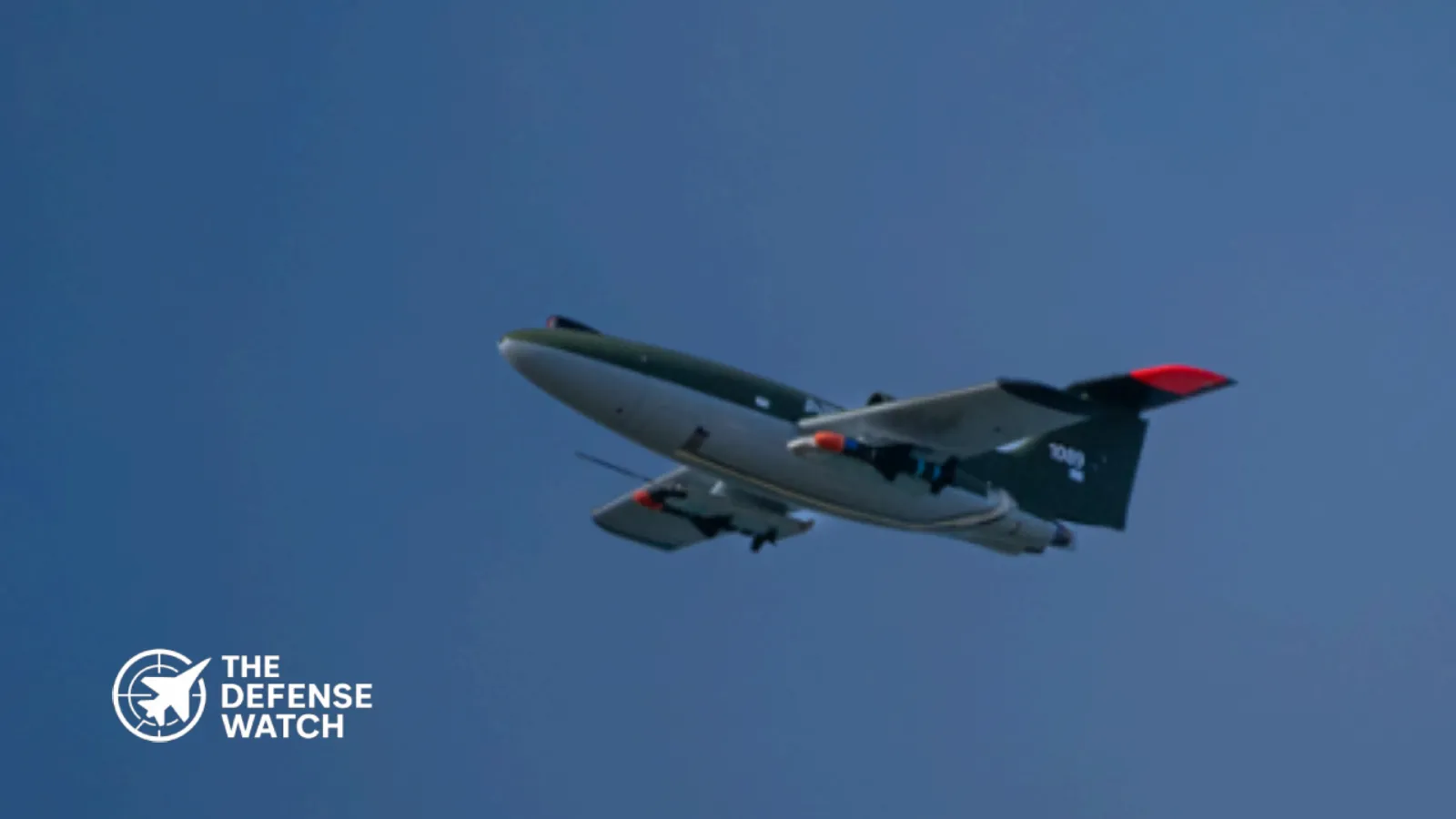
- Airbus’ Bird of Prey drone interceptor completed its first successful demonstration flight on March 30, 2026, at a military training area in northern Germany.
- The system autonomously searched, detected, classified, and engaged a medium-sized kamikaze drone — entirely without a human in the kill chain.
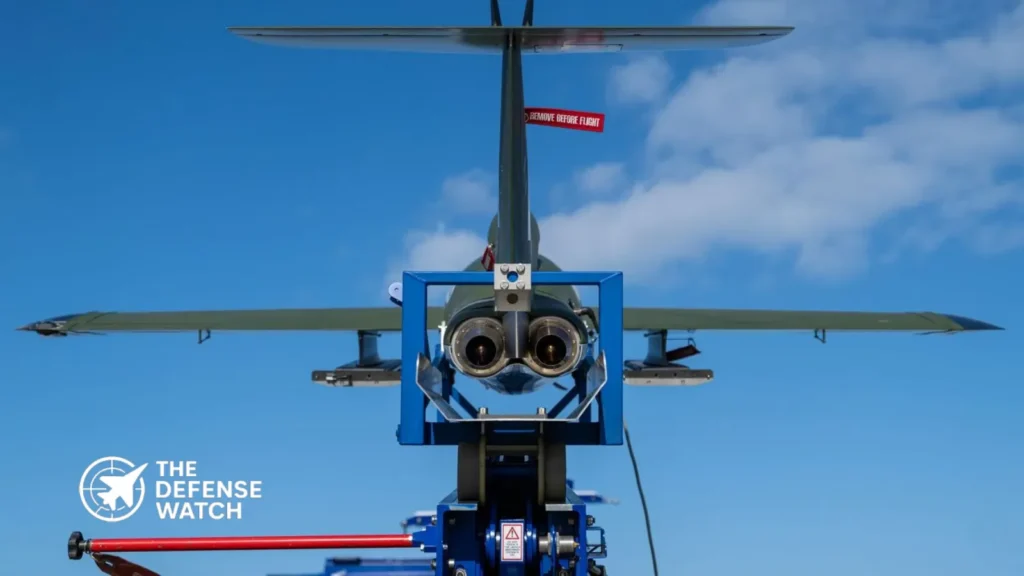
- The Bird of Prey prototype is based on a modified Airbus Do-DT25 drone, measuring 3.1 meters in length with a 2.5-meter wingspan and a max takeoff weight of 160 kg.
- The Frankenburg Mark I missile weighs under 2 kg, measures 65 cm, and carries a fragmentation warhead with an engagement range of up to 1.5 kilometers — making it the lightest guided interceptor developed to date.
- The operational Bird of Prey platform will carry up to eight Mark I missiles and integrates into NATO’s air defense architecture via Airbus’ Integrated Battle Management System (IBMS).
Airbus Bird of Prey Drone Interceptor Makes History With Successful First Flight
MUNICH, GERMANY — March 30, 2026 — In a significant milestone for European air defense technology, Airbus Defence and Space confirmed that its Bird of Prey uncrewed interceptor drone has successfully completed its maiden demonstration flight at a military training area in northern Germany. The autonomous system detected, classified, and neutralized a medium-sized one-way attack drone — commonly known as a kamikaze drone — using a newly developed air-to-air missile built by Estonian defense technology startup Frankenburg Technologies. The test, which took place just nine months after the project officially launched, marks one of the most consequential advances in counter-UAS (Uncrewed Aerial System) defense seen in Europe in recent years.
According to Airbus, the Bird of Prey interceptor autonomously searched for, detected, and classified the target before engaging it with a Mark I air-to-air missile developed by Frankenburg Technologies. The entire engagement sequence operated without direct human intervention in the targeting loop — a critical distinction that sets this system apart from most existing counter-drone platforms currently deployed by NATO forces.
Why This Milestone Matters Now
The timing of this demonstration is no accident. Across the battlefields of Ukraine, the Middle East, and beyond, low-cost one-way attack drones have become one of the defining tactical threats of modern warfare. Iranian-made Shahed-series drones, Russian Lancet loitering munitions, and a growing array of commercial drones modified for military use have exposed a stark capability gap in the air defense architectures of Western nations: most existing systems were designed to defeat expensive ballistic missiles and manned aircraft — not swarms of $500 drones flying at low altitude.
Existing countermeasures, including radar-directed guns, shoulder-fired MANPADS, electronic jamming, and high-energy lasers, each carry significant drawbacks. They are either prohibitively expensive per kill, tactically limited in range, dependent on electromagnetic spectrum conditions, or too slow to respond to mass saturation attacks. Airbus CEO Mike Schoellhorn described the threat environment clearly, noting that defending against kamikaze drones has become “a tactical priority that urgently needs to be tackled” given current geopolitical and military realities.
The Bird of Prey program is a direct industrial response to that operational gap.
Inside the Bird of Prey: Technical Architecture
The Bird of Prey prototype used in the demonstration is built on a modified Airbus Do-DT25 drone platform, featuring a wingspan of 2.5 meters, a length of 3.1 meters, and a maximum takeoff weight of 160 kilograms. Those dimensions position it squarely in the medium tactical drone category — large enough to carry meaningful payloads and carry out extended area patrols, yet agile and relatively affordable compared to larger crewed or high-end uncrewed platforms.
During the demonstration, the prototype carried four Mark I air-to-air missiles. The operational version, however, is designed to carry up to eight of them. That payload increase dramatically improves the system’s per-sortie kill potential, making it capable of neutralizing multiple threats in a single mission — a critical requirement when facing coordinated drone swarm attacks.

The Frankenburg Mark I missile itself is a notable engineering achievement in its own right. The high-subsonic, fire-and-forget weapon measures just 65 centimeters in length, weighs under 2 kilograms, and offers an engagement range of up to 1.5 kilometers — characteristics that make it the lightest guided interceptor missile developed to date. airbus It is equipped with a fragmentation warhead engineered to neutralize airborne targets through proximity detonation, reducing the need for a direct hit and increasing overall kill probability against small, fast-moving targets.
Frankenburg CEO Kusti Salm described the Mark I as representing “a new cost curve for air defense,” arguing that pairing low-cost, mass-manufacturable interceptor missiles with an autonomous drone platform enables defense against mass aerial threats at a scale previously unachievable.
NATO Integration and the IBMS Connection
Perhaps one of the most operationally relevant aspects of the Bird of Prey program is how it is designed to slot into existing military command and control infrastructure rather than require a parallel system. The Bird of Prey is built to operate seamlessly within NATO’s integrated air defense architecture through established command and control systems, specifically Airbus’ own Integrated Battle Management System, known as IBMS.
This integration strategy is smart for several reasons. It means Bird of Prey does not demand that operators learn an entirely new ecosystem or invest in a dedicated ground infrastructure. Instead, it acts as a plug-in enhancement to already-deployed battlefield management networks. Airbus describes this configuration as a “force multiplier” — a term that, in this context, accurately captures how a relatively inexpensive autonomous interceptor swarm, when layered within an existing IBMS-managed air defense grid, can exponentially increase the number of aerial threats an integrated force can handle simultaneously.

This positions Bird of Prey not as a standalone product, but as a modular building block within Europe’s broader layered air and missile defense ambition — a concept that NATO has been pushing member states to accelerate since Russia’s full-scale invasion of Ukraine in 2022.
Analysis: A New Cost Equation for Air Defense
The deeper strategic implication of the Bird of Prey demonstration lies in what it represents economically as much as militarily. For decades, Western air defense doctrine has operated on a fundamentally unfavorable cost exchange: a nation defending against a $500 attack drone was spending tens of thousands — sometimes hundreds of thousands — of dollars per intercept when using conventional systems. Adversaries recognized this asymmetry and exploited it deliberately, using mass drone production to exhaust expensive interceptor stockpiles.
The Bird of Prey / Frankenburg Mark I combination attempts to flip that equation. If the Mark I missile can be manufactured in large numbers at a cost that dramatically undercuts conventional interceptors, and if the Bird of Prey drone can autonomously manage engagements without sustained human operator attention, the cost-per-kill ratio for defending forces could approach parity — or even advantage — for the first time against drone swarm threats.
That is a foundational shift in air defense economics, and it explains why Airbus has moved with unusual speed on this program. The nine-month sprint from project launch to live demonstration is extraordinarily fast by European defense acquisition standards, suggesting both internal urgency and likely early-stage interest from potential government customers within the NATO alliance.
Airbus and Frankenburg confirmed they plan to conduct additional flights using a live warhead throughout 2026, with the goal of further operationalizing the system and presenting full capability demonstrations to interested customers.
What Comes Next
The road from successful first demonstration to fielded operational capability is rarely short in the defense sector. Live warhead testing, reliability trials, environmental qualification, and regulatory clearances for autonomous engagement authority will all need to be addressed before any NATO member could realistically deploy Bird of Prey in a conflict scenario.
The question of autonomous engagement authority — specifically, under what conditions an uncrewed system is legally and ethically permitted to make a kill decision without a human explicitly approving each individual engagement — remains one of the most contested policy debates within the defense community. NATO’s current policy framework generally requires a “human in the loop” for lethal force decisions. Bird of Prey’s demonstrated autonomous engagement capability will inevitably prompt renewed discussions about where that loop should sit in fast-moving, high-volume drone intercept scenarios, where milliseconds matter and human reaction speed is simply insufficient.
Despite these open questions, the Bird of Prey’s debut represents a concrete and credible answer to one of the most pressing tactical challenges currently facing Western militaries. As one-way attack drones continue to proliferate globally — and as adversaries refine their tactics for deploying them at scale — autonomous counter-drone platforms like Bird of Prey are rapidly shifting from a future concept to an operational necessity.
FAQs
The Bird of Prey is an autonomous uncrewed aerial system developed by Airbus Defence and Space, designed specifically to detect and neutralize one-way attack (kamikaze) drones. It is built on a modified Airbus Do-DT25 drone platform and carries Frankenburg Technologies’ Mark I air-to-air missiles.
The Mark I is a high-subsonic, fire-and-forget air-to-air missile developed by Estonian defense tech startup Frankenburg Technologies. It weighs under 2 kilograms, measures 65 centimeters in length, and has an engagement range of up to 1.5 kilometers. It is described as the lightest guided interceptor missile developed to date.
The Bird of Prey demonstrated fully autonomous engagement during its March 2026 demonstration flight — independently searching, detecting, classifying, and engaging a target drone without direct human intervention in the targeting sequence. Integration into Airbus’ IBMS platform provides command and control connectivity.
The system is designed to operate within NATO’s integrated air defense architecture via Airbus’ Integrated Battle Management System (IBMS), enabling it to function as a complementary and highly mobile building block within layered air and missile defense frameworks.
The system is not yet in operational service. Airbus and Frankenburg plan additional live warhead flight tests throughout 2026 to mature the system and demonstrate its capabilities to potential customers. A fielding timeline has not yet been publicly announced.
Get real time update about this post category directly on your device, subscribe now.
