
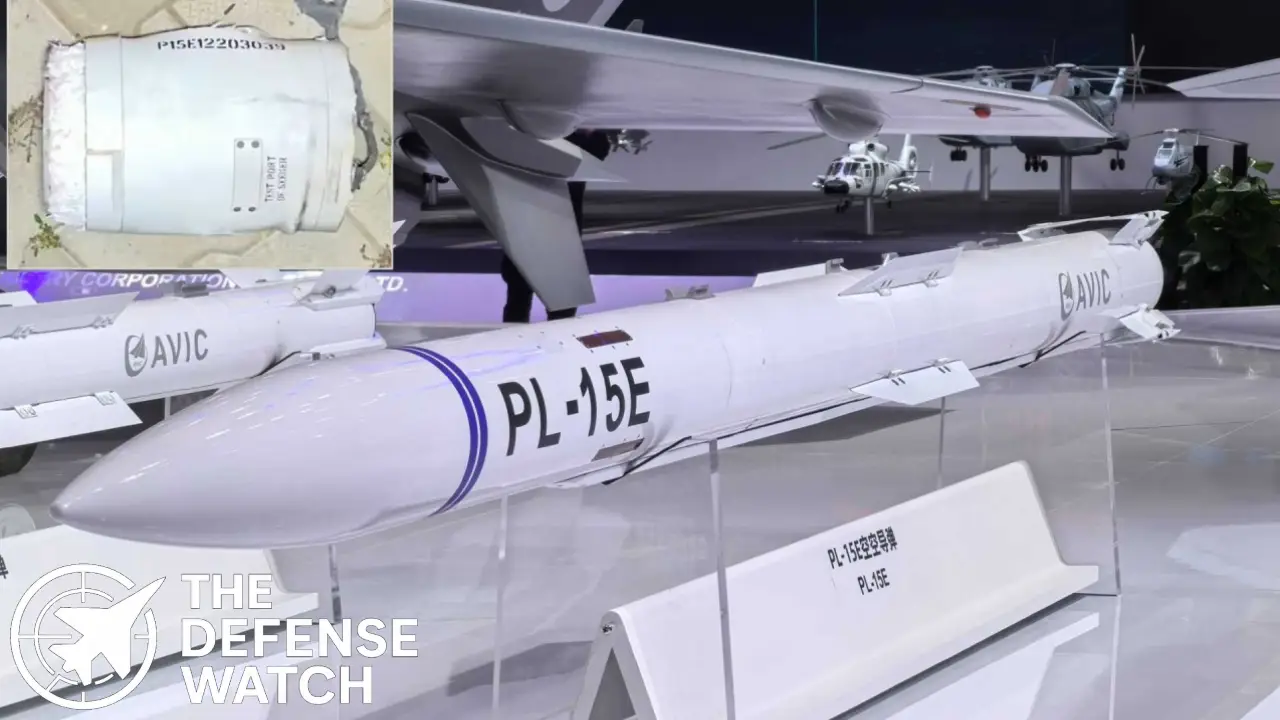
Background & Design Overview of the PL-15
The PL-15 “Thunderbolt-15” is China’s advanced beyond-visual-range air-to-air missile (BVRAAM), designed by the China Airborne Missile Academy (CAMA). Featuring a dual-pulse solid-fuel rocket motor and an active electronically scanned array (AESA) radar seeker, the PL-15 achieves impressive performance—speeds exceeding Mach 5 and a range surpassing 200 km in its domestic variant. The missile’s compact design—around four meters long with a ~200 mm diameter—makes it suitable for internal carriage on stealth platforms like the J-20.
An export variant, the PL-15E, was revealed with folding rear fins to better integrate with stealth fighters’ weapon bays, implying enhanced export ambitions.
Combat Debut: Pakistan’s Bold Deployment
In May 2025, the Pakistan Air Force (PAF) deployed J-10C and JF-17 Block III fighters armed with PL-15E missiles during fierce skirmishes with India along the Kashmir border. Official Pakistani imagery confirmed JF-17 Block III integrating the long-range PL-15 BVRAAM.
Multiple Indian media and analysts reported that at least one Indian Dassault Rafale fighter was downed—possibly from surprising long-range engagement—indicating Pakistan’s willingness to leverage the PL-15 at its outer reach. A section of a PL-15E missile was recovered relatively intact on Indian soil, providing a significant intelligence opportunity.
Strategic Implications and Export Push
The combat debut of the PL-15E marks a pivotal shift in Asia’s aerial balance. It demonstrates China’s emergence as a competitive arms exporter and reassurance for its strategic partners such as Pakistan. Meanwhile, recovered missile debris offers Indian and allied analysts data to develop potential countermeasures and decode design and guidance systems.
Expert voices highlighted the dangers of underestimating the PL-15’s capabilities. Indian pilots allegedly believed the aircraft was beyond range of the PL-15E, based on faulty intelligence estimating its range at only about 150 km. The actual combat engagement may have occurred at approximately 200 km—making it among the longest air-to-air kills recorded.
Stepping back, this episode emphasizes the rising importance of long-range kinetic reach and data-linked guidance in contemporary air warfare—as exemplified by the PL-15—and prompts comparable developments from other global powers. In fact, the US Navy introduced the AIM-174B to counter such threats.
Analysis & Context
This first known combat use of the PL-15E underscores a strategic turning point in aerial warfare in South Asia. Pakistan’s employment of Chinese advanced BVR technology not only tests real-world effectiveness but also signals a shift in regional deterrence calculus.
Intelligence gains from the recovered missile could significantly influence India and its allies in enhancing electronic warfare (EW), jamming, and intercept tactics against sophisticated missiles like the PL-15. Indeed, reports suggest that jamming may have helped some Indian platforms evade hits during the conflict
FAQs
A long-range Chinese air-to-air missile with dual-pulse rocket motor and AESA-guided seeker, exceeding 200 km in range for domestic versions.
An export version with potentially reduced range and folding fins for stealth fighter carriage, used by Pakistan.
Yes—first confirmed in May 2025 when PAF deployed it in skirmishes with India, marking its combat debut.
Recovered debris may reveal technical details—such as propulsion, guidance, materials—useful for countermeasure development and threat assessment.
Its deployment boosts Chinese export credibility and alters air superiority calculations, especially in potential Taiwan scenarios and Indo-Pacific dynamics.
Get real time update about this post category directly on your device, subscribe now.

15 comments
[…] combat debut of GBU-57 underscores a significant capability leap in U.S. conventional arms, delivering […]
[…] May 2025, during heightened India–Pakistan tensions, Pakistan claimed that J-10CEs, supported by long-range PL-15 missiles, downed multiple Indian aircraft—including Rafales. Some reports suggest a world-record BVR kill […]
[…] variant, serves as a mobile anti-tank platform firing TOW missiles at ranges up to 4 km. Its deployment strengthens brigade-level anti-armor overwatch and precision engagement […]
[…] to balance lethality, mobility, and survivability across domains. From squad-level rifles to long-range fires and advanced missile defense, these capabilities are designed to counter both conventional and hybrid […]
[…] a traditional fighter in terms of agility or speed, the F-117 was a precision strike aircraft. Its combat debut in Operation Just Cause (1989) and later prominence in Operation Desert Storm (1991) cemented its […]
[…] Designed for a wide range of Russian weapons, including R-77M and K-77M long-range air-to-air missiles, Kh-59 cruise missiles, and Kh-35 anti-ship […]
[…] juncture. The transition from prototype to practiced operator deployment is underway, with forward deployments and live battery tests offering proof of concept. But the program must now prove that it can be sustainable: […]
[…] warhead. Its advanced guidance and counter-countermeasure systems make it one of the most reliable air combat missiles in modern aerial […]
[…] For example, the head of U.S. Indo-Pacific Command recently told the Senate the pace at which China is building naval combatants is roughly three times that of the […]
[…] in service since the 1970s and has undergone continuous life-extension upgrades. With about 400 missiles deployed across hardened silos, the system remains a pillar of U.S. […]
[…] for air-to-air combat and air superiority.Examples: F-22 Raptor, Rafale, […]
[…] reported range of 200–300 km for the domestic variant allows China to threaten or engage distant targets before they can […]
[…] Alvin Holsey, head of U.S. Southern Command (SOUTHCOM), emphasized that the deployment “stands ready to combat the transnational threats that seek to destabilize our […]
[…] advantage of Skynex lies in its cost-efficiency. The 35 mm AHEAD rounds are far cheaper per engagement than guided missile interceptors, making it viable for high-volume, repeated […]
[…] KNS Al-Garoh, an Um Al Maradim-class missile patrol combatant (approximately 42 meters, 250 tons), emphasizes rapid response and coastal defense. Powered by twin […]