
India Inaugurates Nyoma Air Base in Ladakh, Strengthening High-Altitude Response Near LAC
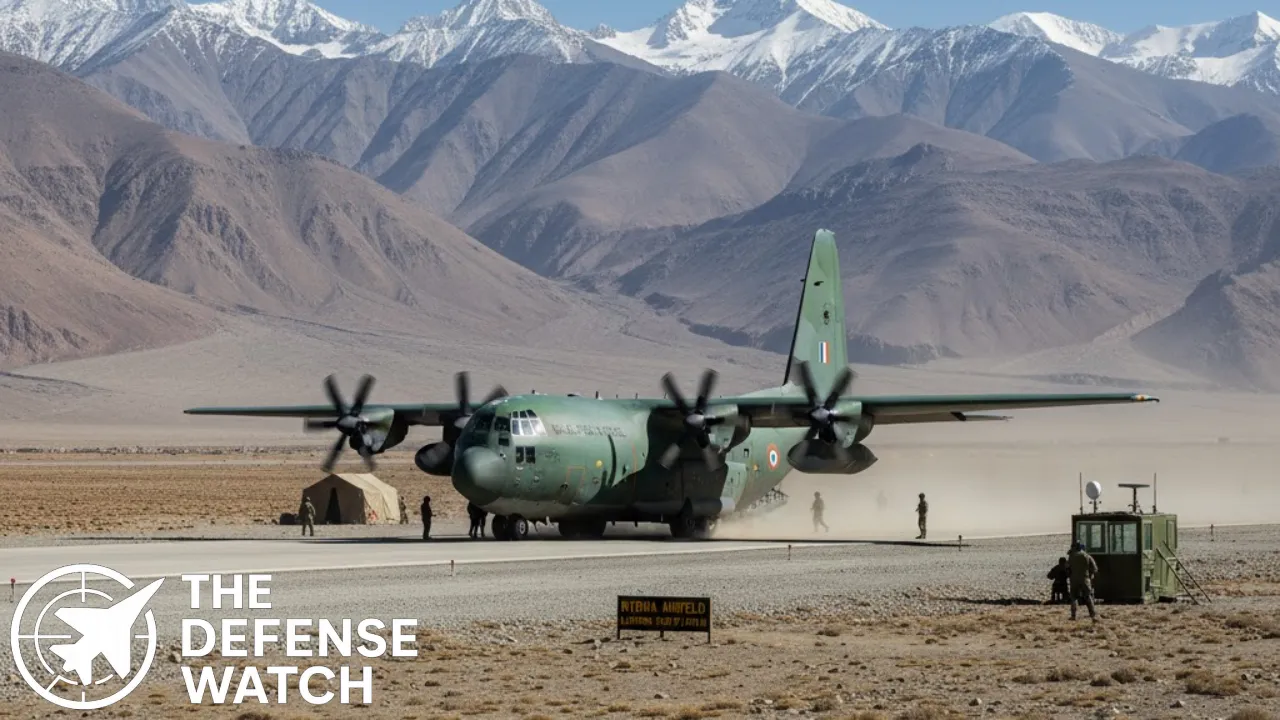
India officially inaugurated the Nyoma Air Base in eastern Ladakh on November 12, with Air Chief Marshal Vivek Ram Chaudhari landing a C-130J Super Hercules to mark its operational status. The new facility significantly enhances India’s high-altitude airlift, surveillance, and rapid-response capability along the Line of Actual Control (LAC) with China.
The forward air base, situated at over 13,000 feet, is now one of the world’s highest military-grade runways capable of handling medium-lift and tactical aircraft. Its activation represents a major infrastructure upgrade in a region that has witnessed heightened military tensions since the 2020 border standoff.
Background: A Strategic Asset in a Sensitive Theater
Nyoma has long existed as an Advanced Landing Ground (ALG), used primarily for helicopter operations and occasional fixed-wing landings. However, following the 2020 Galwan Valley clashes and the prolonged military standoff with China, the Indian government approved its expansion into a full-scale operational air base.
The Border Roads Organisation (BRO) began constructing the 2.7-km paved runway in 2023, designed to support transport aircraft, logistics missions, unmanned systems, and potentially even fighter operations under favorable conditions. Its proximity—less than 50 kilometers—to the LAC gives India a major logistical advantage, allowing faster deployment across eastern Ladakh’s rugged terrain.
The Nyoma Air Base therefore becomes a critical component of India’s ongoing efforts to enhance operational readiness along a disputed border region where China has built extensive dual-use infrastructure, including airfields, roads, and PLA support bases.
Operational Details and Significance
During the inauguration event, Air Chief Marshal Chaudhari highlighted Nyoma’s strategic value, stating that the base “represents a major leap in our ability to operate in high-altitude environments and respond swiftly to any security challenges in the region.”
Nyoma Air Base’s completion provides several key operational benefits:
Enhanced Airlift and Supply Chains
The ability to land C-130J aircraft allows for rapid transport of troops, equipment, medical supplies, drones, and surveillance gear. This reduces reliance on long and vulnerable road convoys.
Improved ISR and Surveillance
The base will likely support UAV operations such as the Heron TP and other long-endurance platforms critical for monitoring PLA movements across the LAC.
Support for Fighter Deployments
While Nyoma is not expected to host fighters permanently due to extreme altitude constraints, the upgraded runway can support limited operations, enhancing flexibility during contingencies.
Year-Round Operational Capability
The new runway and associated infrastructure allow sustained operations even during harsh winters, where temperatures can fall below –20°C.
BRO Director General Lt. Gen. Raghu Srinivasan noted that constructing a high-altitude airfield under extreme weather conditions was a “significant engineering challenge,” but essential to strengthening India’s defensive posture.
Regional Context: India-China Military Dynamics
India’s activation of the Nyoma Air Base comes amid continuing negotiations with China over disengagement and de-escalation along the LAC. Despite multiple rounds of military talks, both sides maintain substantial troop deployments in Ladakh, supported by armor, air defense assets, and close air-support capabilities.
China’s own high-altitude airfields—such as Ngari Gunsa and additional infrastructure across Tibet—provide the People’s Liberation Army (PLA) with strategic depth. Nyoma’s operationalization helps balance this capability by reducing India’s response times and enhancing forward presence.
Defense analysts view the new air base as part of India’s broader strategy to improve border infrastructure, including roads, tunnels, bridges, and logistics nodes in the Himalayas. Over 60 major projects have been inaugurated since 2021 to strengthen India’s access and mobility in high-altitude sectors.
Expert Perspectives
Defense analyst Dr. Abhinav Gupta told TheDefenseWatch.com that Nyoma Air Base is “a transformational asset that fills a long-standing operational gap in India’s Ladakh theater.”
“In a high-altitude conflict scenario, logistics and air mobility determine the tempo of operations. Nyoma ensures that India can sustain forward deployments more effectively and counter any rapid mobilization by the PLA,” he said.
Former IAF officials have also indicated that the base could support a wide range of platforms, including special operations aircraft, UAVs, and rotary-wing assets, all critical for high-altitude missions.
What’s Next: Future Expansion and Integration
India is expected to further integrate Nyoma into its wider surveillance and defense network. Key developments anticipated in the coming years include:
- Expansion of hardened shelters and logistics storage.
- Deployment of advanced UAV systems for persistent ISR coverage.
- Integration with satellite communications and secure data links.
- Improved accommodation for rapid reinforcement units.
- Potential for additional runway extensions or secondary strips.
The air base is also expected to support humanitarian missions, disaster relief, and emergency evacuations—functions vital in a region prone to extreme weather and limited connectivity.
Conclusion
The inauguration of the Nyoma Air Base marks a significant milestone in India’s high-altitude military infrastructure development. Its operationalization enhances India’s capability to conduct rapid airlift, sustained surveillance, and timely response across eastern Ladakh—a theater central to India-China boundary tensions.
As India continues modernizing its border infrastructure and expanding its airpower reach, Nyoma will play a pivotal role in shaping the strategic balance along the LAC.
Get real time update about this post category directly on your device, subscribe now.
