

Executive Summary: Lockheed Martin has demonstrated a pod-to-pod data link connecting Legion infrared search-and-track systems on two F-16 fighters, allowing the aircraft to combine passive sensor measurements during flight. The test, conducted with the Air National Guard and Air Force Reserve Test Center, demonstrated improved target tracking and near-instantaneous range solutions without depending on radar. The capability is designed to improve F-16 targeting and situational awareness when active sensors face electronic warfare, jamming, or emissions constraints. Lockheed Martin says continued testing will examine transportability, performance across other platforms and networks, and integration with software-defined radios and multi-waveform gateways.
Legion Pod Brings Networked Passive Targeting to F-16
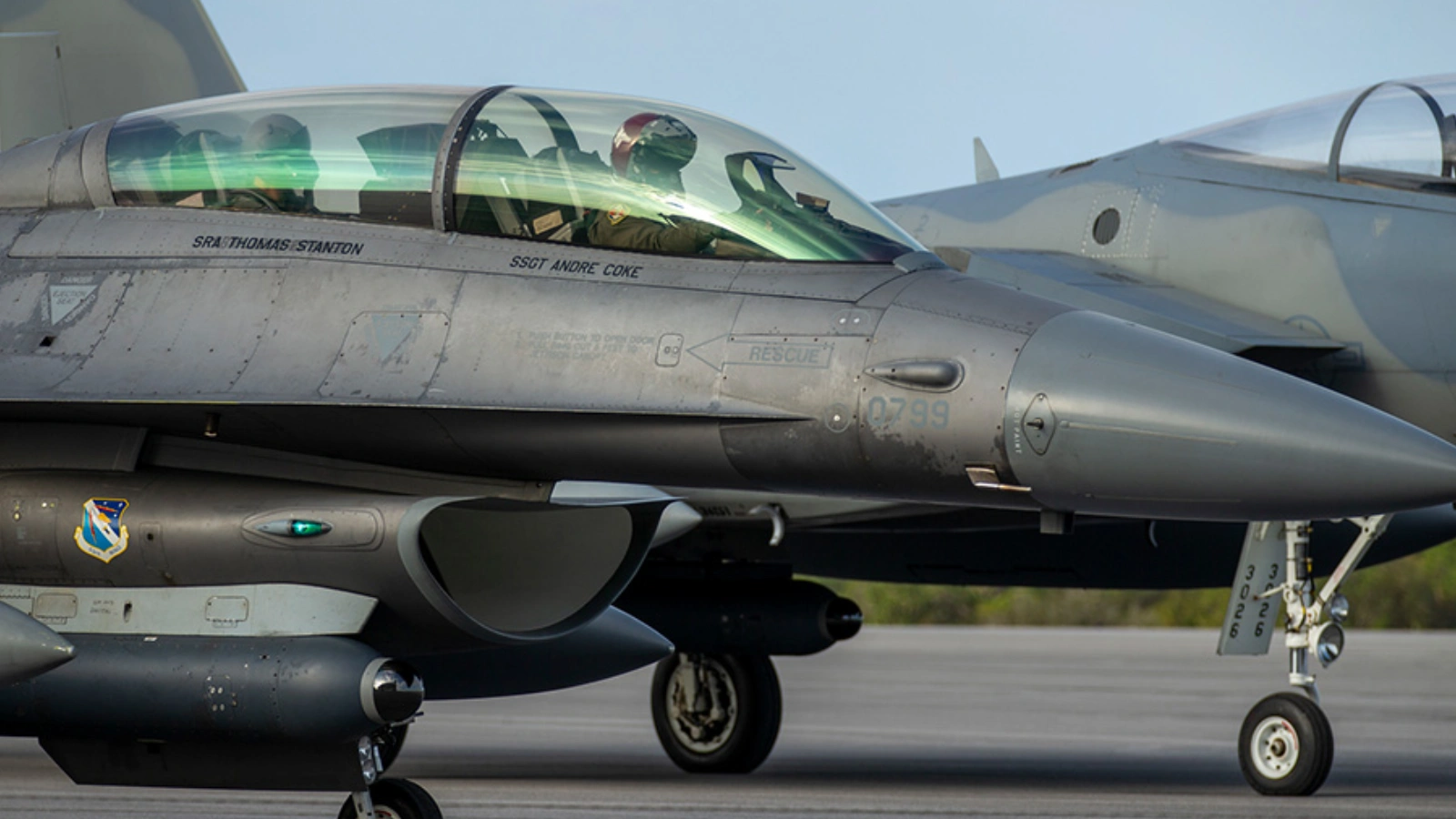
Lockheed Martin has demonstrated a Legion Pod F-16 targeting capability that allows two F-16 fighters to exchange infrared sensor information directly, improving passive target tracking in radar-denied and contested airspace. The September 2026 flight test was conducted from Morris Air National Guard Base in Tucson, Arizona, with the Air National Guard and Air Force Reserve Test Center, known as AATC.
Both F-16s carried Legion pods equipped with a pre-production version of L3Harris Technologies’ HiveLink data link. The aircraft used the shared sensor information to refine target tracks and generate near-instantaneous engagement solutions for multiple airborne targets without relying on radar.
The demonstration builds on earlier U.S. Air Force testing that showed F-15 and F-16 aircraft could use Legion’s Advanced Datalink to share infrared search-and-track data and passively triangulate an airborne target.
How the Legion Pod Works
Legion is a passive infrared search-and-track system based on the IRST21 sensor. Unlike radar, an IRST system detects and tracks targets through their infrared signatures without transmitting a radar signal.
The distinction matters in contested airspace. A fighter using radar must transmit electromagnetic energy, potentially increasing its exposure to electronic surveillance and countermeasures. A passive infrared sensor can instead collect target information without making the same type of radar transmission.
The principal limitation of passive sensing is range determination. A single passive sensor can establish the angular position of a target, but accurately determining distance generally requires additional information or measurements.
Legion’s pod-to-pod architecture addresses that problem by allowing two aircraft with separated sensors to compare their observations.
Lockheed Martin has previously described the concept as providing a form of rapid depth perception. Two geographically separated sensors observe the same target from different positions, allowing the system to derive additional information about target location.
The U.S. Air Force demonstrated the underlying concept in April 2022, when an F-15C and an F-16, both equipped with Legion Pods, shared IRST data through the Advanced Datalink and passively triangulated a target without radar or another active ranging source.
Legion Pod Capability At A Glance
| Capability | Description |
|---|---|
| Sensor | IRST21 infrared search and track |
| Platform tested | F-16 Fighting Falcon |
| Networking | Pod-to-pod data link |
| Current test radio | Pre-production HiveLink |
| Targeting method | Passive infrared sensing |
| Ranging approach | Cooperative measurements between pods |
| Radar requirement | Not required for the demonstrated passive targeting function |
| Primary operating environment | Radar-denied and contested airspace |
| Development partners | Lockheed Martin, Air National Guard, AATC, L3Harris |
Source: Lockheed Martin, U.S. Air Force and L3Harris.
Why Pod-to-Pod Networking Matters
The important change is not simply the addition of another infrared sensor to the F-16. It is the networking of those sensors.
A conventional aircraft sensor operates from its own position and perspective. When multiple aircraft can exchange sensor measurements rapidly, the formation can construct a more complete picture of an airborne target than any single platform could generate independently.
That creates particular value for passive air-to-air operations. Two or more fighters can observe a target without necessarily requiring every aircraft to activate its radar.
The 2022 U.S. Air Force test demonstrated this principle with an F-15 and F-16. The service said the ability to share information gave warfighters information they would not otherwise have from their individual viewpoints.
The September 2026 demonstration extends that concept specifically to direct communication between Legion-equipped F-16s.
Lockheed Martin said the latest capability is intended to reduce pilot workload and shorten target-engagement timelines. Direct communication between the pods can also preserve aircraft bandwidth for other mission requirements, according to the company.
HiveLink Adds a Resilient Networking Layer
The latest test used a pre-production version of HiveLink, developed by L3Harris.
L3Harris describes HiveLink as a high-assurance software-defined radio designed for contested and denied environments. It combines mesh networking, encryption and multi-waveform flexibility in a compact form factor and supports both line-of-sight and beyond-line-of-sight connectivity.
The system is designed to form and repair network paths as conditions change. L3Harris says HiveLink can operate across airborne, unmanned and ground platforms and supports interoperability with existing U.S., NATO and coalition systems.
That architecture is relevant to the Legion concept because passive targeting depends not only on the quality of the infrared sensor, but also on the ability to move measurements between aircraft quickly and reliably.
In a heavily contested electromagnetic environment, communications themselves can become a vulnerability. The networking system therefore has to balance data throughput, transmission characteristics, spectrum availability, resilience and platform size, weight and power constraints.
F-16 Gains Another Option for Radar-Contested Operations
The F-16 remains a major U.S. and allied fighter platform, and newer configurations are increasingly being equipped with improved sensors, displays and electronic systems.
Lockheed Martin identifies Legion-ES as an infrared search-and-track option for the F-16 Block 70/72, alongside the aircraft’s AESA radar and Sniper Advanced Targeting Pod.
The Legion approach does not replace the F-16’s radar. Instead, it provides another sensing method that can contribute to the aircraft’s broader sensor architecture.
That distinction is important because modern air combat increasingly depends on combining information from different sensors rather than relying on one source.
A passive IRST can provide useful information when radar emissions are undesirable or when the electromagnetic environment is heavily contested. Networked IRST can add another layer by allowing several aircraft to combine their observations.
From Individual Sensors to Distributed Targeting
The broader significance of the demonstration is the move toward distributed sensing.
Modern combat aircraft increasingly operate as nodes in larger networks. Instead of requiring every fighter to independently detect, identify, locate and track the same target, networked sensors can distribute observations across multiple platforms.
The Legion architecture fits that model because the pod provides a relatively self-contained sensor capability while its open architecture is designed to support integration with other systems. Lockheed Martin says the system has completed integration and flight testing on F-16 and F-15C aircraft.
The company also says Legion can accommodate additional sensors within its existing structure, potentially allowing the pod to evolve beyond its baseline IRST configuration.
The U.S. Air Force’s earlier testing also pointed toward broader platform interoperability. Officials said the goal was eventually to provide the capability to aircraft carrying an Advanced Datalink-equipped Legion Pod, regardless of platform.
That approach is relevant to mixed formations containing different fighter types and, potentially, crewed and uncrewed aircraft.
Next Steps Include Other Platforms and Networks
Lockheed Martin says F-16 flight testing will continue under an Air National Guard contract.
The next phase is expected to examine system performance, transportability and interoperability with other platforms and networks. Planned work includes integration of software-defined radios and multi-waveform gateways.
The company also intends to expand Legion’s potential role in operations involving crewed and uncrewed aircraft.
That direction is consistent with the wider development of distributed air operations, where fighters, uncrewed aircraft and other sensors can contribute different pieces of the same targeting picture.
For the F-16, the immediate significance is more specific: the aircraft can use a podded infrared sensor while exchanging measurements with another fighter, allowing passive observations to contribute to target ranging and engagement calculations.
The latest test therefore represents an incremental but technically important development in F-16 sensor networking. It combines a mature passive infrared sensing concept with a more resilient communications architecture, giving the aircraft another way to generate targeting information when conventional radar use is constrained.
