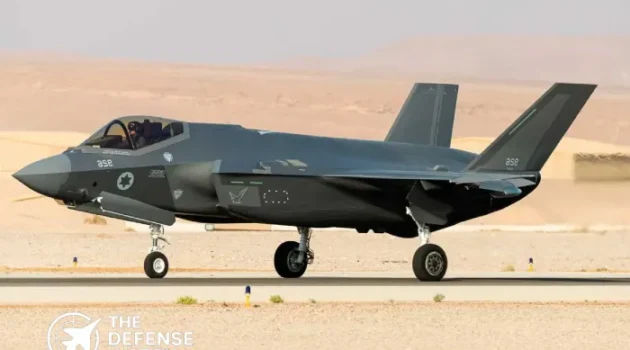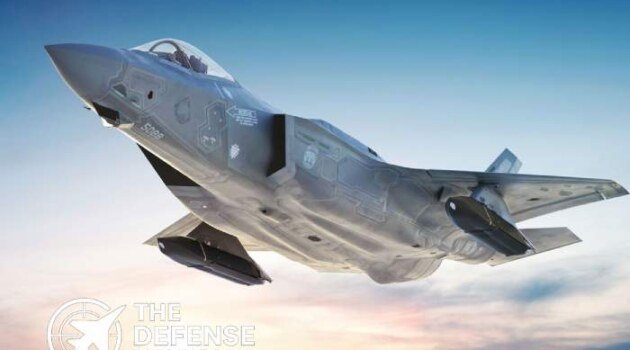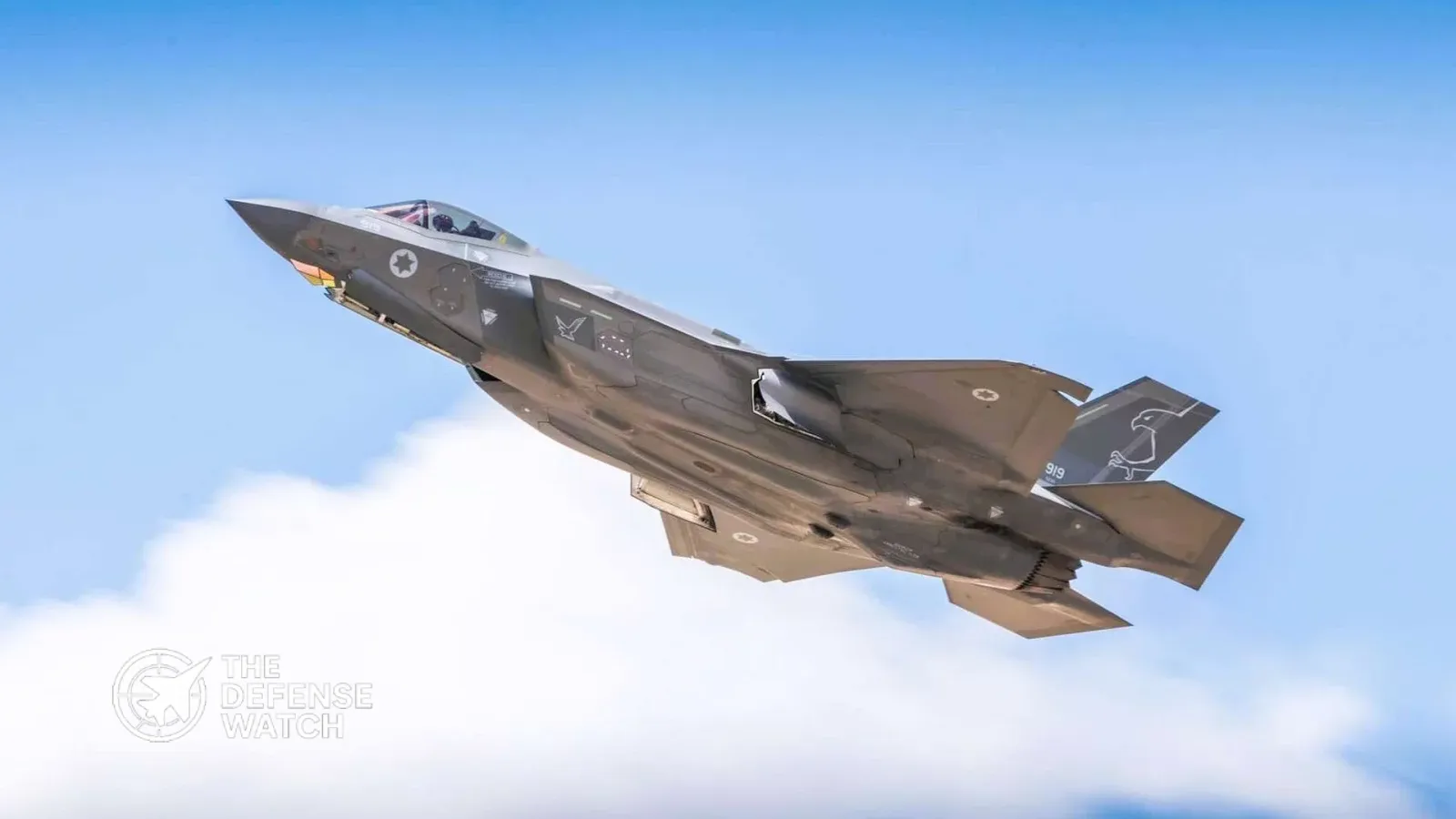
- ► Israel’s Ambassador to the U.S., Yechiel Leiter, confirmed the IAF’s F-35I Adir fleet carries stealth-compatible range-extending fuel tanks.
- ► The modification preserves the aircraft’s low-observable radar signature — a technically demanding engineering achievement.
- ► The Adir can now carry four externally mounted wing missiles in “beast mode” configuration for high-payload strike sorties.
- ► Conformal tank designs are reported to push the F-35I’s combat radius beyond 1,700 km — sufficient for round-trip strikes on Iran without aerial refueling.
- ► The IAF is the only F-35 operator to have conducted combat strikes using the external wing-carriage design.
- ► Israel’s fleet stood at 48 F-35I aircraft as of January 2026, with a total of 75 on order.
- ► The U.S. Air Force cited Israeli modifications when requesting FY2026 funds to explore similar F-35 external fuel tank integration.
Israel’s F-35I Adir Gets Stealth Fuel Tanks — What It Means
The Israeli Air Force’s F-35I Adir stealth fuel tank program has moved from long-rumored development into publicly confirmed operational reality. On February 16, 2026, Israel’s Ambassador to the United States, Yechiel Leiter, stated in an interview with the daily Israel Hayom — as reported by The Times of Israel — that the IAF’s Adir fleet has been fitted with range-extending fuel tanks “without compromising stealth.” Simultaneously, the ambassador disclosed that four external wing-mounted missiles have been added to the platform’s arsenal, formalizing the jet’s “beast mode” capability for high-payload strike missions.
The announcement carries substantial strategic weight. It is the first on-the-record confirmation by a senior Israeli official that the classified program — long speculated about in defense circles — has crossed the threshold from development into declared operational use. The timing, coming eight months after Israel’s June 2025 air campaign against Iran (Operation Rising Lion), signals that Israel intends adversaries, allies, and the broader strategic community to factor a more capable, longer-reaching F-35I into their strategic calculations.
“We developed fuel tanks that extend the aircraft’s range without compromising stealth, and we added four missiles on the wings.” — Yechiel Leiter, Israel’s Ambassador to the United States | Israel Hayom / Times of Israel, Feb. 16, 2026
The F-35I Adir: Not Your Standard F-35
To understand why Israel could achieve this modification while no other F-35 operator has, it is essential to understand what the F-35I Adir actually is. The Adir — Hebrew for “Mighty One” — is the only F-35 variant in global service that was contractually authorized for deep, indigenous systems integration by its operator before the first aircraft was delivered.
While every other nation that flies the F-35 operates a platform locked to Lockheed Martin’s standard hardware and software baseline, Israel negotiated a unique arrangement with the U.S. government and the F-35 Joint Program Office. This agreement permitted the Israeli defense industry to integrate national mission computers, electronic warfare suites developed by Elbit Systems, indigenous weapons, domestic data links, proprietary encryption systems, and custom command-and-control interfaces directly into the aircraft’s architecture.
This modular, open-architecture framework made the stealth tank program technically feasible. Because Israel and its defense contractors could work within the aircraft’s mission-system software and structural envelope — in cooperation with Lockheed Martin and the F-35 JPO — designing and certifying conformal fuel tanks that are aerodynamically and electromagnetically compatible with the airframe was a far less restrictive process than for any other operator.
The Stealth-Range Dilemma: How Israel Solved It
External fuel tanks on a stealth aircraft present a well-understood engineering paradox. The F-35’s low-observable profile derives from the careful geometric shaping of every external surface — every panel line, inlet, and contour is optimized to scatter radar energy away from threatening emitters. Attaching conventional pylon-mounted drop tanks immediately creates sharp edges, new radar-reflective volumes, and surface discontinuities that dramatically inflate the aircraft’s radar cross-section.
Israel’s solution, as described by open-source analysis and corroborated by Ambassador Leiter’s remarks, involved designing conformal tanks — installations that follow the curvature and contour of the fuselage rather than hanging below it on pylons. The tanks are reported to be “covered with absorbent materials” and attached using pylons engineered to preserve aerodynamic and electromagnetic signature characteristics, resulting in a cruise-flight range exceeding 2,200 kilometers — sufficient for a round-trip mission from Israeli airbases to targets deep inside Iranian territory without aerial refueling.
RANGE CONTEXT: The F-35A’s standard published combat radius on internal fuel alone is approximately 670 nautical miles (roughly 1,240 km). The Adir’s conformal tank integration is reported to extend unrefueled operational reach beyond 1,700 km — a critical threshold for striking Iran’s nuclear and missile infrastructure and returning safely.
The War Zone (TWZ), citing U.S. Air Force budget documents, confirmed in June 2025 that Israel’s extended-range capability was employed operationally during the Israel-Iran conflict. While precise technical parameters remain classified, the combination of conformal fuel tank geometry, radar-absorbent coatings, and jettison capability provides a credible, operationally viable answer to the stealth-range dilemma that has constrained fifth-generation aircraft globally.
Beast Mode: Four External Missiles and the Firepower Equation
Leiter’s second disclosure — that the F-35I now carries four externally mounted wing missiles — ties the range story to a separately confirmed IAF capability known colloquially as “beast mode.” The F-35 was originally optimized exclusively for internal weapons carriage. Its two internal bays hold precision-guided munitions while maintaining the aircraft’s full stealth profile. But internal volume is inherently limited.
In the year prior to Leiter’s interview, the IAF publicly announced that its Flight Test Center, working alongside Lockheed Martin and the Pentagon’s F-35 program, had developed an external wing-carriage capability. The IAF stated explicitly that the Adir is “the only F-35 to conduct strikes with this design.” Imagery released by the IDF during the June 2025 Iran air campaign confirmed that F-35Is flew combat missions with missiles visibly attached to their wings.
In “beast mode,” the F-35I trades its minimum radar signature for substantially increased firepower. The configuration is most tactically relevant in phases of a campaign where adversary air defenses have been degraded by prior SEAD (Suppression of Enemy Air Defenses) operations — reducing the survivability premium on stealth and making the firepower premium on heavy external ordnance loads more valuable per sortie.
Operational Impact: Tanker Independence and Mission Flexibility
One of the strategic drivers behind Israel’s long-range fuel tank program was a structural vulnerability in the IAF’s aerial refueling capacity. Prior to the June 2025 campaign, Israel operated only seven Boeing KC-707 Re’em tanker aircraft — a number defense analysts modeled as insufficient to sustain the scale of the observed operations. Extended-range F-35Is appear to have provided the additional endurance that made the campaign viable without confirmed external tanker support.
The equation is now shifting further. Israel has contracted the KC-46A Pegasus — the U.S. Air Force’s next-generation aerial refueling platform — to replace its aging Boeing 707-based tankers. But the conformal fuel tank program provides a complementary hedge: it reduces the dependency on tanker rendezvous points, which are themselves high-value targets and operationally complex to orchestrate in contested airspace.
Ambassador Leiter underscored Israel’s depth of experience in his interview, stating that Israeli pilots have logged more F-35 flight hours than all other foreign partner-nation pilots combined. He also relayed that Lockheed Martin’s chief executive described Israeli technical feedback and field-driven innovations as worth “many billions” to the company — an acknowledgment that Adir program modifications represent not just a national capability gain, but a data resource of global relevance to the entire F-35 enterprise.
U.S. Air Force Takes Note: FY2026 Budget Request Follows Israeli Lead
The Adir’s extended-range performance during Operation Rising Lion appears to have directly influenced U.S. Air Force procurement thinking. According to reporting by The War Zone citing U.S. Air Force budget documents, the USAF’s proposed Fiscal Year 2026 budget includes a request for funds to “evaluate feasibility and decompose requirements for integration of External Fuel Tanks to support long-range missions of the F-35.” This represents a reversal of an earlier programmatic decision that had eliminated the requirement for streamlined F-35 drop tanks.
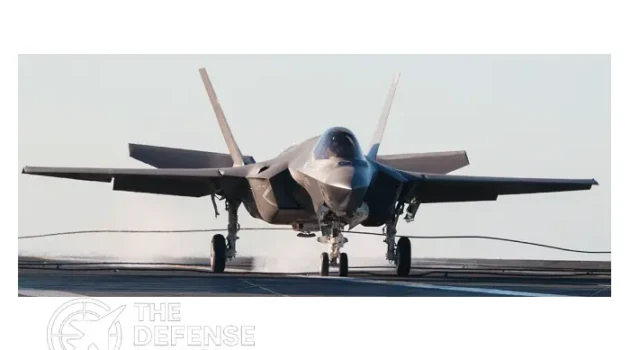
The FY2026 request is particularly notable for the Navy’s carrier-based F-35C, whose existing development of the F/A-XX sixth-generation replacement has been placed on hold — leaving the C-model as the carrier air wing’s primary penetrating strike asset. Extended-range fuel tanks would directly address the F-35C’s combat radius limitations in Indo-Pacific scenarios. The USAF has indicated it will study Israeli modifications to the F-35I Adir as a reference point in the feasibility evaluation.
BROADER IMPACT: The F-35’s external tank challenge is not unique to Israel. Other partner nations operating the F-35 without organic tanker capacity — including several European allies — are watching Israeli developments closely as a potential model for extending their own aircraft’s effective operational reach. Strategic Implications: Deterrence, Iran, and the Regional Air Balance
Read in the context of Israel’s declared military doctrine and its active conflict with Iran, Leiter’s confirmation is clearly intended to carry a deterrence message. The operational credibility of Israel’s strike option against Iran’s nuclear program has historically been questioned by analysts on the grounds of range and weapons load — arguments that a larger aircraft like the F-15I Ra’am was better suited to the deep-strike mission. Those arguments are substantially weakened by the confirmed extended-range and beast-mode capabilities.
A more capable F-35I Adir — one that can reach central Iran and back without tanker support, carry a meaningful weapons load in either low-observable or high-payload configuration, and exploit its advanced sensor-fusion and electronic warfare systems throughout the mission — reinforces Israel’s capacity for unilateral action. It also reshapes alliance planning with Washington: the more credibly self-sufficient Israel’s strike posture is, the greater its leverage in discussions about U.S. involvement in future escalation scenarios.
For Iran, the strategic calculus is less favorable. The June 2025 air campaign already demonstrated that F-35I Adirs could penetrate Iranian air defenses — including elements of the Russian-origin S-300PMU-2 network — and strike hardened infrastructure. The confirmation that those aircraft now carry significantly more fuel and more weapons, with fewer logistical constraints, means the same capability is not a one-time demonstration but a durable, repeatable operational posture.
Fleet Status and What Comes Next
As of January 18, 2026, the IAF received its 48th F-35I Adir at Nevatim Air Base — adding tail numbers 978, 979, and 983 to its inventory in a single delivery ceremony. Under existing agreements with the United States, Israel is contracted to receive a total of 75 F-35Is, meaning more than a third of the eventual fleet has yet to be delivered. As those aircraft arrive in an already upgraded baseline configuration, Israel’s aggregate strike capacity will grow incrementally.
Technical details of the conformal tank program remain classified. Neither the Israeli government nor Lockheed Martin has released specific data on fuel volume, weight penalty, signature penalty, or integration architecture. External analysts note that some residual signature increase is almost certainly present with any external or conformal installation, and that the tanks would likely be jettisoned before penetrating the densest threat rings. The operational value, however, lies in the transit phase and the flexibility to reach distant targets with reduced reliance on tanker support.
What Ambassador Leiter’s public disclosure does, above all, is remove the capability from the realm of speculation. The F-35I Adir with stealth fuel tanks and external wing missiles is not a development program or a future aspiration — it is, by Israel’s own account, fielded and operationally proven. The Middle East air balance has shifted accordingly, and every actor in the region — and every F-35 operator beyond it — will be recalibrating their assessments in the months ahead.
Get real time update about this post category directly on your device, subscribe now.