

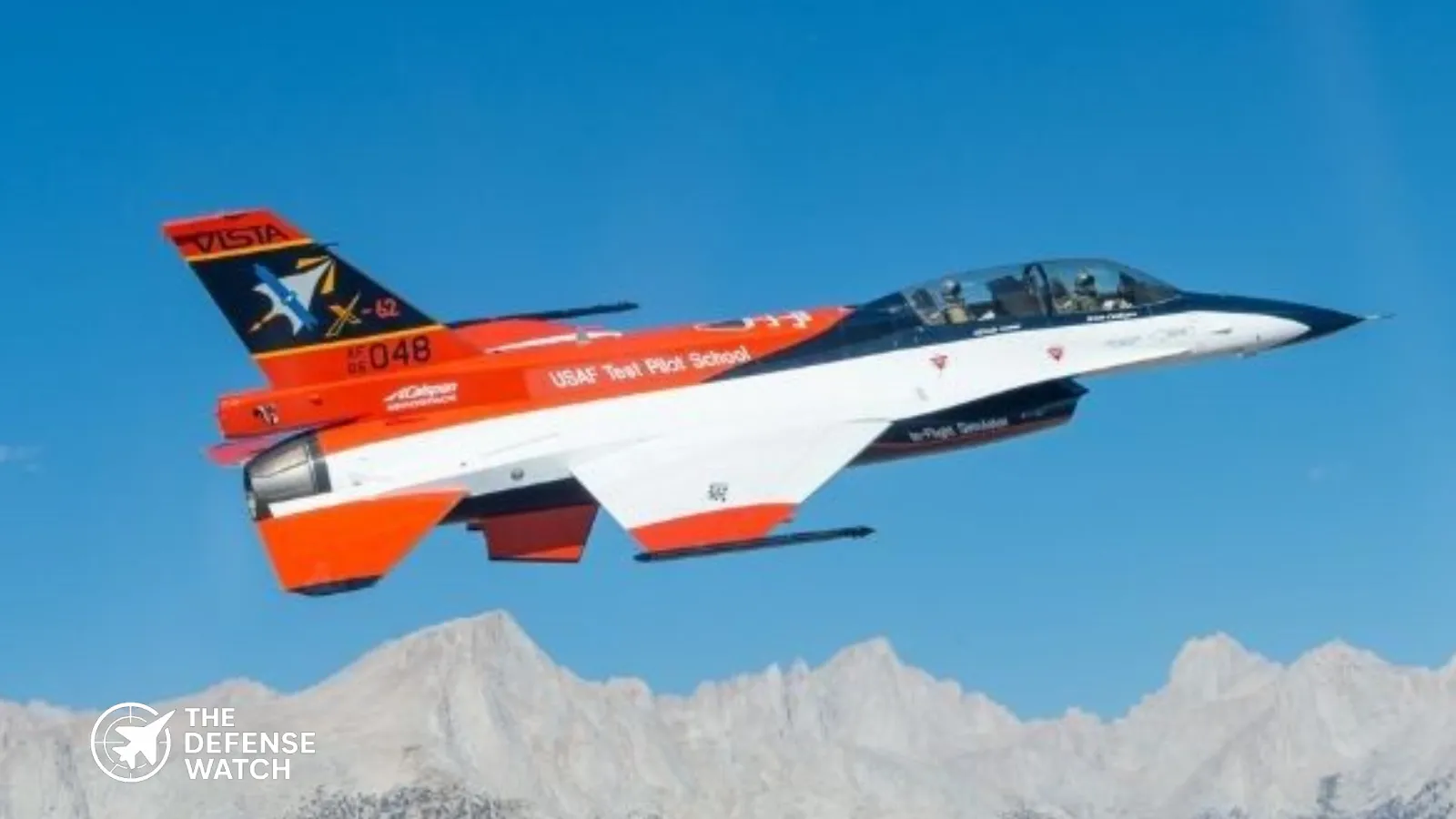
The US Air Force is upgrading its experimental AI fighter jet, the X-62 VISTA, adding new radar and mission systems to expand its testing of artificial intelligence in flight. The upgrades began in December 2025 at Edwards Air Force Base in California and focus on integrating advanced radar, sensors, and mission-critical electronics to support more complex autonomy experiments.
What’s Happening With the X-62 AI Fighter
The X-62 VISTA (Variable Stability In-flight Simulator Test Aircraft) is a modified F-16D used as a flying lab for advanced aerospace experiments. The aircraft has been repurposed over the years to test new avionics, flight control systems, and most recently, autonomous flight capabilities driven by artificial intelligence.
In its latest update, the Air Force Test Pilot School, part of the 412th Test Wing at Edwards, is installing new mission systems. This work includes integrating advanced radar technology and enhanced sensors. These additions are meant to let the X-62 operate in more demanding scenarios, pushing AI decision-making to handle real-time collaboration, sensor fusion, and complex mission tasks.
Why the Upgrade Matters
The improvements to the X-62 are a direct result of funding from the Pentagon’s Test Resource Management Center. The goal is to expand the aircraft’s role beyond simple flight tests into rich autonomy experiments that simulate near-combat conditions. Integrating radar with AI systems allows testing of autonomous combat tasks, not just basic navigation or control.
A key feature of the upgrade is the addition of Raytheon’s PhantomStrike radar. This system is a compact, air-cooled active sensor designed to provide fire-control capability while using less power and space than traditional radar arrays. Raytheon describes PhantomStrike as lighter and more energy efficient, making it suitable for autonomous aircraft and other lighter platforms.
Raytheon says PhantomStrike can fit a wide range of aircraft types, including uncrewed vehicles, light attack jets, and rotary-wing aircraft, offering strong tracking and targeting capability at about half the cost of typical fire-control radars.
Background on Autonomy Tests
The X-62 made headlines in 2023 when it took part in a series of tests, including dogfights where artificial intelligence flew the aircraft against human pilots. Those experiments were part of the Air Combat Evolution program, a joint effort between the Air Force and the Defense Advanced Research Projects Agency to explore what AI can do in aerial combat.
Data from those early demonstrations has helped shape longer-term efforts to develop systems where uncrewed or autonomous partners operate alongside manned fighters. These concepts include collaborative combat aircraft, sometimes called drone wingmen, which could perform tasks such as air-to-air engagement or suppression of enemy defenses in support of manned flights.
What Official Sources Say
In a statement about the upgrades, Air Force Test Pilot School Commandant Colonel Maryann Karlen noted that the X-62 “serves as a bridge” between traditional piloted aircraft and future uncrewed combat systems. The new mission systems are intended to help AI systems address more complex scenarios while working alongside human aircrew or other autonomous agents.
The addition of a radar like PhantomStrike supports this vision by giving the aircraft sensor capability on par with operational combat jets. Having radar data available to AI systems lets them identify, track, and react to threats in simulated operational conditions.
Technical Aspects of PhantomStrike Radar
PhantomStrike uses advanced Gallium Nitride technology, which boosts performance while reducing cooling needs. Traditional arrays often require complex liquid cooling, adding weight and power demands. PhantomStrike’s air-cooled design supports agile platforms like the X-62 VISTA AI fighter and future autonomous aircraft.
The radar’s design also emphasizes digital beam steering and multimode operation, letting it handle both air and ground tracking tasks. This flexibility makes it useful for AI applications where the aircraft might need to manage multiple objectives or targets at once.
What Is Next
With these upgrades in place, the Air Force plans to use the X-62 for even more challenging autonomous flight tests. The work supports a broader shift toward AI-enabled systems across the service, from collaborative unmanned platforms to advanced sensor networks. The next phase of testing could include scenarios where autonomous agents use radar to make tactical decisions without human intervention.
As autonomous systems evolve, integrating advanced sensors like PhantomStrike will likely become standard for future AI combat jets or drone wings. These experiments on the X-62 VISTA AI fighter will help shape how AI can assist or even operate alongside human pilots in contested environments.

11 comments
[…] The effort was led by Naval Air Systems Command’s Strike Planning and Execution Systems (PMA-281) and Aerial Targets (PMA-208) offices with industry partners Shield AI, Kratos and CTSI. Shield AI provided the autonomy software, Kratos supplied the BQM-177A platforms, and CTSI delivered mission planning and pilot-vehicle interface systems. […]
[…] M270A2 retains a dual-pod launcher able to fire 12 guided rockets or two tactical missiles, with upgraded digital systems aimed at faster mission processing and better accuracy compared with older […]
[…] The contract reinforces cooperation between Thales, NAHEMA, the French Direction Générale de lArmement (DGA) and Spanish defence procurement authority DGAM. It aligns with broader NH90 modernisation efforts aimed at delivering advanced mission systems and safety tools to European armed forces. […]
[…] reducing operator workload and enabling a single crew to oversee multiple autonomous systems. As autonomy systems continue to evolve, open, government-defined reference architectures may help ensure […]
[…] proposed P 8A Poseidon sale includes aircraft, mission systems, training, spares, and long term sustainment support. While the exact number of aircraft has not […]
[…] Force’s enterprise cloud program office, providing standardized, secure cloud environments for mission systems, business applications, and software development efforts. The program supports a wide range of […]
[…] Typhoon among a select group of modern fighters with long histories of sustained operations. The aircraft’s usage covers routine peacetime missions as well as higher-intensity activities for NATO and coalition partners. Its multirole design […]
[…] in a hybrid power plant can increase endurance and efficiency, particularly for heavy cargo missions where fuel use and system redundancy matter. The hybrid approach aims to support missions like international logistics, […]
[…] the Point Mugu event, the F A 18 demonstrated compatibility with the new missile and the aircraft’s mission systems. Navy engineers use these test launches to validate software, avionics integration, and weapon […]
[…] apprenticeship program led realistic scenarios to test mission flow from planning through execution. Soldiers trained on the full sequence of tasks needed to […]
[…] follows a modular “genus/species” concept that lets a common airframe integrate different mission systems […]