• Home
  • About
  • Defense Systems
  • Manufacturer
  • Comparisons
  • Compare 
  • Tools
TheDefenseWatch.com
  • Aerospace & Aviation
  • Military & Ordnance
  • Naval & Maritime
  • Cyber & Space Defense
  • Policy & Strategy
  • Global News
  • Tools Library
    • Smart Calculator
    • Drone Flight Time Calculator
    • Drone Range Calculator
    • Counter-Drone Jammer Effective Range Calculator
    • Counter-Battery Radar Detection Calculator
    • Artillery Fire Correction Calculator
    • Thermal Camera Detection Range Calculator
    • Missile Range & Time-of-Flight Calculator
    • Radar Detection Range Calculator
    • FPV Strike Drone Payload vs Range Calculator
    • Loitering Munition Endurance Calculator
    • Sniper Ballistic Drop & Windage Calculator
    • Bullet Drop Calculator
    • U.S. Army Combat Fitness Test (ACFT) Calculator
    • Military Pension Calculator
    • Military Retirement Calculator
    • Military Pension Calculator
    • Large Number Calculator
Font ResizerAa

TheDefenseWatch.com

The Defense Watch | U.S. & Global Defense News, Analysis & Military Updates

Search
  • Home
  • About
  • Defense Systems
  • Manufacturer
  • Comparisons
  • Compare 
  • Tools

Stay Updated

Get the latest update

Subscribe

Explore

  • Drone
  • Fighter Jets & Military Aircraft
  • Hypersonic Weapons
  • Aircraft Carriers
  • Strategic History & Missions
  • Tools Library
Home » China Aircraft Carrier vs US: Who Leads in Naval Air Power in 2026
Head-to-Head

China Aircraft Carrier vs US: Who Leads in Naval Air Power in 2026

TeamDefenseWatch
Last updated: December 13, 2025 10:43 am
TeamDefenseWatch
Share
3 Min Read
china aircraft carrier vs us
SHARE

China Aircraft Carrier vs US Carrier

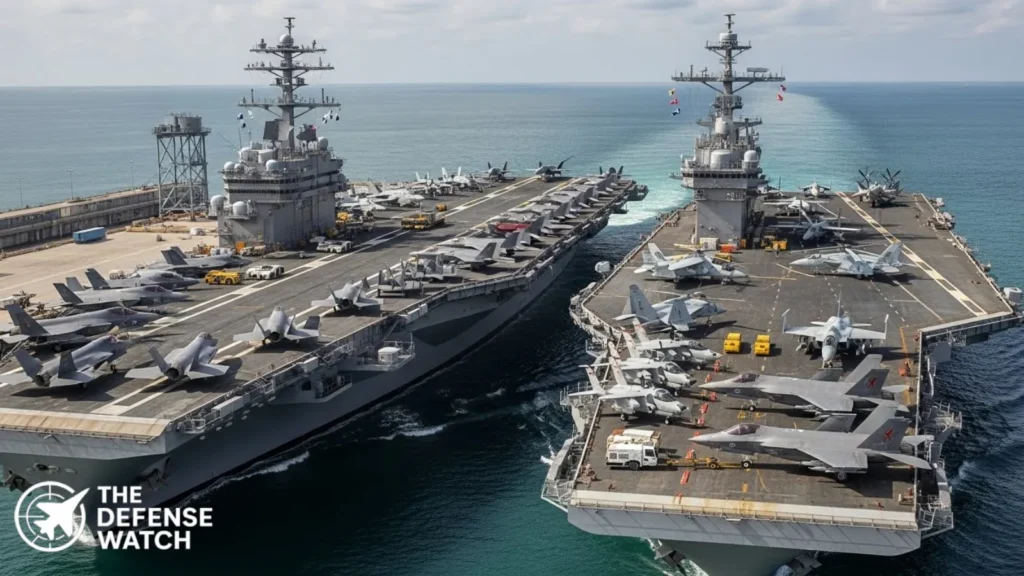
For decades the United States Navy’s aircraft carriers have been the backbone of American military power at sea, acting as floating air bases wherever Washington wants global influence. Now China’s rapid push into carrier development has shifted this balance in the Indo‑Pacific. With China operating multiple carriers and building even more advanced ones, the question is no longer theoretical: in a China aircraft carrier vs US contest, who leads in strength, capability, and strategic impact today and in the near future? This comparison matters not just for Taiwan or the South China Sea, but for NATO partners in Asia, U.S. deterrence posture, and global trade security across vital sea lanes.

Contents
  • China Aircraft Carrier vs US Carrier
  • China Aircraft Carrier vs US Carrier Specifications Table
  • Design & Technology
    • China’s Carriers
    • U.S. Carriers
  • Firepower & Performance
    • China’s Carrier Air Wing
    • U.S. Carrier Air Wing
  • Operational Range & Mobility
  • Combat Effectiveness
    • China’s Experience
    • U.S. Operational Record
  • Cost & Export Value
  • Analysis
  • Conclusion
  • FAQs

China Aircraft Carrier vs US Carrier Specifications Table

FeatureChina’s Carriers (Fujian Class)U.S. Navy Carriers (Ford/Nimitz Class)
Number in Service3 (Liaoning, Shandong, Fujian)11 supercarriers overall
Displacement~80,000 tons (Fujian)~100,000+ tons
PropulsionConventional (fuel)Nuclear
Aircraft LaunchElectromagnetic (Fujian), ski jump (older)Catapult (steam/EMALS)
Typical Air Wing~50–60 aircraft~70–90 aircraft
Endurance at SeaLimited (fuel dependent)Very high (nuclear)
First Service Entry2012 (Liaoning) to 2025 (Fujian)1975 (Nimitz) to 2017 (Ford)
Estimated Cost~5 to 6 billion USD each~13+ billion USD each

Design & Technology

China’s Carriers

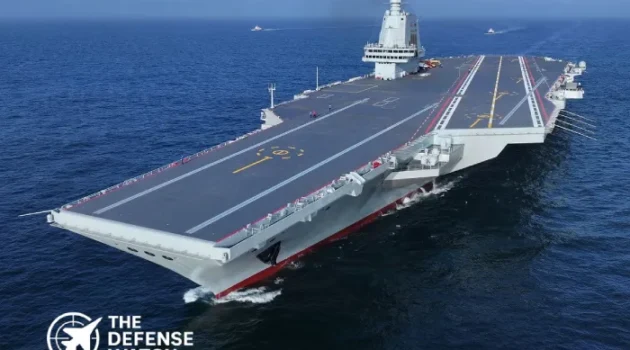
China’s first carriers were built from Soviet designs and launched aircraft off a ski ramp. The newest, the Fujian, shifts to electromagnetic launchers like those on U.S. carriers. That lets China operate heavier aircraft and yields greater payload capacity. But China’s carriers use conventional engines, which means they need regular refueling and lack the almost unlimited reach that nuclear power provides. China is also building a future carrier design (Type 004) that may be nuclear and larger than the U.S. Ford class.

  • Fujian (CV-18) Aircraft Carrier

    Fujian (CV-18) Aircraft Carrier

    • Large Flight Deck: Flat top with 3 EMALS catapults
    • Onboard Air Wing: Fighters, AEW, ASW, and support aircraft
    • Advanced Command & Control: Integrated combat systems
    • Defensive Weapon Systems: CIWS + short-range SAMs
    • View Details →
    8.8

    U.S. Carriers

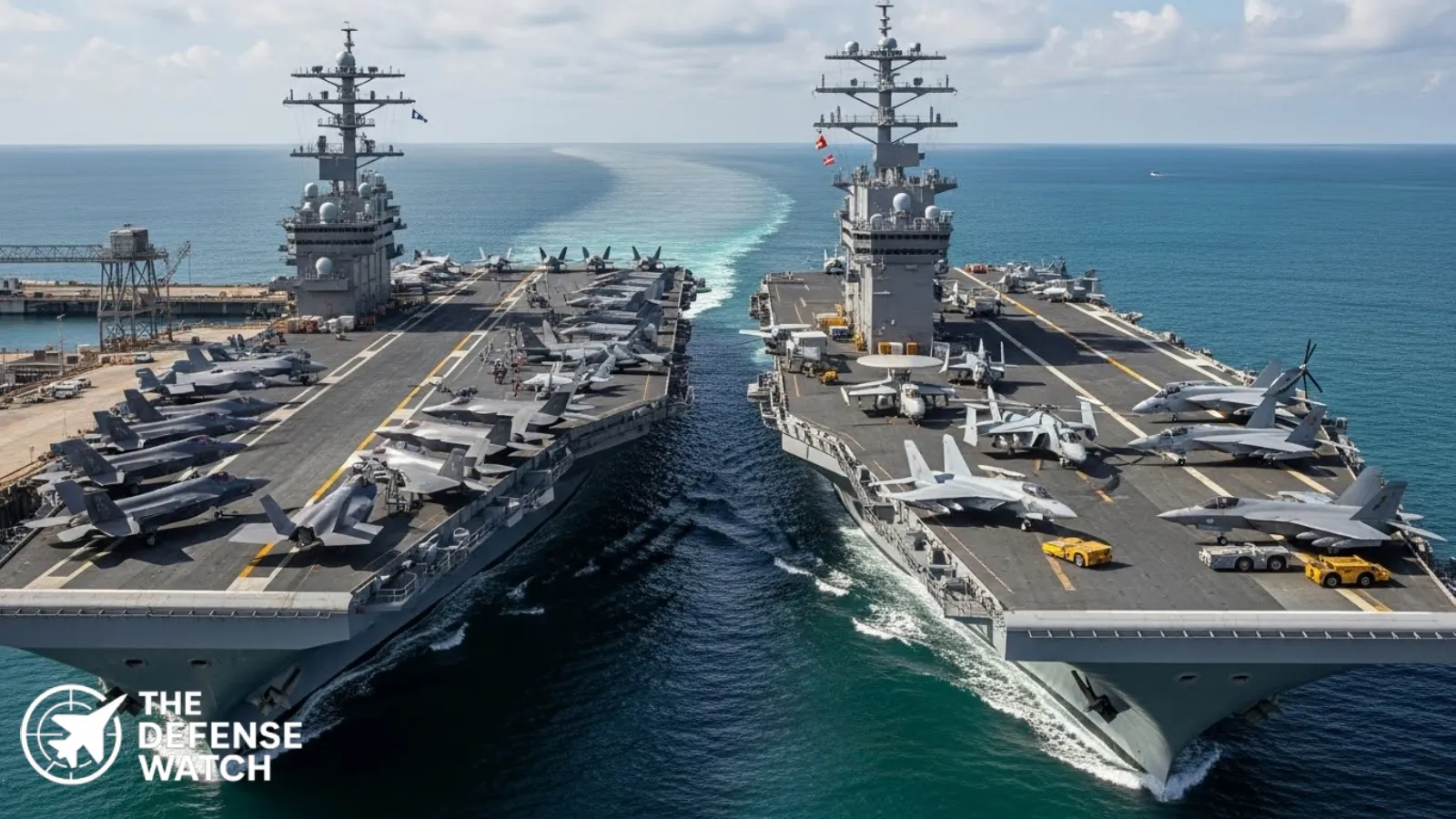
    U.S. Navy carriers are all nuclear powered, giving them unmatched endurance and speed without refuel stops. The newest Ford class adds more automation, faster sortie support, and advanced radar and command systems. Their flight decks use electromagnetic aircraft launch systems that work with a wide range of aircraft from fighters to early warning planes. Even older Nimitz‑class carriers use steam catapults with proven reliability.

    • USS Nimitz Aircraft Carrier

      USS Nimitz Aircraft Carrier

      • Large Flight Deck: Supports CATOBAR operations
      • Onboard Air Wing: 60+ fixed-wing and rotary aircraft
      • Advanced Command & Control: Integrated CIC and data links
      • Defensive Weapon Systems: CIWS, RAM, Sea Sparrow
      • View Details →
      8.3

      Firepower & Performance

      China’s Carrier Air Wing

      China’s air wings include J‑15 fighters, new J‑35 stealth jets, airborne early warning aircraft (KJ‑600), and drones. This mix gives China a broader range of mission profiles than earlier carriers could manage, but they still trail the U.S. in mature combat systems and number of fighter sorties per day.

      U.S. Carrier Air Wing

      U.S. carrier air wings include F‑35C stealth fighters, F/A‑18 Super Hornets, E‑2D Hawkeyes for airborne radar, and EA‑18G Growlers for electronic warfare. The U.S. can support large air wings and sustain high sortie rates thanks to advanced deck tech and long experience.

      china aircraft carrier vs us

      Operational Range & Mobility

      With nuclear propulsion, U.S. carriers can stay at sea for months without refueling, and move quickly across oceans. China’s current carriers must refuel more often and rely on supply ships, which adds complexity to long‑range operations. Future Chinese carriers with nuclear plants could narrow this gap.

      Combat Effectiveness

      China’s Experience

      China’s carrier operations are relatively new. The PLAN has conducted exercises and integrated carriers into fleet drills, but it lacks real combat experience. Training, logistics, and joint‑force command will take years to mature.

      U.S. Operational Record

      The U.S. Navy has decades of carrier operations, including combat deployments worldwide. Institutional knowledge, global logistics bases, and integrated joint operations give U.S. carriers an edge in sustained, high‑intensity conflicts.

      Fujian (CV-18) Aircraft Carrier vs USS Nimitz Aircraft Carrier

      Cost & Export Value

      U.S. carriers are among the most expensive warships ever built, but they also support vast industrial bases and export naval aviation tech to allies. China’s carriers cost less but their export value is limited since no other navy yet operates similar ships at scale.

      Analysis

      In a straight China aircraft carrier vs US comparison today, the United States maintains the lead in overall capability. U.S. carriers are larger, nuclear powered, and carry more aircraft, supported by decades of operational experience and a global network of bases. China is closing the technology gap with electromagnetic launch systems, domestic aircraft development, and plans for future nuclear carriers. But China’s fleet is smaller, less tested, and more regionally focused around the First Island Chain. U.S. doctrine still emphasizes integrated air, sea, and joint operations with allies, while China continues to build institutional expertise.

      China’s carrier program is rapidly evolving. Newer designs like the projected Type 004 could rival or even surpass U.S. carriers in size and aircraft capacity. Still, numbers and technology do not automatically translate to combat effectiveness without experience and logistics support.

      Conclusion

      In a direct China aircraft carrier vs US comparison today, the United States clearly leads in capability, reach, and operational experience. China’s carriers are credible and improving quickly, but they remain second with limited endurance and less battle‑tested systems. Under specific conditions close to China’s coast and within integrated PLAN operations, Chinese carriers could be effective. On a global scale, U.S. carriers retain the edge in power projection and sustained operations.

      FAQs

      In a China aircraft carrier vs US clash who has more carriers?

      The U.S. Navy operates more carriers (11) compared with China’s three.

      How do China’s carriers differ in launch technology?

      China’s newest carrier uses electromagnetic launch systems like U.S. Ford class, while earlier Chinese carriers used ski‑jump ramps.

      Why does propulsion matter in carrier ops?

      Nuclear propulsion lets U.S. carriers stay at sea longer without refueling, giving them greater range and endurance. Chinese carriers now are conventionally powered.

      Can China’s carriers carry stealth aircraft?

      China is developing carrier‑based stealth jets like the J‑35, expanding their mission sets.

      Does the U.S. still lead in carrier combat experience?

      Yes. The U.S. has longer and more varied operational experience with carriers, especially in real combat scenarios.
TAGGED:China aircraft carrierFujian vs FordIndo‑Pacific defensenaval power comparisonUS Navy carriers
Share This Article
Facebook Copy Link Print
ByTeamDefenseWatch
TeamDefenseWatch is the official editorial byline of TheDefenseWatch.com. Working under one umbrella, TheDefenseWatch.com, the team delivers verified, factual reporting on global defense, military technology, aerospace systems, and security developments. Articles are sourced from official statements, defense industry releases, and trusted media, with editorial review to ensure accuracy and clarity.Contact: info@TheDefenseWtach.com
3 Comments
  • Pingback: History of U.S. Battleships and Why They Were Retired | TheDefenseWatch.com
  • Pingback: UK Sonobuoy Contract Strengthens Royal Navy Merlin Anti-Submarine Force | TheDefenseWatch.com
  • Pingback: Royal Navy Achieves UK First: Wildcat Helicopters Command Multiple Drones in Flight | TheDefenseWatch.com

Leave a Reply Cancel reply

Your email address will not be published. Required fields are marked *

Latest Defense Systems

  • RUTA B1 Cruise Missile RUTA B1 Cruise Missile
  • XQ-67A Drone XQ-67A Drone
  • B-25 Mitchell Bomber B-25 Mitchell Bomber
  • F-100 Super Sabre F-100 Super Sabre
  • North American F-86 Sabre North American F-86 Sabre
  • North American XB-70 Valkyrie North American XB-70 Valkyrie
  • Northrop YF-23 Fighter Northrop YF-23 Fighter
  • P-51 Mustang Fighter Aircraft P-51 Mustang Fighter Aircraft
  • Rafale F5 Fighter Rafale F5 Fighter

Recent Compares

  • J-10C vs JF-17 Thunder: Which Fighter Is More Capable? J-10C vs JF-17 Thunder: Which Fighter Is More Capable? View Comparison →
  • Tejas vs Gripen: Key Differences and Capabilities Tejas vs Gripen: Key Differences and Capabilities View Comparison →
  • Tejas vs MiG-21 Bison: How India Replaced Its Iconic Supersonic Fighter Tejas vs MiG-21 Bison: How India Replaced Its Iconic Supersonic Fighter View Comparison →
  • F-35 vs F-16: Stealth, Sensors and Combat Roles F-35 vs F-16: Stealth, Sensors and Combat Roles View Comparison →
  • Tejas Fighter Jet vs F-16 Fighting Falcon: Capability Compared Tejas Fighter Jet vs F-16 Fighting Falcon: Capability Compared View Comparison →
  • Rafale Fighter Jet vs F-16 Fighting Falcon : Which Fighter Has the Edge? Rafale Fighter Jet vs F-16 Fighting Falcon : Which Fighter Has the Edge? View Comparison →
  • Su-57 Fighter Jet vs J-20 Fighter Jet: Stealth and Air Combat Compared Su-57 Fighter Jet vs J-20 Fighter Jet: Stealth and Air Combat Compared View Comparison →
  • Mirage 2000 vs Tejas Mk1A: Legacy Combat Power vs Indigenous Modernization Mirage 2000 vs Tejas Mk1A: Legacy Combat Power vs Indigenous Modernization View Comparison →
  • Rafale Fighter Jet vs F-22 Raptor: Which Air Dominance Fighter Has the Edge? Rafale Fighter Jet vs F-22 Raptor: Which Air Dominance Fighter Has the Edge? View Comparison →
  • Tejas Fighter Jet vs. Rafale Fighter Jet: India’s Indigenous Fighter Meets France’s Proven Multirole Combat Aircraft Tejas Fighter Jet vs. Rafale Fighter Jet: India’s Indigenous Fighter Meets France’s Proven Multirole Combat Aircraft View Comparison →

Recent Posts

  • Iran Releases Footage of Underground Missile Tunnels Amid Rising US Military Tensions
  • China Says HQ Missile Systems Intercepted Two New Missile Types in PLA Drill
  • Phoenix Defense Ventures Wins $310.5 Million HH-60W Training Contract
  • Rolls-Royce Showcases Naval Engines and Automation Systems at Euronaval 2026
  • North Korea Tests Cruise Missile With Dispersal Warhead, KCNA Says

You Might Also Like

HIMARS vs Kalibr
Head-to-Head

HIMARS vs Kalibr: Detailed Range, Strike Power & Capability Comparison

September 9, 2026
Iron Beam vs Iron Dome comparison
Head-to-Head

Iron Beam vs Iron Dome: Israel Deploys World’s First Operational Laser Air Defense System

September 12, 2026
Rafale vs Eurofighter Typhoon
Head-to-Head

Rafale vs Eurofighter Typhoon: A Comprehensive Fighter Jet Comparison

September 8, 2026
ngad vs tempest fighter
Head-to-Head

NGAD vs Tempest, Competing for Air Dominance in the Sixth Generation Era

September 8, 2026

Logo

Copyright © 2026 TheDefenseWatch.com

Helpful Links

  • Home
  • About Us
  • Privacy Policy
  • Terms of Use / Disclaimer
  • U.S. Privacy Notice – CCPA Compliance

Defense Systems

  • Defense Systems
  • Comparisons 
  • Manufacturer
  • Tactical Calculators

Popuplar

Which 5 Air Forces Possess the Costliest Fighter Jet Fleets in the World
Evolving Strategic Value: Carrier Strike Groups in the Indo-Pacific’s Future Security Architecture
Autonomous Weapon Systems Spark U.S. Ethics Debate Amid Rapid Military AI Integration

We report on developments involving military forces, governments, defense companies, research organizations, and security institutions around the world. 

Welcome Back!

Sign in to your account

Username or Email Address
Password

Lost your password?