

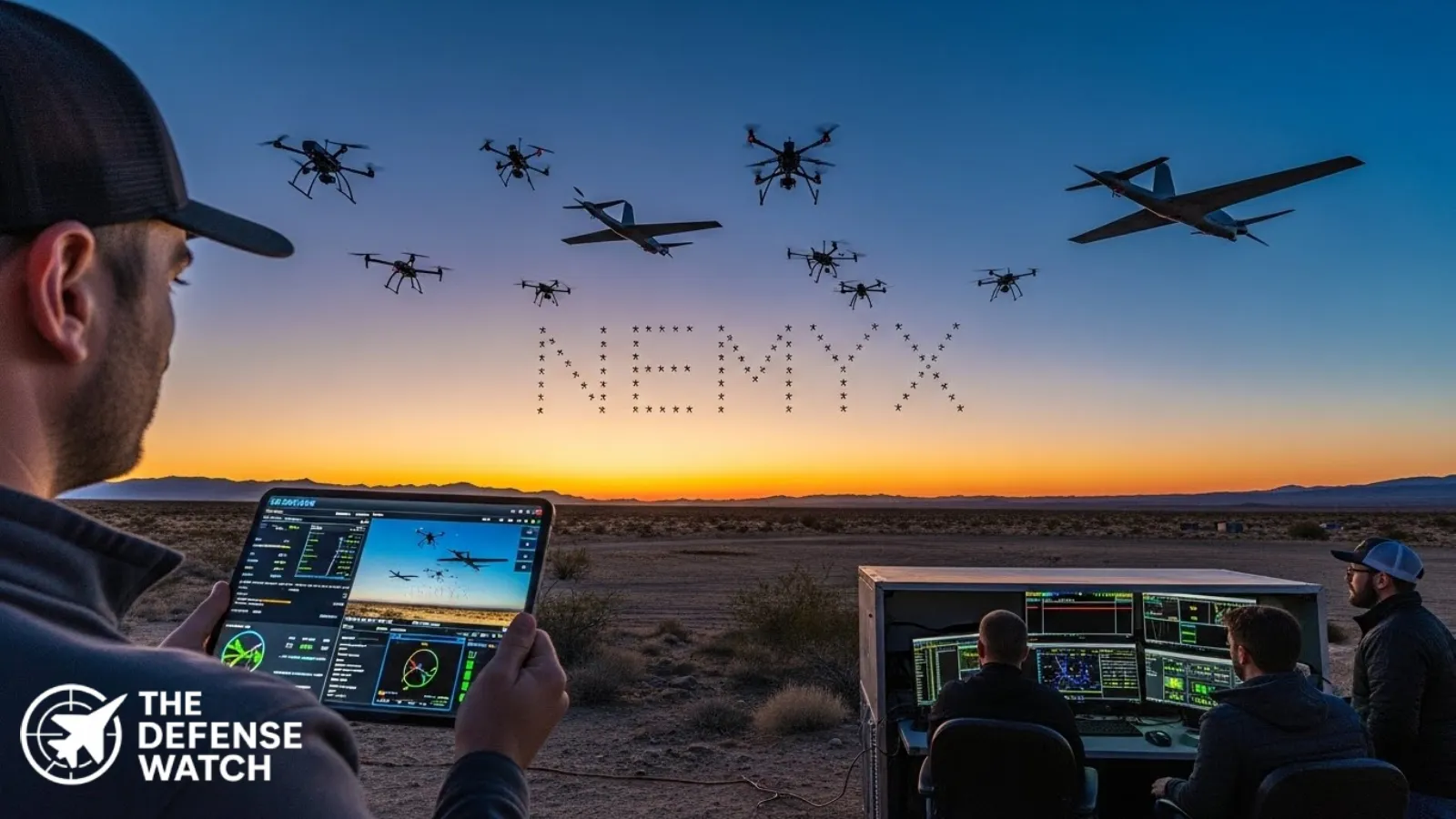
Auterion has completed a live demonstration of a hybrid drone swarm that coordinated unmanned aerial vehicles (UAVs) from multiple manufacturers as a unified force, executing an end-to-end operational sequence including target detection, tracking, and strike effects. The event took place over a test range near Munich and showcased the company’s Nemyx swarm engine operating atop its AuterionOS autonomy stack.
The demonstration brought together eight short-range first-person-view (FPV) munitions and two medium-range fixed-wing drones, all flying under a single mission plan without individual piloting. Auterion described the test as the first hybrid swarm strike featuring aircraft from different manufacturers functioning together as one coordinated unit.
Background on Swarm Technology
Swarm technology aims to enable groups of unmanned systems to operate cooperatively, sharing mission data and synchronizing actions with minimal human input. This approach contrasts with traditional UAV operations, where individual drones are controlled one-by-one or in small teams by human pilots. With current battlefield demands increasing the pace of operations, autonomy is seen as a key factor in executing complex tasks faster and with less workload on operators.
Auterion launched its Nemyx swarm engine in September 2025, positioning it as a cross-platform solution that allows compatible drones to function as distributed elements of a larger system. This software-centric strategy lets operators program mission intent, with the autonomous system handling navigation, timing, and role assignment across the swarm.
Details of the Munich Demonstration
During the Munich event, the mixed formation of drones carried out a complete kill chain sequence without manual control of individual platforms. FPV drones performed rapid, low-altitude maneuvers, while fixed-wing units provided intelligence, surveillance, reconnaissance (ISR) and longer-range actions. Mission logic was shared across the swarm, allowing each vehicle to time its actions in concert with others.
Auterion officials highlighted that Nemyx feeds real-time mission data and live video into standard command interfaces such as the Android Team Awareness Kit, while using established messaging formats like Cursor on Target to integrate with broader military networks. This approach gives human operators situational awareness and command intent without micro-managing the swarm’s movements.
The demonstration was conducted before government observers. Auterion stressed that the role of personnel shifted toward high-level decisions and rules of engagement, while autonomous systems handled routing, deconfliction, and timing within the swarm.
Nemyx and AuterionOS
At the core of the hybrid swarm operation is Auterion’s Nemyx engine, designed to unify drones from different sources into a single autonomous formation. Powered by AuterionOS, the system can scale from small groups of UAVs to larger swarms capable of simultaneous multi-target engagement. The software is compatible with drones that can be upgraded through a simple software installation, enabling interoperability without hardware replacement.
Auterion’s software ecosystem also includes the Skynode series of mission computers and autonomy modules, which provide secure communications, onboard processing, and real-time navigation. The company reported widespread adoption of these systems, including deliveries to allied forces and integration into ongoing defense programs.
Strategic Context
The demonstration arrives as defense forces worldwide explore autonomous and semi-autonomous systems to supplement existing capabilities. Swarm technologies are increasingly seen as a means to achieve mass effects and rapid response in contested environments where adversaries field similar capabilities. Multinational interoperability remains a focus, as coalition forces seek systems that can function across platforms from different suppliers.
In addition to swarm developments, Auterion has been engaged in related projects, including long-range strike drones under the U.S. Defense Innovation Unit’s Artemis program and software deliveries to partners in Europe and Asia. The company’s move to Arlington Virginia reflects its growing role in U.S. defense markets.
What’s Next
With this hybrid swarm demonstration complete, attention will likely turn to operational testing, wider integration with military systems, and refinement of autonomy in real-world conditions. The ability to coordinate assets from multiple manufacturers could lower barriers for coalition deployment and reduce reliance on single-vendor solutions. Further trials and potential fielding decisions by defense forces are expected in the months ahead as autonomous swarm concepts evolve into deployed capabilities.

1 comment
[…] recent conflicts, including the ongoing war in Ukraine and various Middle East engagements, where drone swarms have demonstrated effectiveness against conventional military […]