

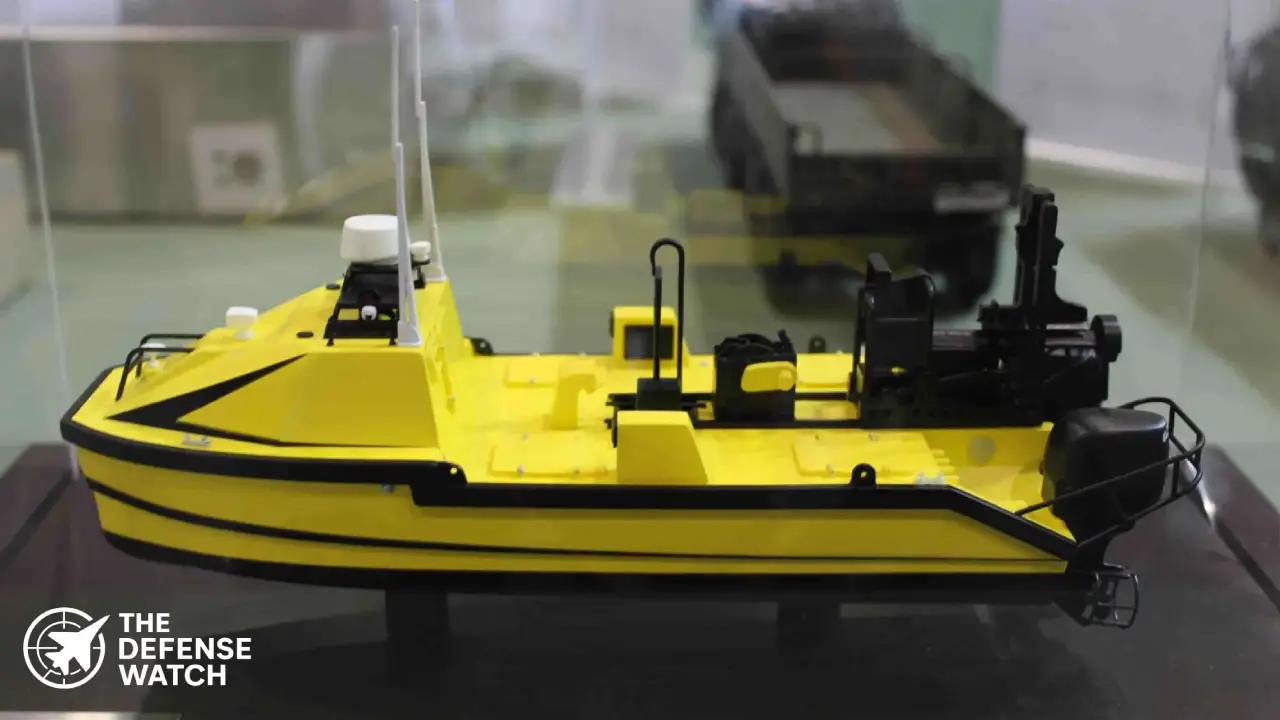
Bogotá, Colombia – December 2025 – At Expodefensa 2025, China unveiled its latest unmanned marine survey craft (USV) for the Latin American market, signaling growing interest in autonomous maritime technologies for coastal security and surveillance missions. The event, held in Bogotá, brought together defense and security experts from across the region, highlighting the increasing role of unmanned systems in modern naval operations.
Expanding Coastal Security Capabilities
China’s introduction of the USV at Expodefensa represents a strategic step toward exporting autonomous maritime technology to Latin America. Designed for comprehensive maritime surveillance, hydrographic mapping, and coastal security missions, the craft integrates advanced autonomous navigation systems, radar, and sonar sensors, enabling real-time monitoring of coastal zones without risking crewed vessels.
According to officials from the exhibiting Chinese company, the USV can operate in a variety of maritime environments, from shallow bays to open seas, providing continuous data collection and situational awareness. The platform is designed for modular payloads, allowing adaptation to specific mission requirements such as environmental monitoring, port security, or anti-smuggling operations.
Technological Features
The new craft features an AI-enabled navigation suite capable of autonomous route planning and obstacle avoidance. Its onboard radar and sonar systems allow for high-resolution seabed mapping and detection of underwater objects. With endurance reportedly exceeding 24 hours per mission, the USV can cover extensive areas along coastlines efficiently, reducing operational costs and increasing coverage compared to traditional crewed vessels.
Expodefensa organizers noted that this unveiling marks one of the first instances of a Chinese USV tailored specifically for Latin American coastal defense needs, reflecting a growing demand for autonomous naval systems in the region.
Regional Implications
Analysts observe that the introduction of Chinese USVs in Latin America could reshape regional maritime security operations. With increasing threats from illegal fishing, smuggling, and maritime crime, the adoption of autonomous systems offers smaller naval forces enhanced monitoring capabilities. Experts also highlight that USVs may complement traditional patrol vessels, enabling faster response times and persistent surveillance.
Future Prospects
The deployment of Chinese unmanned marine survey craft in Latin America may influence procurement trends across the region, with potential interest from multiple coastal nations exploring advanced, cost-effective maritime security solutions. Continued technological development could see the integration of additional sensors, communication systems, and autonomous decision-making capabilities, further extending operational effectiveness.
As autonomous maritime systems become more prevalent, Latin American navies may increasingly rely on USVs to enhance coastal protection and situational awareness, positioning them to respond more effectively to evolving maritime threats.

3 comments
[…] 30 mm revolver cannon capable of firing programmable airburst ammunition. It is designed to engage unmanned aerial vehicles weighing up to 600 kilograms at ranges up to five kilometres. Onboard sensors include radar and […]
[…] on Wildcat helicopters and is designed to engage small fast targets, including small boats, unmanned surface vehicles, and aerial […]
[…] The Raytheon development could provide automated overwatch capabilities for medium and large unmanned surface vehicles, as well as manned combatants operating across multiple theaters of […]