

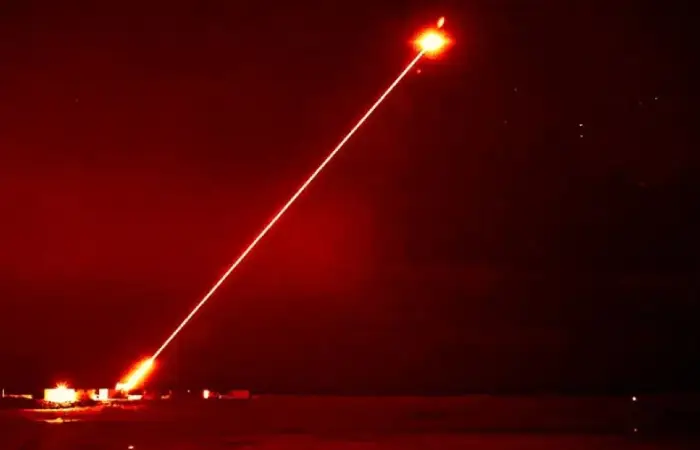
UK’s High-Power Laser “DragonFire” Downs Fast Drones in Landmark Trials
On 20 November 2025, at the Ministry of Defense (MoD) test range in the Hebrides, Scotland, the UK successfully demonstrated that its high-powered laser weapon system DragonFire could destroy drones flying at speeds up to 351 knots (404 mph / 650 km/h).
In light of this success, the government awarded a £316 million contract to MBDA UK to deliver the system to the Royal Navy — accelerating the planned in-service date from 2032 to 2027.
Context: Why DragonFire Matters
Directed-energy weapons like DragonFire are being developed to address evolving aerial threats — notably fast, low-cost drones and swarming unmanned aerial vehicles (UAVs) that challenge traditional missile- and gun-based air defense.
Conventional air-defense systems expend expensive missiles (often costing hundreds of thousands or millions of pounds per shot) to intercept relatively cheap drones. A laser system like DragonFire — with its near-instantaneous “projectile” (light), high precision, and low per-shot cost — offers a fundamentally different and potentially more sustainable approach.
First unveiled as a technology demonstrator in 2017, DragonFire has since matured through a series of tests — ultimately culminating in this high-speed drone interception capability.
Trial Details: What the Tests Showed
- The test on November 20, 2025, saw DragonFire take down drones travelling up to 650 km/h (404 mph), marking the first time a British laser weapon intercepted a target at such speed.
- The system demonstrated an “above-the-horizon” targeting capability, meaning it engaged drones at altitudes and distances where line-of-sight targeting would previously have been impractical or impossible.
- According to the MoD, DragonFire can hit a target the size of a £1 coin (roughly 23 mm in diameter) from one kilometer away.
- The cost per “shot” — i.e., the energy required to fire the laser for the necessary engagement duration — is reportedly about £10.
- The contract awarded to MBDA UK covers development and delivery of systems suitable for installation on Type 45 destroyers beginning in 2027.
In announcing the contract, officials described DragonFire as a major step forward: the system will be “the first high-power laser weapon in service with any European nation.”
The programme brings together UK firms and government science laboratories: MBDA UK, Leonardo UK, QinetiQ, and the government research body Defence Science and Technology Laboratory (Dstl).
Strategic Implications: What This Means for Naval Defence
The accelerated deployment of DragonFire signifies a shift in naval air defence doctrine — from relying solely on conventional missiles and guns to incorporating directed-energy weapons capable of cost-effective, rapid response against emerging threats like swarming drones or high-speed UAVs.
The “above-horizon” targeting capability is particularly significant. Because traditional laser or point-defense systems are constrained by line-of-sight, they can struggle to engage low-signature or distant aerial targets. DragonFire’s ability to integrate with shipborne radar, airborne sensors, or networked detection assets could extend its effective engagement envelope — enhancing a destroyer’s layered defense capacity.
Moreover, with each shot costing only a fraction of a missile or gun round, DragonFire presents a more sustainable and scalable weapon for engaging multiple or repeated drone threats, particularly important in densely contested or high-tempo conflict zones.
Industry & Job Impact
The £316 million contract with MBDA UK is also designed to create or sustain nearly 600 skilled jobs across the UK — with significant allocations in Scotland, the South West, and the East of England — underscoring the government’s framing of defense procurement as an engine for industrial growth.
Officials emphasized the broader aim of meeting the priorities set out in the Strategic Defense Review by rapidly fielding next-generation directed-energy capabilities.
Challenges & Considerations
While the trials demonstrate promise, certain limitations remain inherent to laser-based systems: atmospheric conditions (e.g., rain, fog, sea spray), power generation and thermal management aboard ships, and the requirement for line-of-sight or sensor-linked targeting systems. Several analysts caution that real-world maritime conditions will test the robustness of the system before it can be fully trusted in combat scenarios.
Also, while firing costs are low per shot, the total lifecycle cost — including maintenance, optics degradation, power supply, and integration with combat management systems — remains to be assessed over time.
What’s Next
With the contract now in place, the first DragonFire installation is scheduled for a Type 45 destroyer by 2027 — five years ahead of the original plan.
Over the next two years, MBDA UK, Leonardo, and QinetiQ will refine the system design, complete integration efforts, and prepare the first “deployable capability.”
Observers and defense watchers will be closely monitoring the system’s performance in real-world maritime conditions. Should DragonFire perform reliably, it may mark the beginning of a broader shift toward energy-based air defense across NATO navies and beyond — reshaping how militaries counter drone threats, cruise missiles, and swarming UAV attacks.

2 comments
[…] drones are designed for expendability and mass deployment. Vatn’s mission software enables a single operator to plan and monitor hundreds of vehicles at […]
[…] controversy over weapon deployments has drawn extensive attention. Thai authorities have raised alarms over the presence of […]