

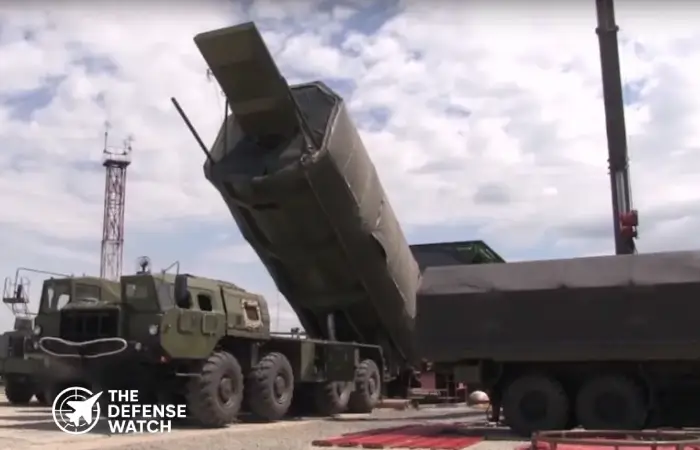
The Avangard hypersonic glide vehicle is currently the only confirmed operational system of its type deployed by Russia, enabling Russian hypersonic missiles to reach hypersonic speed while maneuvering to evade hypersonic missile defense networks. Entering service with Russia’s Strategic Rocket Forces in 2019, the weapon has been fitted to modified UR-100NUTTKh intercontinental ballistic missile boosters, with future integration planned for the RS-28 Sarmat ICBM once it becomes operational. The Avangard remains a central component of Moscow’s nuclear modernization efforts and its strategic deterrence posture.
What the Avangard Hypersonic Glide Vehicle Is and How It Works
The Avangard is a boost-glide hypersonic reentry system designed to detach from its launch booster, re-enter the atmosphere, and glide at sustained hypersonic speed.
Key Characteristics (as publicly reported)
- Launch Platform: UR-100NUTTKh ICBM (active), RS-28 Sarmat (planned)
- Declared Speed: Exceeds Mach 20 (Russian statements, not independently verified)
- Flight Profile: Atmospheric glide with unpredictable trajectory
- Payload: Nuclear warhead (no confirmed conventional variant)
- Deployment: Two silos reported operational at Dombarovsky base in Orenburg region
Why Glide Vehicles Matter
Unlike traditional ballistic reentry vehicles, the Avangard performs:
- Cross-range maneuvering
- Altitude shifting
- Non-ballistic trajectory shaping
These characteristics complicate early warning tracking and interceptor targeting timelines.
How Russian Hypersonic Missiles Achieve Hypersonic Speed
Russian hypersonic systems fall into three categories:
1. Boost-Glide Systems (Avangard)
- Achieve hypersonic velocity via ICBM booster acceleration
- Glide through the atmosphere using lift and thermal shielding
2. Aero-Ballistic Systems (Kinzhal)
- Air-launched ballistic missile derived from Iskander
- Reaches around Mach 10 according to Russian claims
3. Scramjet Cruise Systems (Zircon)
- Ship-launched hypersonic cruise missile
- Uses sustained atmospheric propulsion
Only Avangard is confirmed as deployed in nuclear strategic service.
Why the Avangard Challenges Hypersonic Missile Defense
Current U.S. and NATO missile defense architectures are optimized for:
- Predictable ballistic trajectories
- Exo-atmospheric interception windows
- Midcourse discrimination capabilities
Hypersonic glide vehicles undermine these assumptions by:
Reduced Warning Time
Lower flight altitude shortens radar horizon detection.
Complex Tracking Requirements
Maneuvering invalidates extrapolated intercept paths.
Limited Interceptor Suitability
Systems like GMD, Aegis BMD, and THAAD are not designed for atmospheric glide targets.
The U.S. Missile Defense Agency is pursuing layered counter-hypersonic capabilities including:
- Glide-phase intercept programs
- Over-the-horizon sensing networks
- Space-based tracking constellations
No confirmed operational counter-hypersonic interceptor exists.
Strategic Context and Current Status
- Russia frames Avangard deployment as a response to U.S. missile defense expansion.
- The U.S. assesses Avangard as a nuclear strategic delivery system, not a battlefield weapon.
- Western intelligence agencies believe deployment numbers remain low.
- The operational status of Sarmat-mounted Avangard units is still unclear as of 2025.
Analysis: Implications for U.S. and Allied Defense Planning
The Avangard does not alter nuclear parity by itself, but it presents several implications:
For Strategic Deterrence
- Reinforces Russia’s second-strike survivability narrative
- Complicates arms control verification mechanisms
For Missile Defense Policy
- Accelerates investment in space-based sensors
- Encourages allied interoperability in tracking networks
For Hypersonic Competition
- Increases urgency for U.S. hypersonic programs such as ARRW successors and CPS
- Expands relevance of glide-phase interception research
Despite limited deployment numbers, Avangard’s operational status demonstrates a capability threshold that other nations—China, the U.S., and India—are advancing toward.
FAQs
Is the Avangard hypersonic glide vehicle operational?Yes, Russia claims active deployment since 2019 on UR-100NUTTKh boosters.
Can Avangard be intercepted by current U.S. missile defense systems?Existing systems are not optimized for maneuvering hypersonic glide vehicles.
Does Avangard carry conventional warheads?There is no verified evidence of a conventional variant; assessments describe it as nuclear-only.
How many Avangard-equipped missiles does Russia have?Deployment numbers remain classified, with Western estimates suggesting limited fielding.
Will Avangard be integrated with the Sarmat ICBM?Yes, Russia intends to do so once Sarmat achieves full operational status.

1 comment
[…] m (roughly 26,000 ft). Under favorable conditions, such systems could allow loads — including vehicles or equipment — to glide 30–80 km after […]