

Table of Contents
Supersonic vs Hypersonic: Understanding Speed, Missiles, Technology, and Modern Aircraft
The debate over supersonic vs hypersonic systems has become central to today’s defense landscape as militaries race to field faster, more maneuverable, and harder-to-intercept weapons. While supersonic platforms have been operational for decades, hypersonic missiles, hypersonic glide vehicles (HGVs), and emerging hypersonic aircraft represent the cutting edge of strategic competition among the United States, China, and Russia.
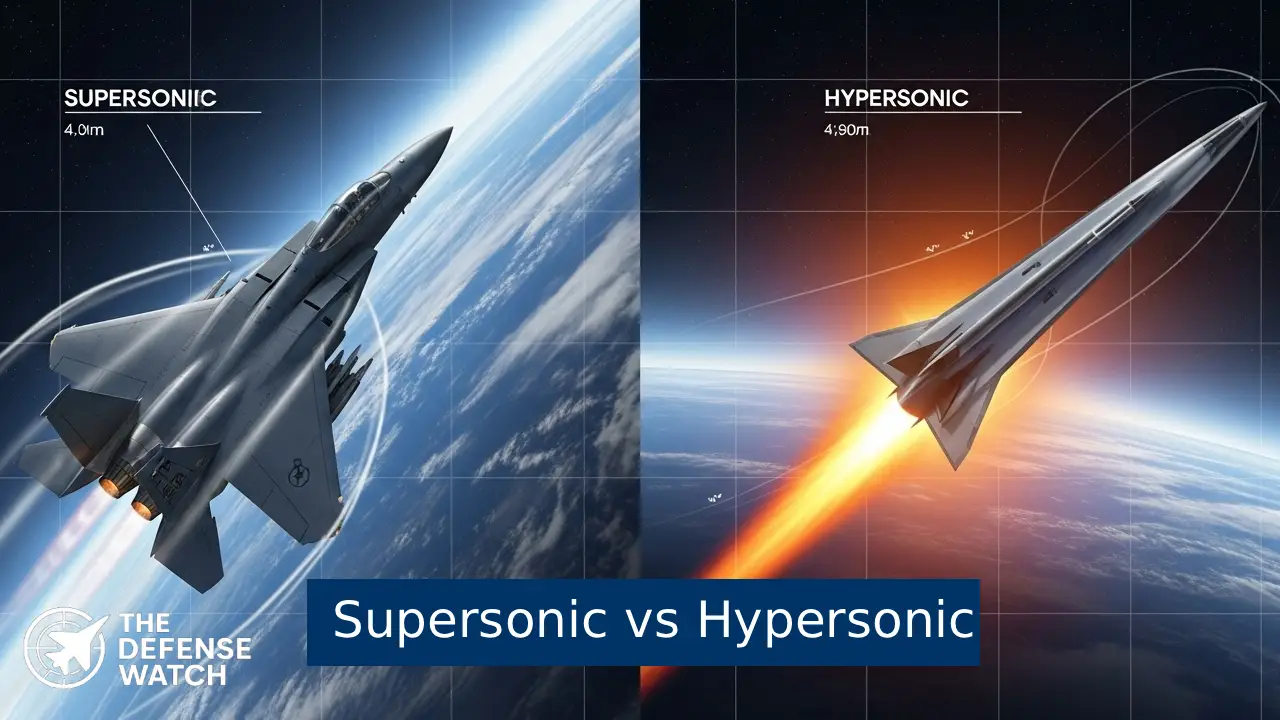
What Defines Supersonic vs Hypersonic Speeds?
Supersonic Speed (Mach 1–5)
- Travels faster than the speed of sound (approx. 343 m/s at sea level)
- Widely used in fighter aircraft, cruise missiles, and interceptors
- Established technologies with predictable aerodynamic behavior
Examples of active supersonic systems:
- U.S. AGM-86C Conventional Air-Launched Cruise Missile (CALCM)
- Russia’s P-800 Oniks anti-ship missile
- India/Russia BrahMos cruise missile
- F-16, F-15, Rafale, Su-35, and Eurofighter Typhoon (supersonic fighters)
Hypersonic Speed (Above Mach 5)
- Extremely high aerodynamic heating
- Requires advanced materials and thermal protection
- Maneuverability increases complexity for missile defense
- Relatively new and still maturing
- Used for strategic-range strike, anti-ship missions, and potential ISR/strike aircraft concepts
Examples of active hypersonic systems (as of 2025):
- Russia: Avangard HGV (operational), Kinzhal (limited hypersonic performance), 3M22 Zircon (in service with Russian Navy)
- China: DF-17 HGV-equipped ballistic missile (operational)
- U.S.: No fully deployed hypersonic weapons yet; programs advancing (ARRW cancelled after tests, HACM under development, Glide Phase Interceptor in progress)
Hypersonic Missiles vs Supersonic Missiles
Supersonic Missiles: Mature, Widely Fielded, Highly Reliable
Supersonic missiles constitute the backbone of global strike arsenals. Their speed reduces exposure time to enemy air defense systems while maintaining affordable, scalable manufacturing.
Common roles include:
- Anti-ship strike
- Land-attack precision strike
- Interception and air-defense missions
Many navies and air forces rely on supersonic anti-ship missiles such as BrahMos, Harpoon (high subsonic), RGM-84 variants, and Oniks. Their predictability and cost-effectiveness make them ideal for mass deployment.
Hypersonic Missiles: Maneuverability, Speed, and Anti-Ship Breakthrough
Hypersonic missiles promise:
- Reduced defender reaction time
- High survivability against interceptors
- Ability to maneuver unpredictably
Two main types exist:
- Hypersonic Glide Vehicles (HGVs)
- Launched via ballistic missile booster
- Glide at hypersonic speed with unpredictable flight paths
- Examples: Russia Avangard, China DF-17
- Hypersonic Cruise Missiles (HCMs)
- Scramjet-powered
- Maintain sustained Mach 5+ in atmosphere
- Examples: Russia Zircon; U.S. HACM in development
Operational deployment remains limited due to:
- Thermal protection challenges
- Materials science constraints
- High cost
- Launch platform limitations
Hypersonic Aircraft vs Supersonic Aircraft
Supersonic Aircraft: Global Standard for Combat Aviation
Supersonic jets remain the world’s primary combat aircraft.
Advantages include:
- Proven propulsion
- Broad industrial base
- High maneuverability
- Compatibility with existing infrastructure
Examples:
- F-22, F-35 (supercruise capability), F-15EX
- Su-57, Su-35
- J-20 Mighty Dragon
Hypersonic Aircraft: Still Experimental
As of 2025, no operational hypersonic aircraft are in service.
Key U.S. and Chinese programs under research:
- U.S. DARPA HTV-2 (test program)
- Lockheed Martin SR-72 concept (ISR/strike concept)
- China’s Starry Sky-2 test vehicle
Technical barriers include:
- Scramjet reliability
- Reentry thermal loads
- Sensor survivability
- Human survivability at high thermal stress
Hypersonic aircraft remain long-term strategic projects rather than near-term operational systems.
Why Hypersonic Systems Are Strategically Important
Reduced Reaction Time
Hypersonic weapons can reduce defender response windows to a few minutes, challenging existing missile defenses.
Maneuverability
Unlike traditional ballistic missiles, HGVs can alter course mid-flight, complicating interception.
Long-Range Precision Strike
Hypersonics can threaten high-value, time-sensitive, or heavily defended targets.
Analysis: The Strategic Race Is About More Than Speed
The U.S., China, and Russia treat hypersonics as part of a broader competition in sensor networks, missile defense, command-and-control, and space-based tracking. The race is less about raw velocity and more about integrated ecosystems:
- Early-warning satellites
- Over-the-horizon radars
- Glide-phase interceptors
- AI-enabled targeting
- Future scramjet-enabled strike aircraft
Whichever nation pairs hypersonic offense with hypersonic defense first will gain significant strategic advantage.
FAQs
No. They are difficult to intercept, but the U.S. and partners are developing glide-phase interceptors, next-gen radars, and space-based tracking systems.
Not yet. Major programs are advancing, but no weapon has reached full operational status as of 2025.
No. Supersonic missiles and aircraft remain widely used, affordable, and integral to modern militaries.
Russia and China have operational HGV systems. The United States is developing its own but has not deployed them.
Any system traveling faster than Mach 5—approximately 3,836 mph (6,174 km/h).
