The U.S. Department of War’s Joint Interagency Task Force 401 (JIATF-401) has reached its first anniversary after a year focused on speeding up counter-drone procurement, coordinating federal agencies and improving defenses for military personnel and sensitive installations.
Established in August 2025, the task force was created to address a persistent problem in counter-unmanned aircraft systems (C-UAS) acquisition: military services and government agencies need to identify, evaluate and deploy effective technologies faster than traditional procurement processes often allow.
Its first year has involved more than purchasing equipment. JIATF-401 has worked to standardize testing, clarify operational policies, improve training and establish common pathways for bringing commercial counter-drone systems into military service.
Recent Army announcements show the effort moving toward a more competitive, multi-vendor acquisition model, with systems evaluated against operational requirements before procurement decisions are made.
From organizational reform to fielded counter-drone systems
The Pentagon established JIATF-401 in August 2025, directing the Army to replace the Joint Counter-small Unmanned Aircraft Systems Office with a task force reporting to the deputy secretary of defense.
The new organization was intended to bring together resources, acquisition activity and policy coordination across the military services and relevant federal agencies. Its mission covers countering small unmanned aircraft threats to U.S. forces and facilities at home and abroad.
By December 2025, the Army reported that the task force had consolidated counter-drone policy guidance, assessed installation vulnerabilities and accelerated requirements development for capabilities along the southern border.
The Army also reported that JIATF-401 had helped coordinate counter-drone efforts in the National Capital Region and worked with federal partners on training and operational coordination. Those activities addressed a central challenge: effective defenses depend on trained personnel, clear authorities and coordinated command systems, not hardware alone.
The anniversary therefore provides an opportunity to assess whether the organization can turn its streamlined acquisition process into sustained operational capability.
A marketplace designed to shorten procurement timelines
One of JIATF-401’s principal initiatives is a centralized marketplace for counter-UAS technologies. Instead of relying exclusively on lengthy, platform-specific acquisition programs, the approach is intended to help the government assess available systems and procure equipment against identified operational needs.
An Army announcement on September 29, 2026, detailed a new series of multiple-award indefinite-delivery, indefinite-quantity contracts supporting Domestic Shield and other counter-drone requirements.
The announced base contract awards included:
- Allen Control Systems: $500 million
- Digital Force Technologies: $500 million
- DroneShield: $500 million
- Echodyne: $250 million
- Napatree Technology: $500 million
- PVP Advanced EO Systems: $250 million
- RADA Technologies: $500 million
- SmartShooter: $150 million
- SRC: $500 million
- L3Harris WESCAM: $500 million
These are contract award values under an IDIQ framework, not evidence that the full amounts have already been spent or that equipment worth those amounts has been delivered. Actual orders and expenditures depend on subsequent procurement actions.
The selected suppliers cover different parts of the counter-drone mission, including optical targeting aids, radar, tracking cameras and automated weapon stations. A multi-vendor approach can give commanders access to different technologies for different threats, rather than requiring every installation to rely on a single system.
The Army has also emphasized open architecture standards intended to reduce dependence on proprietary equipment and simplify integration with existing defense networks. Whether that approach delivers the intended interoperability will depend on how well systems work together during testing and operational deployment.
Testing before procurement remains central
Counter-drone technology presents a difficult acquisition challenge because systems must perform against threats that vary in size, speed, flight profile and operating environment.
A sensor that detects a small quadcopter may not provide the same performance against a faster, larger unmanned aircraft. Similarly, a system capable of tracking a target does not necessarily have the means to defeat it.
JIATF-401 has therefore supported comparative testing intended to establish a common basis for procurement decisions.
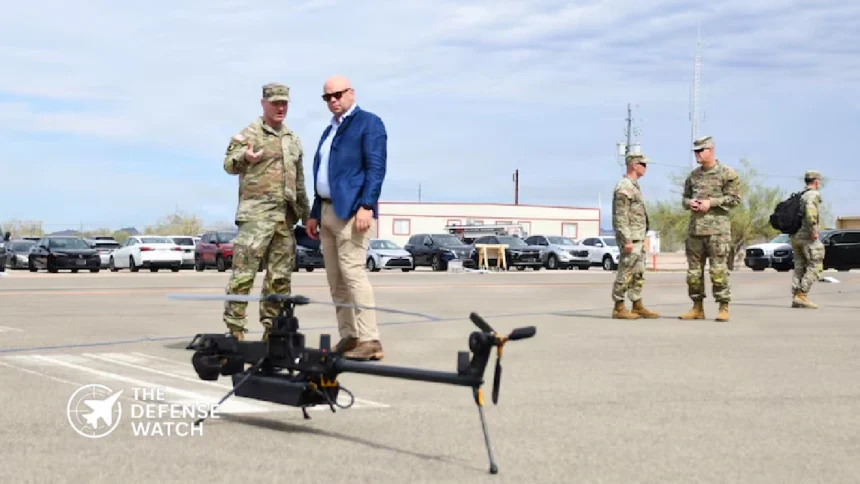
In a September 29 Army report, the task force said it had completed a counter-UAS evaluation at Yuma Proving Ground, Arizona, conducted with the Army’s Portfolio Acquisition Executive Fires from August 17 to 28, 2026. The event assessed multiple systems against Group 3 unmanned aircraft threats.
The Army said the evaluation used common criteria to generate comparable performance data. Following the assessment, JIATF-401 awarded a contract for Lockheed Martin’s Grizzly system. The announcement did not provide enough public performance data to establish how the system compared with every competing solution.
This model could help the department move promising technologies into procurement without treating every new system as a separate, lengthy development program. It also provides a way to compare systems against defined requirements instead of relying solely on manufacturers’ advertised capabilities.
However, test results must reflect the conditions in which the equipment will be used. Performance against one class of drone does not establish effectiveness against every unmanned threat, particularly when electronic warfare, multiple simultaneous targets or difficult terrain complicate detection and engagement.
Why the homeland mission matters
Counter-drone defense has become a force-protection concern for military bases, logistics facilities and other sensitive sites. Small unmanned aircraft can be relatively inexpensive and difficult to detect, while the systems used to stop them may require specialized sensors, trained operators and significant infrastructure.
The cost imbalance is important. Using an expensive interceptor against a low-cost drone may be necessary in some circumstances, but doing so repeatedly can place pressure on ammunition stocks and defense budgets.
A layered approach can distribute the workload among detection sensors, tracking systems, electronic countermeasures and kinetic or directed-energy effectors, depending on the threat and the authorities available to the operator.
Not every layer is suitable for every environment. Electronic effects can be constrained by the need to avoid interference with friendly systems, while kinetic engagements introduce safety considerations around falling debris and the location of the target. Lasers and high-powered microwave systems also have operating limits that must be assessed under real conditions.
JIATF-401’s acquisition and testing work is intended to help military organizations match available systems to these differing requirements rather than treating counter-drone defense as a single equipment purchase.
The task force’s homeland responsibilities also involve legal and administrative questions. Federal law provides specific authorities for protecting designated facilities and assets against unmanned aircraft, but the ability to detect a drone does not automatically mean every military unit can engage it in every circumstance.
Clarifying those responsibilities and training personnel to use approved systems safely are therefore as important as obtaining additional equipment. The Army’s early account of JIATF-401’s work identified policy, training and operational processes as core parts of the mission.
What will determine the task force’s longer-term impact?
The first year’s activity establishes that JIATF-401 has created new acquisition and coordination mechanisms. It does not, by itself, demonstrate how much those measures have improved protection across all relevant U.S. military facilities.
Several indicators will matter as the program continues:
- Delivery and deployment: How quickly contract awards translate into equipment installed at priority sites.
- Operational performance: Whether systems meet requirements against representative drone threats, including multiple targets.
- Interoperability: Whether equipment from different manufacturers can share information and operate within existing command networks.
- Sustainment: Whether units can maintain the equipment, train operators and obtain replacement components over time.
- Cost effectiveness: Whether the selected mix of sensors and defeat systems provides an affordable response to repeated drone incursions.
The distinction between procurement activity and operational readiness is particularly important. Contract ceilings create options for buying equipment, but they do not establish delivery quantities, deployment dates or the effectiveness of the resulting defenses.
JIATF-401’s first year has focused on building a faster route from operational requirements to testing and acquisition. The next measure of progress will be whether that process produces reliable, interoperable counter-drone coverage that military units can sustain over time.